Civic Participation in Erlangen: Shaping Urban Development
Civic Participation & Urban Development in Erlangen: What Could Come Next
What could Erlangen look like in the coming years if citizens are involved in urban development issues even earlier, more understandably, and more effectively? This article looks exclusively forward: at expected opportunities for participation, typical procedural steps, and practical ways for people to get involved in the future.
Why Civic Participation Will Become Even More Important in the Future
In the coming years, urban development in Erlangen (as in many growing cities) is likely to become particularly visible at points where interests collide: scarcity of space, affordable housing, climate adaptation, energy and heating transition, noise protection, school and daycare needs, as well as the redistribution of street space.
Precisely because such projects have long-term effects, participation will be perceived as fair in the future especially if it is early, transparent, and effective. Effective does not mean that every wish is automatically implemented, but that feedback is visibly incorporated into considerations and decisions are explained in an understandable way.
Guidelines, Formats, and Decision Paths: How Participation Can Proceed
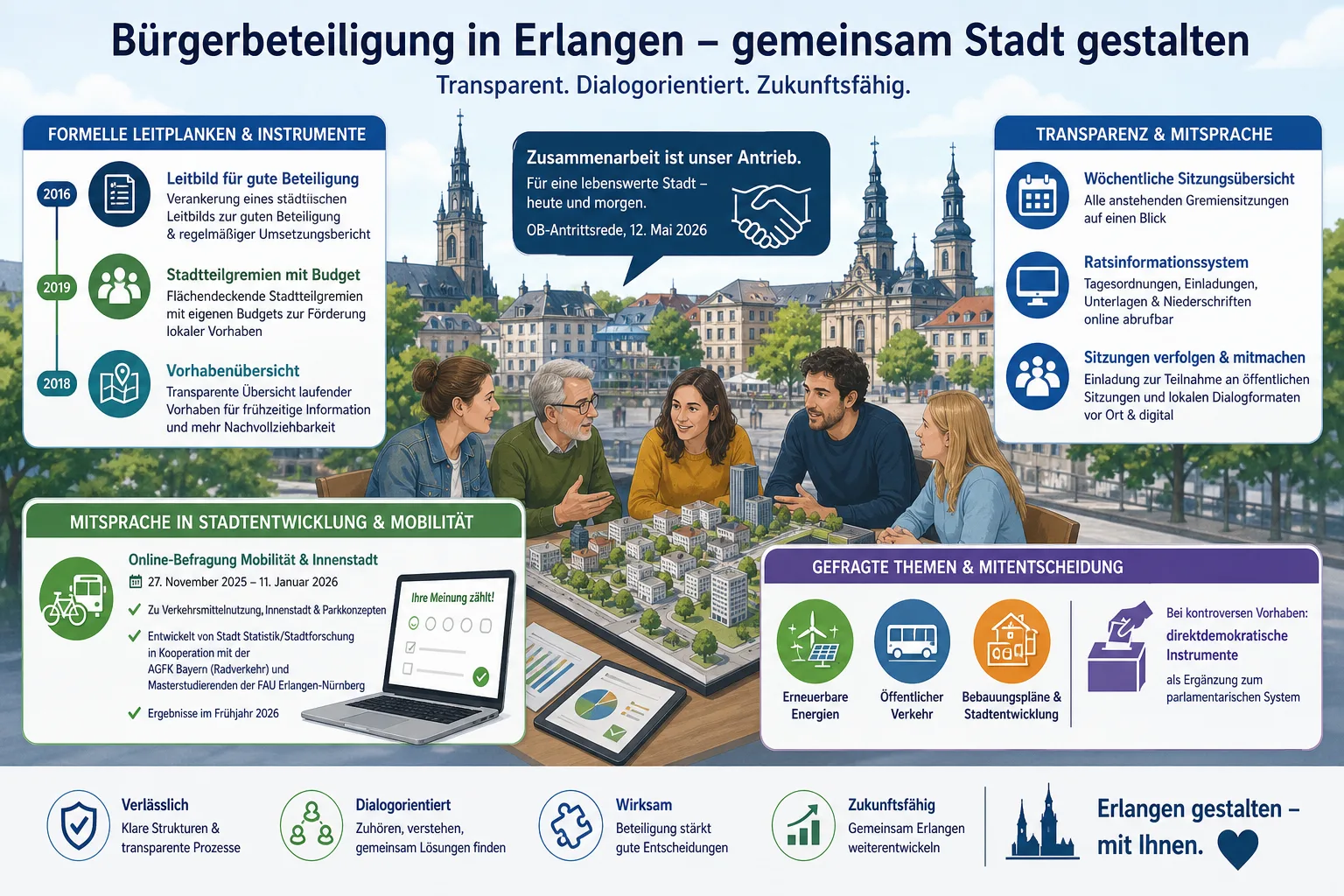
If larger projects are upcoming in the coming months or years (for example, new residential quarters, traffic calming, redesign of squares, or development plans), participation can be organized in several stages in the future:
- Early information (project goals, framework conditions, responsibilities, schedule).
- Dialogue phase (workshops, online participation, neighborhood walks, thematic rounds).
- Evaluation & Consideration (documentation, feedback on which suggestions can be adopted and why).
- Political decision (deliberation in committees and council, resolution).
- Implementation & Monitoring (construction measures, traffic trials, accompanying evaluation, renewed adjustment).
For upcoming participation processes, it is helpful if administration and politics transparently clarify in advance which part of a project is negotiable (e.g., design, priorities, accompanying measures) and which part is fixed by law or framework conditions (e.g., safety requirements, budget limits, overarching planning goals).
Neighborhoods in Focus: What Local Committees and Budgets Can Achieve in the Future
Many improvements do not arise from large master plans, but from a sequence of small, concrete decisions in the neighborhood: safe crossings, shady places to stay, better lighting, play and sports facilities, greening, cultural neighborhood projects.
For the future, it is expected that neighborhood-based participation structures will be particularly effective if they combine three characteristics:
- Low entry barriers: understandable procedures, clear contacts, accessible locations/times.
- Concrete scope for design: visible decision windows (what can really be changed?).
- Reliable resources: plannable funds for small-scale measures or seed funding.
Such structures can help in the future to make suggestions testable more quickly (e.g., time-limited traffic trials or prototype redesigns) before long-term decisions are made.
Transparency in Council & Administration: What You Can Observe in Future Decisions
In future urban development decisions, transparency is not just "nice to have," but a central trust issue. For citizens, it will be crucial whether they can recognize in time:
- When a topic will be discussed politically (committees, council, working groups).
- What exactly it is about (decision templates, variants, cost/benefit considerations).
- How one can still get involved (deadlines, participation formats, contacts).
- What happened to feedback (responses, consideration documents).
In the coming years, it will therefore become increasingly important that documents are not only published but also summarized in an understandable way (e.g., one-pagers, visualizations, short decision logics). This can make political negotiation more comprehensible without shortening content.
Mobility & City Center: Where Many Opportunities for Participation Are Expected in the Future
Hardly any field generates as much feedback as mobility: cycling and walking, public transport, parking, delivery zones, safety at intersections, school routes. In the coming years, opportunities for participation may arise particularly often where several goals are to be achieved simultaneously, such as:
- Safer routes for children and the elderly, without reducing accessibility.
- More quality of stay in the city center, without ignoring commercial traffic.
- Climate adaptation (shade, unsealing, greening), without displacing important uses.
For future participation, it may be helpful if feedback is not only collected as opinions, but as everyday data: typical route chains, places with conflicts, times of day, concrete situations. Such information can later be better translated into variant checks, safety assessments, and prioritizations.
"Good participation is recognized by the fact that it answers the question: What will change concretely now – and how will success be measured?"
Direct Democracy: When Citizen Petitions/Citizen Decisions May Become Relevant in the Future
In the future, citizen petitions and referenda may come into focus especially when very far-reaching projects are perceived as insufficiently clarified or when goal conflicts (e.g., land use, traffic management, major investments) are not resolved politically in a satisfactory way.
For citizens, it may make sense to understand these instruments early on as an option, but to initially focus on cooperative procedures: The better questions, variants, and consequences are disclosed in early phases, the more likely conflicts can be dealt with constructively before they escalate.
Important for all involved: Direct democracy does not fundamentally replace representative decision-making, but can supplement it depending on the legal situation. The details are governed by the municipal law provisions of the Free State of Bavaria.
Practical Steps: How You Can Effectively Get Involved in the Future
Anyone who wants to help shape urban development in Erlangen in the coming years can significantly increase their impact by proceeding in a structured way. These steps have proven effective in many municipalities:
- Be early: As soon as a topic appears on the political agenda, a short written submission with concrete points (location, problem, suggestion, justification) is worthwhile.
- Provide concrete observations: Instead of "too much traffic," better: "Dangerous situation daily between 7:30–8:00 am at intersection X, because ..."
- Suggest variants: Name at least two solutions (e.g., short-term marking + long-term reconstruction).
- Find allies: Neighborhood, school, clubs, businesses – the broader the perspective, the more robust the proposal.
- Insist on feedback: Request a comprehensible answer on what will be adopted, what will not, and why.
- Name success criteria: For example: fewer conflicts, lower speed, better visibility, more shaded areas.
This turns an idea into a contribution that is much easier to consider in future deliberations – and at the same time makes transparent which goals are important to you.