Cultural Education and Participation in Erlangen
Cultural Education & Societal Discourse in Erlangen: Outlook on Upcoming Developments
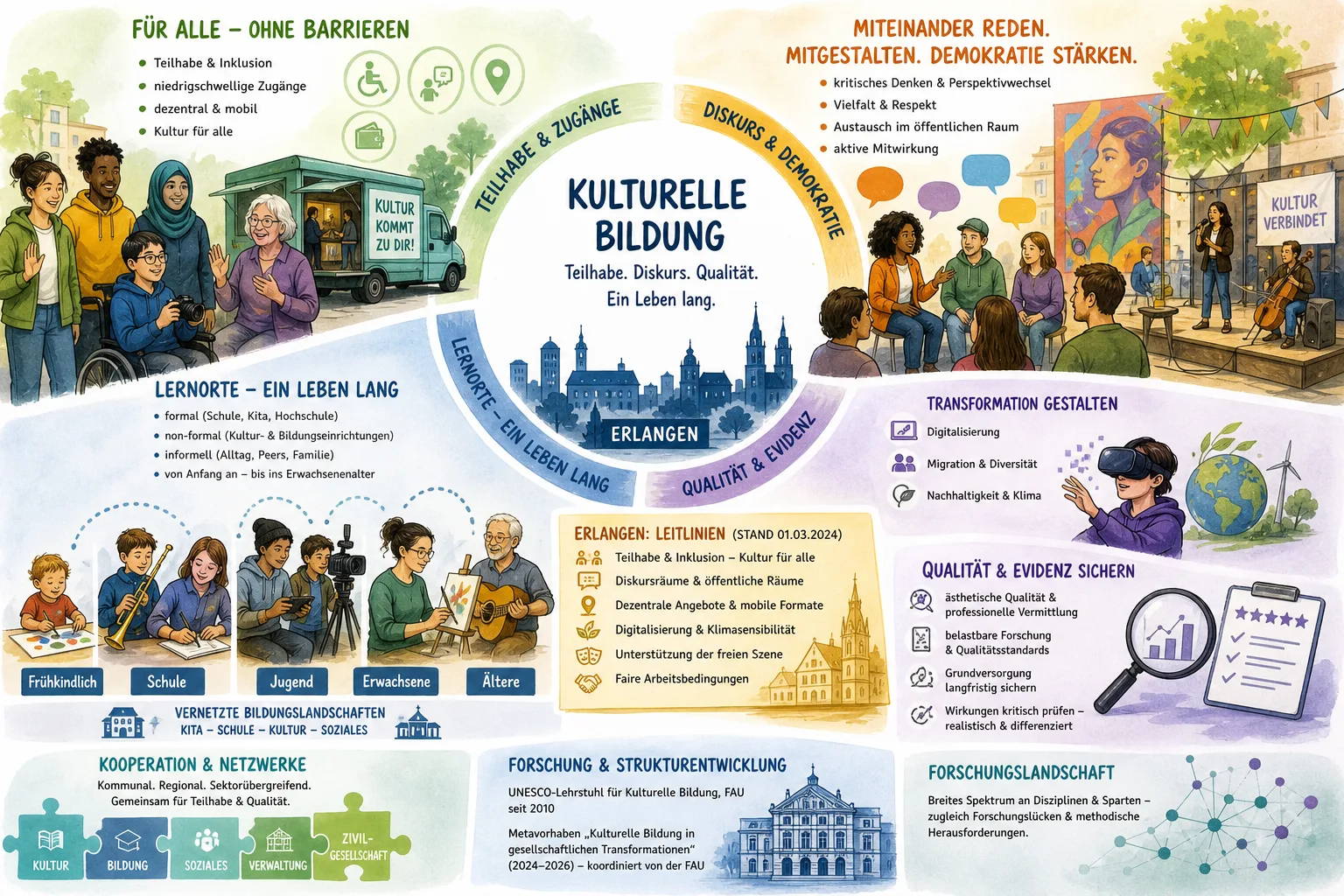
In the coming years, cultural education in Erlangen can become an even more important driver for participation, involvement, and democratic dialogue. What will be crucial is how access is expanded, mediation is professionally secured, and new topics such as digitalization and sustainability are translated into concrete formats.
Learning Spaces Throughout Life: From Early Childhood to the Neighborhood
In the coming years, cultural education in Erlangen is likely to become particularly sustainable if it is planned as part of a municipal educational landscape along the life course: formal (e.g., school), non-formal (e.g., clubs, workshops), and informal (e.g., neighborhood festivals, open stages, encounters in libraries).
Early Childhood: Daycare Centers and Family Offers
For the coming years, a focus on everyday-integrated formats may be appropriate: music and movement, visual arts, storytelling, and early media education as recurring routines. Such offers are likely to be particularly effective when they accompany professionals, involve parents, and reduce material or transportation barriers.
School and All-Day: Cooperation with Cultural Partners
In the school context, all-day schooling will play a central role in the future to permanently anchor artistic practice. Promising are cooperations that not only "buy workshops," but jointly clarify learning objectives, roles, and quality standards: artistic freedom, pedagogical responsibility, protection concepts, and evaluation.
Neighborhoods and Districts: Decentralized Places People Already Use
In the neighborhoods, especially places close to everyday life can benefit in the coming years: community centers, youth centers, libraries, open studios, mobile workshops, or temporary formats in public spaces. Such learning spaces tend to expand access when they take place at suitable times, consider multilingualism, and are planned together with local initiatives.
For visitors, Erlangen can thus become a city where culture does not take place exclusively "indoors," but becomes visible as an offer for participation in urban space.
Research, Quality, and Evidence: What Will Become More Important
In the coming years, the credibility of cultural education will likely depend greatly on how transparently goals are formulated and how carefully quality is ensured. This also includes not overpromising effects: Cultural education can promote dialogue and participation, but will not "automatically" solve social problems.
For future programs in Erlangen, three quality questions can be guiding:
- Who specifically benefits from the offer? Target groups, barriers, and support needs are named in advance (instead of just claiming "for everyone").
- What does good mediation look like? Clarification of roles, qualification, methodology, spaces for reflection, and a reliable approach to diversity and conflicts.
- How is success recognized? Simple, fair indicators (e.g., repeat participation rates, qualitative feedback, barrier experiences, depth of cooperation) instead of just participant numbers.
If Erlangen in the future more closely links research, practice, and administration (e.g., through joint learning and evaluation formats), an advantage can arise: programs can be iteratively improved, and the city can transparently show why certain formats work and for whom they are effective.
Public Spaces as Places of Discourse: Mediation Between Art and Everyday Life
In the coming years, public spaces in Erlangen can be used even more as places of societal discourse: squares, parks, cultural and neighborhood festivals, temporary exhibitions, or artistic interventions. Such formats are likely to function as "city conversations" when mediation is planned not as an add-on, but as a core component.
Future projects can become particularly dialogical if they include the following elements:
- Inviting introductions: clear, understandable questions ("What is this about?") and visible contact persons on site.
- Moderated participation: formats that listen, endure conflicts, and make perspectives visible without exposing people.
- Openness of results with framework: participants help shape while basic rules (respect, protection, data privacy) are transparent.
- Feedback: results are documented and publicly fed back (e.g., exhibition, reading, online dossier, closing discussion).
Professional art and cultural mediation will thus become a key competence in the future: it can build bridges between artistic complexity, everyday life situations, and politically sensitive topics.
Digitalization, Sustainability, and Next Steps
The coming years will shape cultural education in Erlangen above all through two fields of transformation: digitalization and sustainability. Both topics can expand access, but also bring new exclusions and goal conflicts.
Digitalization: Hybrid Formats, Media Literacy, Fair Access
Future digital or hybrid formats can reduce barriers (e.g., flexible participation, new forms of expression), but should actively solve access issues: technical equipment, data privacy, platform competence, and accessible design. In perspective, cultural education in Erlangen can particularly benefit if media education is not just "technical training," but combines artistic practice with critical thinking (e.g., image and source criticism, AI and platform logics, copyright in everyday life).
Sustainability: Climate-Conscious Cultural Practice and Long-Term Infrastructure
Sustainability can become relevant in the coming years on three levels: (1) climate-conscious production and event organization, (2) sustainable material and stage practice, (3) artistic engagement with environmental and future topics. For this to remain credible, transparent decisions will be important (e.g., mobility, procurement, reuse) and a communication practice that does not moralize but involves.
Concrete Next Steps for the Coming Years (as a Framework for Orientation)
- Broaden access: mobile, neighborhood-based offers and multilingual communication, combined with genuine co-creation.
- Strengthen spaces for discourse: public formats that combine art, conversations, and workshops and make results visible.
- Ensure quality: qualification for mediation, protection and participation concepts, as well as regular, understandable evaluation.
- Consolidate cooperation: long-term partnerships between education, culture, social space, and science to avoid breaks in the life course.
This way, Erlangen can further develop an urban culture in the coming years in which cultural education is not an "extra," but a reliable invitation: to participate, to change perspectives, and to actively help shape urban society.