The History of Erlangen in 10 Stops
The History of Erlangen – Excitingly Told in 10 Stops (Tour & Event Plan from 2026)
Would you like to see Erlangen with new eyes in the coming months? This article is designed as a future walking tour: ten stops that you can visit (guided or on your own) to discover the city's historical themes along real locations – from the river area to campus and museum sites.
For whom: Visitors, newcomers, locals, families (with optional shortcuts).
Format: The tour can be done as a self-guided route at any time. Additionally, the route is suitable as a basis for future group tours (e.g. clubs, schools, companies).
Planning Notes (Duration, Accessibility, Arrival)
- Total duration: In the future, plan about 3–4 hours for the complete route (including short stops).
- Route profile: Mostly flat; an optional detour to the Burgberg includes an incline.
- Accessibility: The city center sections are generally easy to walk; for some sections (e.g. cobblestones, incline at the hill), it is recommended to check current city maps in advance.
- Arrival: The starting point is chosen so that it will be easily accessible by train and bus in the future.
- Current opening hours: If you plan to visit interiors (e.g. museum, archive exhibition, church space), please check the current information on the official websites of the institutions on the day of your visit.
The 10 Stops (Route in Order)
The stops are formulated to focus on future content and on-site observations: What will you see, what should you pay attention to, which questions are suitable for further reflection?
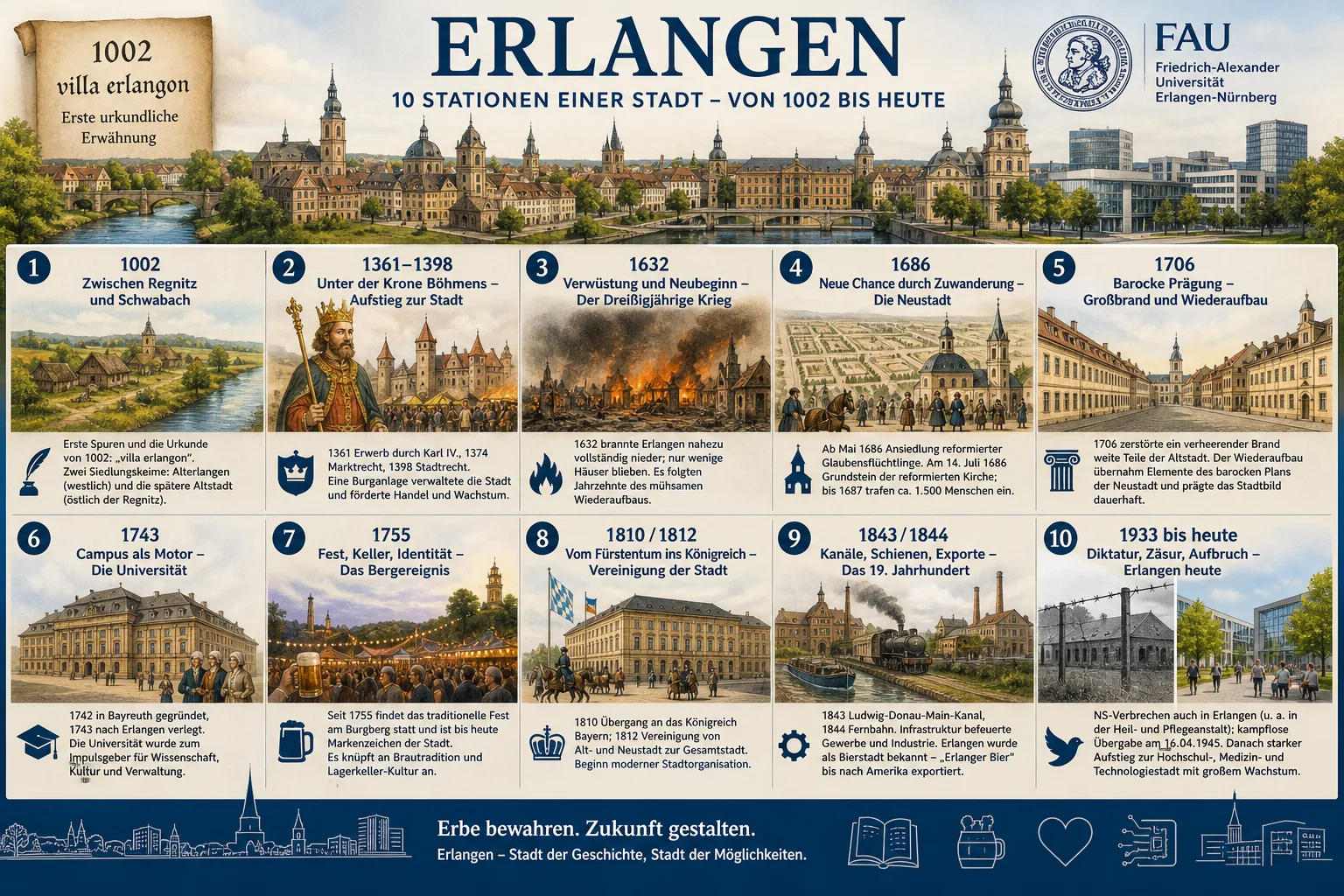
1) River Landscape & Early Settlement Traces: Regnitz Crossings
At this first stop, you will focus on the topography: crossings over the Regnitz, route guidance, and the logic of settlement sites. Pay attention to bridge areas, riverbanks, and sightlines – they explain why places on rivers often develop into hubs.
- Observation question: Which routes converge here today – and which might have converged historically?
- Tip for families: A short “map challenge”: Which route is the driest, which is the fastest, which is the most beautiful?
2) City Center & Market Logic: Squares, Axes, Everyday Paths
Here you will trace how a city center can be read through squares, main routes, and “everyday corridors.” This stop is ideal for thinking about the role of market spaces, supply, and encounters – regardless of whether there is a market at the moment or not.
- What to look for: Width of streets, location of square edges, transitions between quiet and lively zones.
3) City as a Space of Risk and Crisis: Fire Protection, Material, Reconstruction
This stop will help you in the future to see urban development as a sequence of decisions: building materials, distances, access for emergency services, escape and rescue logic. Look at facades, plot widths, and street layouts – they often tell of safety and order principles.
- Impulse: Which structural details seem “planned” – and which rather “grown”?
4) Experience the Baroque Planned City: Grid, Squares, Symmetry
In this section, you will read a baroque order system in the city layout: straight lines, recurring parceling, and a special clarity in orientation. Even without expert knowledge, this can be easily grasped on site through sightlines and street connections.
- Mini-exercise: Stand at an intersection: Which direction feels like the “main axis” – and why?
5) Migration & Urban Society: Places of Arrival
This stop is intended for the topic of immigration and urban change. You will discuss (or reflect on your own) how new population groups can shape spaces, professions, networks, and cultural practices in cities – and how memory of this is kept visible.
- Discussion question: How can you recognize “arrival” in a city – by architecture, names, institutions, language?
6) Museum & Source Perspective: Understanding City History Through Objects
Plan a museum stop in the future: This stop will function as a source window. Instead of just “talking about history,” you can work with objects, maps, images, and explanatory contexts. This is especially helpful for anchoring impressions from the city tour.
- Tip: Choose a topic in advance (e.g. city map, crafts, everyday life) and specifically look for suitable exhibits in the building.
7) University & Knowledge City: Learning as a City Engine
Here you will focus on Erlangen as a center of knowledge and research. Campus locations and science-related institutions are good venues to think about the city economy, student life, and international networking – topics that are likely to become even more important in the coming years.
- What to look for: Transitions between historic buildings, modern institutes, and public spaces.
8) Beer Culture & Annual Festivals: Places of Celebration (optional Burgberg)
If you are planning an extended tour, this section will focus on festival culture and “the city as a stage.” Depending on the season, you can visit places that are particularly lively during major festivals. This stop is also a good starting point for discussions about noise, protection of green spaces, and visitor management.
- Planning note: For the Burgberg detour, you should allow extra time and wear suitable shoes.
9) Mobility & Modernization: Station Area, Routes into the Region
This stop will bundle future perspectives on transport and urban networking: arrival, transfers, flows of goods and people. The station area is a good place to talk about sustainable mobility, urban growth, and the role of regional connections.
- Impulse: Which functions are concentrated here – and which do you think are missing?
10) Culture of Remembrance & Responsibility: Memorial Sites in the Urban Space
To conclude, the route will deliberately set a quieter focus: culture of remembrance in public space. You can understand memorial signs as part of urban education – they invite you to reflect on responsibility here and now, without overloading the tour.
- Note: For groups, a short moderation with clear discussion rules and enough time for questions is recommended.
Suggestion: Day Program for a Date in Autumn 2026
If you want to plan the tour as a concrete future day program, you can use this structure as a guide. Times are intended as a practical framework and can be adjusted to weather, opening hours, and group pace.
- 10:00 – Start at an easily accessible point in the city center (arrival by public transport recommended).
- 10:10–11:40 – Stops 1–5 (Reading the urban space: river, routes, planning structures, arrival).
- 11:40–12:30 – Museum/exhibition window (Stop 6) as a quiet deepening block.
- 12:30–13:30 – Lunch break (at your own choice; please consider individual needs).
- 13:30–14:30 – Stop 7 (Knowledge City) with campus walk.
- 14:30–15:30 – Optional Stop 8 (Burgberg/festival culture) or alternative route in the flat city center area.
- 15:30–16:15 – Stop 9 (mobility) and final impulse.
- 16:15–16:45 – Stop 10 (culture of remembrance) + joint conclusion.
Practical tip: For group tours from 2026 onwards, it is recommended to collect a “question list” in advance (e.g. architecture, religion, migration, beer culture, science). This keeps the tour focused and personally relevant at the same time.
Deepen & Discover More (Future Exhibitions, Archives, Collections)
If you want to delve deeper after the tour, curated exhibitions, lectures, and digital collection offers will be particularly suitable in the future. Formats that combine city maps, objects, and biographies are especially helpful.
- City Museum / Collections: Ideal for connecting topics across stops (urban development, everyday culture, material sources).
- City Archive / Source Work: Suitable if you want to research yourself in the future (e.g. family history, house history, club history).
- University & Public Lectures: Recommended for context and current research perspectives.
For planning, it is recommended to check dates and program points via the official event calendars (see source list).
Sources & Further Links
The following links are suitable for future planning (events, opening hours, programs, background offers). Please note that content may be updated continuously.
- City of Erlangen (Official Website) — central contact point for services, culture, and current information (accessed 2026-06-10)
- Erlangen City Museum — information on exhibitions, collections, and visits (accessed 2026-06-10)
- Erlangen City Archive — research offers, holdings, usage information (accessed 2026-06-10)
- Friedrich-Alexander-University Erlangen-Nuremberg (FAU) — public information on the university, events, and transfer (accessed 2026-06-10)