Discover Spiritual Places & Meditation in Erlangen
Spiritual Places & Meditation in Erlangen: Where You Can Find True Silence in the Coming Weeks
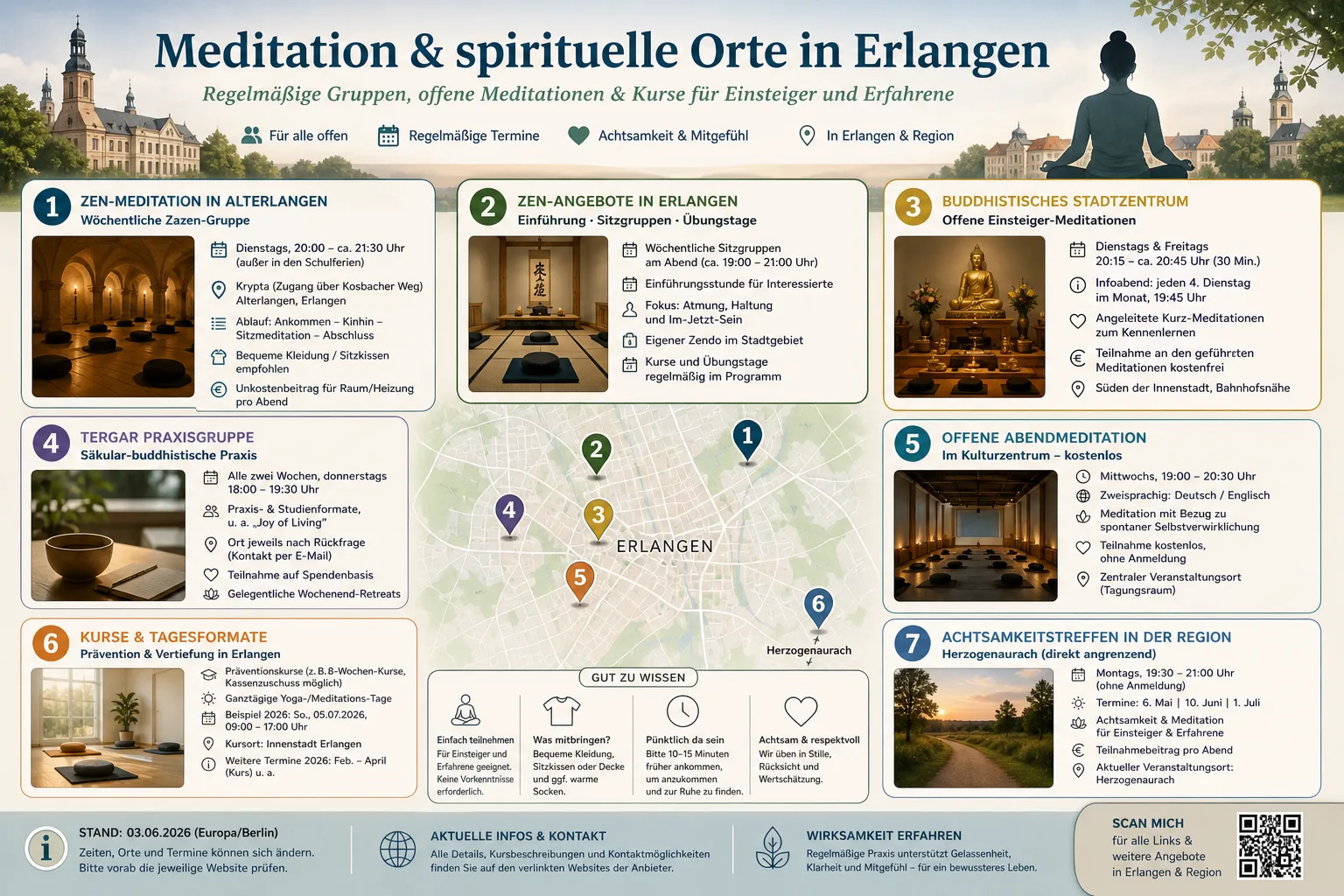
This guide helps you discover suitable places for meditation, mindfulness, and spiritual practice in Erlangen in the future – from silent Zen sitting meditation to open evening formats in the city community.
Where in Erlangen Will You Find True Silence in the Future?
If you want to explore Erlangen with a different focus in the near future, it is worth taking a perspective that does not ask about deadlines and walking routes, but about silence, breath, and attention. Even in a lively university and research city, you can find spaces in the future where conscious pausing is possible: in simple meditation rooms, in sacred side rooms, in cultural centers, or in groups that practice secular mindfulness.
This overview shows you which formats you are likely to encounter in the coming weeks and months, how to make a good start, and what you should pay attention to before your first visit. Since times and places can change, the most important rule is: always check the current information of the respective group beforehand.
Zen Meditation in Erlangen: What to Expect at Zazen, Kinhin, and Silent Evenings
If you are interested in Zen, you can find offers in Erlangen in the future that enable classic Zazen practice (sitting meditation) in a clear, calm setting. A typical process can carry you without much prior knowledge: arriving in silence, a short introduction to posture and breathing, then sitting meditation – often supplemented by Kinhin (meditative walking).
How to Prepare for Your First Zen Evening
- Clothing: Comfortable, preferably warm clothing without disturbing zippers or hard belts.
- Sitting: Often, your own cushion (zafu) is helpful. Many groups have limited materials on site; clarify this in advance.
- Timing: Plan to arrive a few minutes early, as late entry can disturb the silence.
- Contribution: Some meetings are donation-based, others charge a small fee (e.g., for room/heating). Check the current conditions in advance.
Especially helpful for beginners in the future: introductory sessions (e.g., on sitting posture, dealing with thoughts, physical discomfort) and formats with clear guidance. If you have health restrictions (knees, back), ask in advance about alternative seating options (chair, bench) – many groups are prepared for this.
Buddhist City Center: Open Short Meditations as an Introduction (Expected Regularly)
If you are looking for a low-threshold introduction in the next few weeks, you will often find formats in Erlangen that are designed as short, guided meditation units. Such offers are often explicitly aimed at people with no prior experience: you arrive, sit down, are guided through an exercise (breath focus, body awareness, metta/loving-kindness, or simple mindfulness impulses), and then return to your everyday life.
Depending on the provider, participation can be free of charge or donation-based. Some centers will combine the practice with information evenings in the future, where basics are explained: What is mindfulness in the Buddhist sense? How can compassion be practiced? What role do ethics and everyday practice play?
So you don't stand in front of a closed door, especially here: Check the current information before your visit (registration yes/no, punctual arrival, language, possible closing times).
Secular-Buddhist Practice Groups & Mindfulness: Meditation Without Dogma (With Exchange)
If you would rather practice mindfulness secularly in the future – that is, without a religious framework – you can find practice groups in Erlangen and the surrounding area that combine meditation with study, reflection, and sharing experiences. The tone is often down-to-earth: stress in studies, mental overload, constant digital stimuli, or the desire for more emotional stability are taken seriously as real starting points.
Such groups often work with structured practice paths (e.g., mindfulness programs, guided exercises, short impulse texts) and meet at regular intervals. Sometimes there are also weekend formats or in-depth practice days. For you as a participant, it is crucial to clarify in advance:
- whether a session is open or intended as a course series,
- whether you need to register,
- what duration (e.g., 60–120 minutes) is realistic,
- and whether donations are requested.
Cultural Center, Prevention Courses & Public Formats: Meditation as Part of the Urban Community
If you are looking for a form of meditation in the future that offers less of a "sangha feeling" and more of an open meeting space, public evening meditations in cultural or educational settings are a good option. In Erlangen, there are always formats that are bilingual (German/English) or internationally oriented – practical for students, researchers, and guests of the city.
In addition, you can probably find offers in the coming months that treat meditation as a health or prevention topic (e.g., stress management courses, mindfulness-based training, combined yoga & meditation days). If you expect a health insurance subsidy, it is important to check the specific requirements directly with the provider and your insurance (certification, course ID, attendance rate).
For changing dates (workshops, lectures, day formats): Rely on the current event page and check cancellation conditions, minimum number of participants, and required materials.
What You Should Consider Before Your Next Meditation Visit
- Up-to-date information: Times, places, and frequency can change at short notice. Always check the latest information.
- Choose the right format: Silent (Zen/Zazen) vs. guided (short meditation/mindfulness) vs. course (multi-week). Choose according to your needs, not according to "right" or "wrong".
- Respect boundaries: If you feel uncomfortable (physically or mentally), stop the exercise, talk to the leader, or leave. Serious groups accept this.
- Expectation management: Being "restless" in the first sessions is normal. Progress often shows as better self-awareness, not as perfect thought silence.
- Everyday transfer: Plan small units (e.g., 5–10 minutes) between group meetings in the future – this stabilizes the practice.
If you want to experience Erlangen in the future not only as a place to work and study, but also as a place of inner retreat, even a regular evening appointment per week can make a noticeable difference: less autopilot, more conscious decision-making – in conversation, in walking, in dealing with stress.