Experience Animals Live: Farms & Petting Zoos Near Erlangen
Experience Animals Live: Farm & Petting Zoo Experiences Around Erlangen (Outlook 2026/2027)
If you are planning animal encounters in the greater Erlangen area in the coming months, you will often find offers such as farm tours, petting areas, feeding times, holiday programs, or educational workshops. To ensure that your next outing is not only enjoyable but also responsible, this article forward-looking summarizes what you can typically expect at upcoming events—and how you can recognize animal welfare and quality on site.
Season Calendar 2026/2027: When Which Formats Are Particularly Common
If you are already considering dates for the coming months, a seasonal orientation can help. It does not replace a concrete list of dates (offers vary by provider), but shows when which types of programs are typically announced more frequently and what you should pay attention to when booking.
Autumn 2026 (October–November)
- Typical occasions: Holiday programs, lantern/autumn events, “Harvest & Farm Life” tours.
- Animal welfare focus: More indoor areas; pay attention to sufficient space, good stable air, and clear rest zones.
- Your advantage: Tours with observation tasks (instead of constant petting) are often particularly suitable at this time of year.
Winter 2026/2027 (December–February)
- Typical occasions: Short farm tours, thematic learning stations (e.g., feed, tracks, animals in winter), smaller group formats.
- Animal welfare focus: Animals often have less space to retreat in winter; good providers limit visit duration and contact intensity.
- Planning tip: Prefer formats with guidance and clear structure rather than “open petting sessions.”
Spring 2027 (March–May)
- Typical occasions: Season start, more outdoor activities, occasionally young animal topics (if offered).
- Animal welfare focus: Especially with young animals, rest and distance are crucial; reputable programs focus on observation and explain boundaries.
- Important: A good offer communicates clearly when animals should not be disturbed (e.g., rest times, cordoned-off areas).
Summer 2027 (June–September)
- Typical occasions: Holiday programs, long opening hours, high visitor numbers on weekends.
- Animal welfare focus: Heat and stress management (shade, water, retreat, dispersing visitor flows).
- Your planning tip: If possible, book off-peak times or guided slots; this is often much more pleasant for the animals.
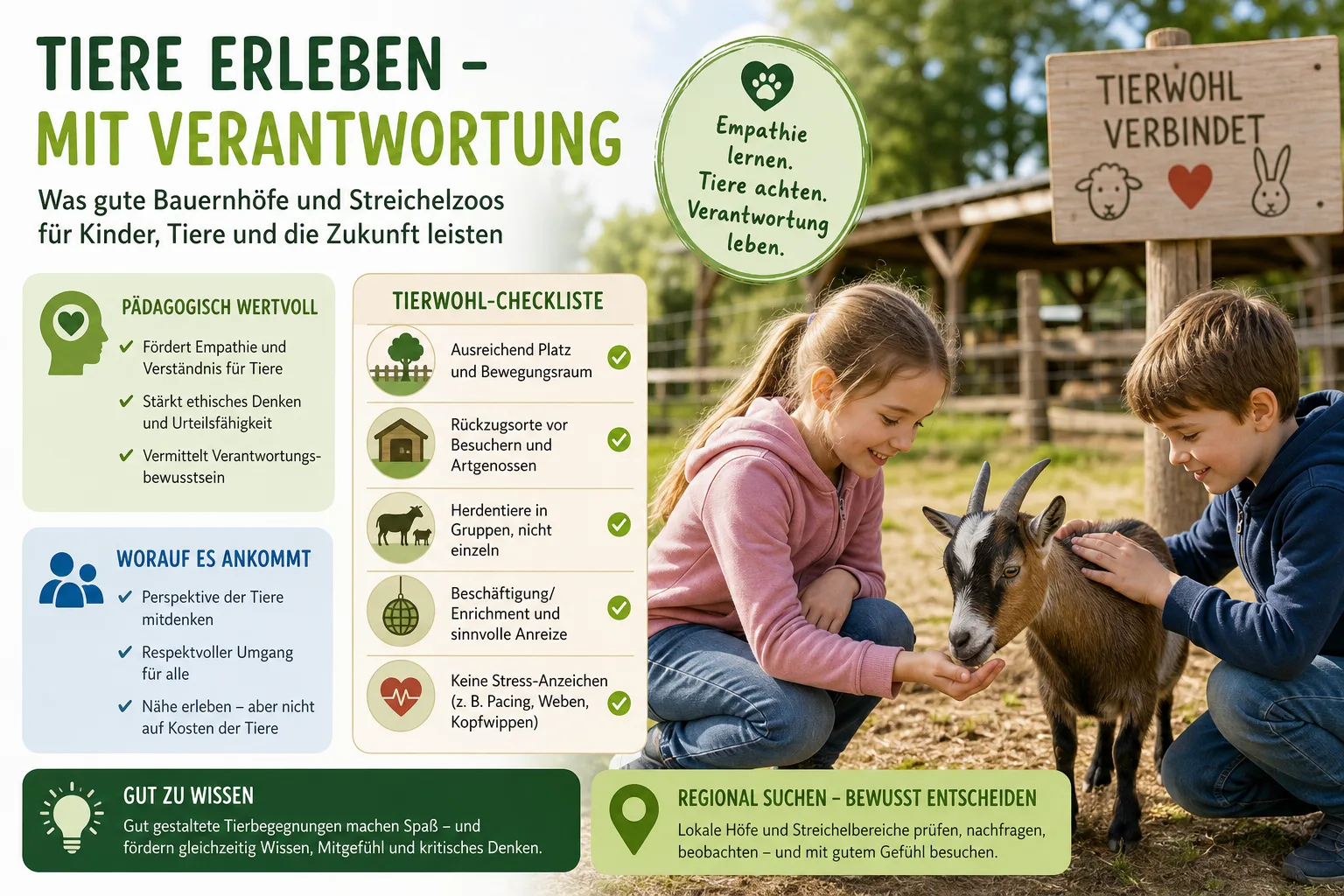
Animal Welfare Check for Your Next Visit (On Site in 5–10 Minutes)
You don’t have to be a professional to recognize the most important signals during an upcoming visit. This check is deliberately practical—and is based on basic principles of animal protection (including care, health, behavior, and stress avoidance).
1) Retreat is available—and respected
- There are inaccessible areas (stable sections, huts, separated zones) where animals can retreat.
- Signage and staff make it clear: Animals are allowed to say “no” (no chasing, no lifting, no surrounding).
2) Space, climate, flooring, and hygiene are appropriate
- Sufficient space to move without constant crowding.
- Clean, non-slip flooring; dry lying areas; no permanently wet, heavily soiled areas.
- Pleasant stable air (no pungent ammonia odors) and suitable temperature/shade options.
3) Social structure matches the animal
- Herd animals (e.g., many goat or sheep breeds) are kept in groups.
- It seems inappropriate if an animal is permanently isolated or constantly separated from others without a recognizable reason.
4) Behavior: calm and curious rather than stressed or “switched off”
Pay attention to the overall impression. Signs to be particularly aware of:
- Repeated, monotonous movements (e.g., constant pacing along the fence).
- Avoidance or withdrawal behavior while visitors persistently follow.
- Restlessness, loud confusion, animals being pushed into contact.
5) Visitor management is visible
- Clear rules (e.g., feeding only with suitable food and only at certain places/times).
- Limited group sizes or slots, especially for contact offers.
- Supervisors who calmly guide and enforce boundaries.
Pedagogy with Animal Contact: What Will Characterize Good Programs in the Future
For upcoming tours and workshops, it is worth not only asking “Can we pet?” but also about the learning objective. Good programs put the animal’s perspective at the center and turn this into concrete rules of conduct for visitors—especially for children’s groups.
Features you can ask about when booking
- Observation tasks instead of constant activity: “How can you tell the animal wants distance?”
- Calm structure: short sequences, breaks, alternation between information & observation.
- Age-appropriate ethics: Why do animals need places to retreat? What does stress mean? What is fair contact?
- Hygiene and safety concept: clear handwashing rules, feeding only supervised, behavior in enclosures explained.
A particularly good sign is when an offer transparently communicates that animal contact is optional and will be reduced if necessary—in favor of rest, health, and safety.
How to Plan Upcoming Visits Fairly for People & Animals
To ensure that future outings around Erlangen are successful for everyone involved, these steps can help—regardless of whether you are planning as a family, school class, or club:
- Get information in advance: Are there fixed times, guided slots, or a limit on the number of visitors?
- Choose contact intensity appropriately: For very young children, a short, guided sequence is often better than long stays in the petting area.
- Practice rules beforehand: Quiet voices, slow movements, no chasing, no lifting, do not surround animals.
- Critically check feeding: Reputable providers strictly regulate feeding (suitable food, defined quantities, fixed places/times).
- Use off-peak times: If possible, schedule upcoming visits for less busy times (more peace, less stress).
- Reflect after the visit: What was good for the animals? What was too much? This will make the next visit even better.
Note on responsibility: Animal contact is not a “right” of the public. Good offers make it clear that the welfare of the animals sets the limit—even if this means that petting or feeding is temporarily not possible.
If Something Seems Critical at an Event: Sensible Next Steps
If, during a future visit, you get the impression that animals are overwhelmed or rules are not being followed, you can act calmly and constructively:
- Address on site: Ask politely (“Is there a rest area?”, “Is feeding allowed right now?”). Reputable teams respond transparently.
- Manage your own group: Increase distance, reduce noise, shorten stay duration.
- Give feedback: After the visit, provide objective feedback on what you observed (specific, without speculation).
- In case of serious concerns: If you suspect an acute danger, it makes sense to contact the responsible authorities (e.g., veterinary office). Use precise observations (time, place, situation).
This way you protect animals and also help to improve future offers in the region.
Sources & Further Information
The following sources were used for the content classification of animal welfare, stress avoidance, and responsible animal husbandry:
- Animal Welfare Act (TierSchG) — Legal basis for the protection of animals in Germany (retrieved on 2026-10-07)
- EFSA (European Food Safety Authority) — Scientific assessments on animal health, husbandry, and welfare aspects (retrieved on 2026-10-07)
- WOAH (World Organisation for Animal Health): Animal Welfare — International principles and frameworks on animal welfare (retrieved on 2026-10-07)
- Federal Ministry of Food and Agriculture (BMEL) — Background information and classification on livestock farming and animal welfare policy (retrieved on 2026-10-07)