Experience Street Music & Concerts in Erlangen
Street Music & Spontaneous Concerts in Erlangen: How to Find Live Music Beyond the Calendar in the Future
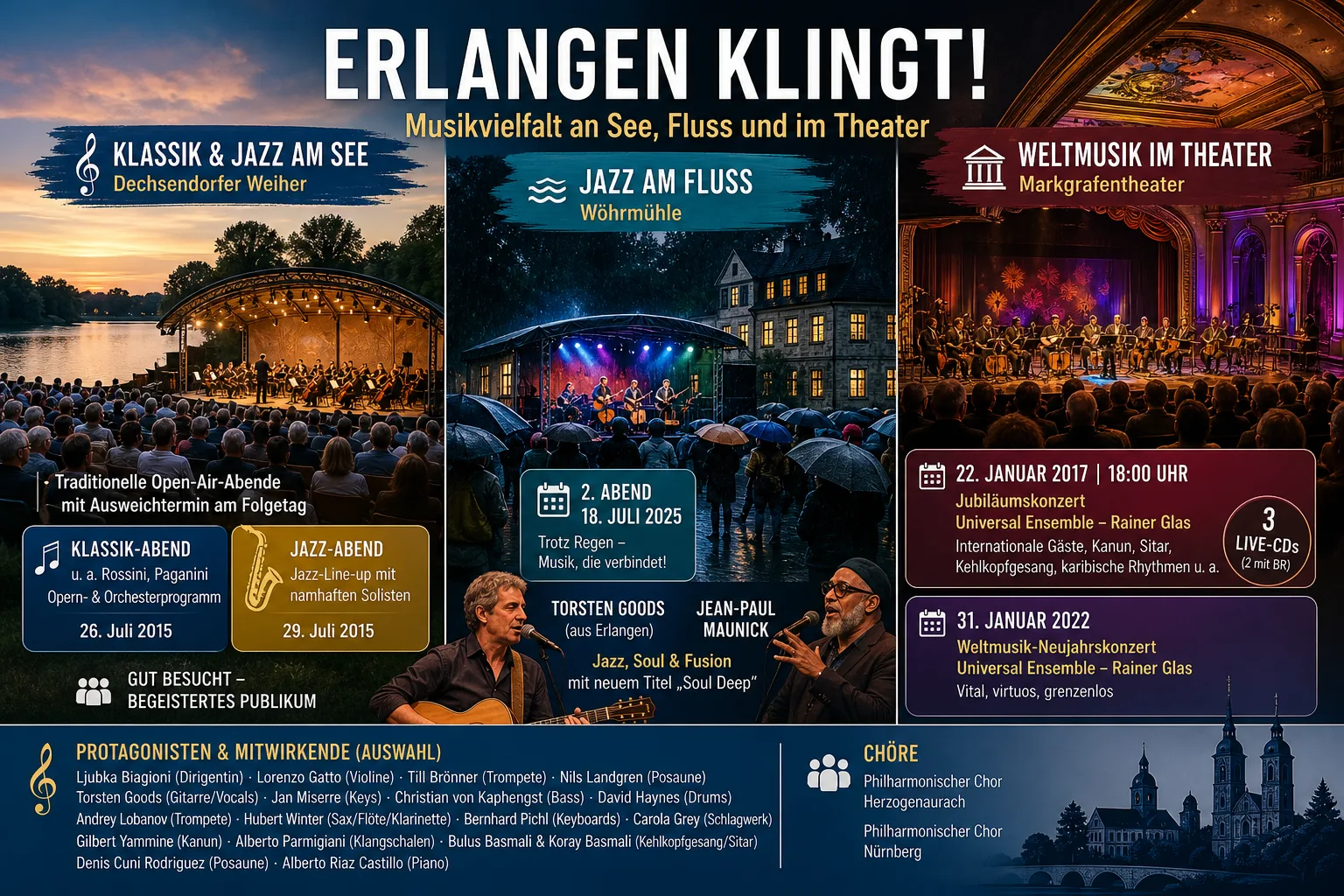
Do you want to experience live music in Erlangen without committing to a single major concert? In the coming weeks and months, you can use the city as a "sound route": from announced stages to spontaneous sets in public spaces. This guide shows you how to sensibly combine both in the future, what you as an audience should pay attention to, and how musicians can plan performances so that they fit the city, neighborhood, and rules.
Low-Threshold Formats: Attend at Short Notice, Still Legal & Fair
In the coming season, you will likely find formats in Erlangen that make it easy to get started without having to plan weeks in advance:
- Free Admission Evenings (e.g. small series, initiatives, university ensembles),
- Open Stages (short slots, new acts, experimental sets),
- Sing-along or Participation Formats (choir or karaoke formats where the audience becomes part of the performance).
For you as a visitor, this means: You can decide at short notice and still get a "real concert feeling." For the scene, such formats are also a bridge between rehearsal, first stage, and later, larger performances.
Street Music: Why It Rarely Appears in the Calendar – and How to Find It in the Future
Street music remains intentionally not as plannable as a ticketed concert in many cities: It thrives on people using the space at the moment, the weather and mood being right, and musicians performing spontaneously. That's why it often only appears indirectly in classic event lists.
If you want to specifically look for street music in Erlangen in the future, these strategies work most reliably:
- Go at the Right Time: Plan your city stroll so that you are out during typical strolling times (late morning to early evening). Then the likelihood is higher that audience and venue "carry" each other.
- Choose Busy but Not Narrow Paths: Wider sidewalks, edges of squares, and transitions between shopping streets and squares are often more suitable than bottlenecks.
- Pay Attention to Acoustics: Underpasses, arcades, or house walls amplify sound. This can sound great, but can also be perceived as too loud more quickly.
- With Open Ears Instead of Fixed Expectations: Street music is not a program booklet—it is a find. Plan time buffers so you can stop and listen.
This creates a realistic approach: You plan the framework (route, time), but leave the musical moment open.
Rules & Consideration: How Street Music Remains Possible
For the coming months, as a guideline: Street music in Germany is not "lawless," but moves in the tension between artistic freedom and protection from noise. Which details apply locally (e.g. permitted times, location changes, amplifiers) can be regulated differently depending on the municipality and specific area.
What You as a Musician Should Check Before a Performance in the Future
- Municipal Requirements: Inform yourself before your first gig on the website of the city of Erlangen or at the public order office whether there are regulations on playing times, locations, amplification, or group size.
- Volume & Duration: Plan set lengths so that you take breaks and do not play the same spot continuously—this reduces the risk of conflict.
- Avoid Particularly Sensitive Places: Near hospitals, schools, or purely residential areas, restraint is especially important because the interest in peace is typically weighted higher there.
- Keep Passageways Clear: Position yourself so that pedestrian and emergency routes remain open and no bottlenecks arise.
What You as an Audience Can Contribute in the Future
- Respectful Distance: Keep access to shops, stops, and entrances clear.
- Feedback Without Escalation: If it seems too loud, a polite hint is often more effective than on-site discussions.
- Show Appreciation Fairly: Applause, a quick "thank you," or a donation within your means supports culture in everyday life.
The best future mode is a simple one: Enable music, protect everyday life. Then street music is more likely to remain welcome and thus be heard more often in the long term.
Practical "Sound Route" for Your Next City Stroll
If you want to experience both planned and spontaneous music in Erlangen soon, you can structure your evening like this:
- Start with Reliability (30–60 minutes): Choose a fixed program point in advance (e.g. concert, session, open stage). This "secures" your evening.
- Arrive Early (20–40 minutes): Use the buffer for a walk along central paths and squares. This period is often suitable for random street music finds.
- Plan for Afterglow (15–30 minutes): After the official program point, a short detour instead of going straight home is worthwhile—this is when spontaneous small follow-up moments often arise (e.g. a duo in front of a restaurant).
This way, you combine the best of both worlds in the future: reliable stage and unplanned find.
Tips for Musicians, Visitors, and Local Stakeholders
For Musicians
- Set Design for Public Space: Plan short, rounded sets with clear beginnings/endings. This suits passing audiences and reduces continuous noise.
- Acoustic Before Amplified: If possible, prefer acoustic versions or very restrained amplification—this reduces conflicts and often sounds more musical.
- Communication with the Environment: A friendly sentence to surrounding shops ("We'll play for 20 minutes, then take a break") builds trust and lowers the likelihood of complaints.
- Bridge to Indoor Stages: Use open sessions/small stages as the next level: There you can play longer sets and see new listeners again.
For Visitors and Locals
- Hybrid Plan: Fix an indoor appointment and leave time before/after for spontaneous discoveries.
- Consideration as a Cultural Technique: If you stop, pay attention to passageways and to people who work or live there.
- Sharing Without Pressure: If you make recordings, briefly ask for consent—especially with individuals, this comes across as respectful and professional.
For the Local Scene, City Life, and Economy
- Clear, Easily Accessible Rules: The more understandable municipal information is, the fewer conflicts arise—and the more likely music remains possible in public spaces.
- Low-Threshold Micro-Stages: Small, clearly defined areas (e.g. in front of cafés with enough space) can help channel music in the future instead of displacing it.
- Cooperation Instead of Displacement: If trade, gastronomy, and the cultural scene support agreements on times and volume, acceptance of live music in everyday life increases.
Outlook: How Erlangen Can Continue to Sound in the Future
In the coming years, Erlangen can particularly benefit if plannable concert culture and spontaneous sound moments are not seen as opposites, but as a complement: Some create reliability, others make city life lively and surprising.
If you want to experience live music regularly in the future, the best attitude is a double one: Use dates when you definitely want to hear music—and stay open when you want to experience the city as a sound space. It is precisely in this mix that the evenings you remember are created.
Sources & Further Information
- Basic Law (GG) – Art. 5 — Artistic and freedom of expression as a framework, which in practice is weighed against other legal interests (e.g. interests in peace) (accessed 2026-04-14)
- Civil Code (BGB) — general civil law principles that may become relevant in conflict situations (e.g. disturbances); details depend on the individual case (accessed 2026-04-14)
- City of Erlangen – Official Website — responsible contact point for local regulations/information (e.g. public order office, information on the use of public spaces) (accessed 2026-04-14)