
Ernst Barlach
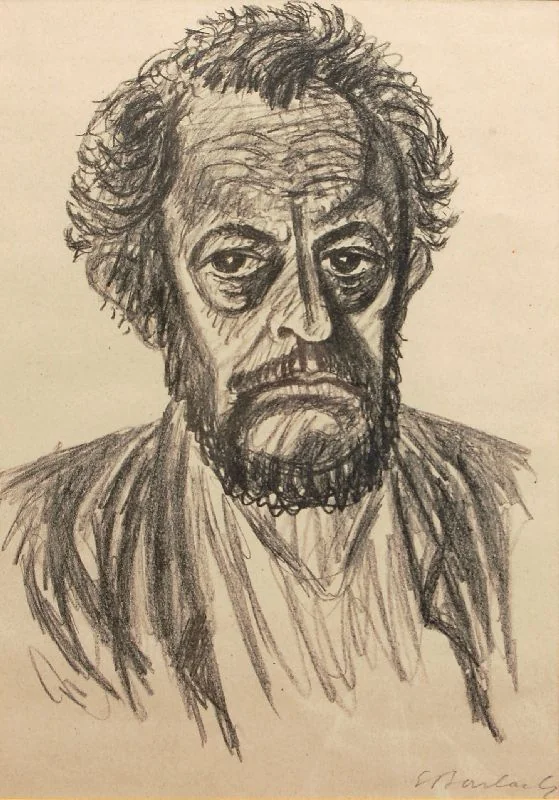
Image from Wikipedia
Image from Wikipedia
Ernst Barlach: The Expressionist Sculptor between Wood, Humanity, and Inner Drama
An artist who transformed form into spiritual tension
Ernst Heinrich Barlach is one of the defining figures of German modernism. He was born on January 2, 1870, in Wedel and died on October 24, 1938, in Güstrow; his work includes sculpture, medal art, printmaking, drawing, writing, and drama. He is especially known for his wooden sculptures and bronzes, in which he made human existence, suffering, and dignity visible with unusual intensity. His art stands between realism and expressionism and continues to resonate today in museums, collections, and exhibitions. ([britannica.com](https://www.britannica.com/biography/Ernst-Barlach))
Biographical Roots and Artistic Training
From Holstein origins to major art centers
Barlach grew up in northern Germany and received his education at institutions that were crucial for his later artistic language. After attending the Hamburg School of Arts and Crafts, he studied at the Dresden Academy, where he was a master student of Robert Diez, and in 1895/96 at the Académie Julian in Paris. This early training combined academic discipline with international openness and laid the foundation for his later distinctive form language. ([deutsche-biographie.de](https://www.deutsche-biographie.de/downloadPDF?url=sfz2085.pdf))
During this phase, Barlach worked on figurative assignments, drawings, and ceramics and came into contact with important mediators and journalists of his time through the art scene. This includes encounters with Karl Scheffler and Reinhard Piper in Berlin, as well as later activities in the ceramic and applied arts scene. These milestones show an artist who did not start as an isolated sculptor but experimented with his means of expression across several disciplines. ([deutsche-biographie.de](https://www.deutsche-biographie.de/downloadPDF?url=sfz2085.pdf))
Searching for a personal style
Barlach initially worked in various places, including Wedel, Höhr in the Westerwald, and Florence, before settling permanently in Güstrow in 1910. The biographical wandering years enhanced his perspective on social reality, religious image traditions, and the archaic character of material and form. It was this combination of personal quest and craftsmanship that later became a core aspect of his artistic authority. ([deutsche-biographie.de](https://www.deutsche-biographie.de/downloadPDF?url=sfz2085.pdf))
Art history often categorizes Barlach as an expressionist sculptor, but his impact goes beyond that. Britannica describes his art as “modern Gothic” and emphasizes its focus on human suffering. This explains why his sculptures do not appear decorative but rather as condensed expressions of human states: silent, heavy, yet full of inner movement. ([britannica.com](https://www.britannica.com/biography/Ernst-Barlach))
The Breakthrough: Wood, Bronze, and the Drama of the Human Condition
Sculpture as an expression of inner tension
Barlach's fame grew particularly in the 1920s and early 1930s, when he gained significant attention for his war memorials in Magdeburg and Hamburg, as well as for religious figures for St. Catherine's Church in Lübeck. Britannica highlights his famous works as possessing a raw, almost eruptive form language that combines the massiveness of the figures with an intense psychological presence. In works like The Solitary One and the bronze Death, this tension is especially apparent. ([britannica.com](https://www.britannica.com/biography/Ernst-Barlach))
Wood became a key material for Barlach because it offered an immediate, almost resistant surface. He preferred the raw power of the material and approached late Gothic sculpture without falling into historical imitation. It is precisely this mix of archaic hardness and modern interiority that makes his sculpture distinctly recognizable even today. ([britannica.com](https://www.britannica.com/biography/Ernst-Barlach))
Literature, Drama, and Graphics as an extension of sculpture
Barlach was not only a sculptor but also a playwright, graphic artist, and writer. From around 1910, he increasingly focused on theater; his most important plays include Der tote Tag and Der Findling, which combine symbolism and realism. In parallel, he created woodcuts and lithographs to accompany his texts, intertwining image and language closely in his work. ([britannica.com](https://www.britannica.com/biography/Ernst-Barlach))
The biography of the Ernst Barlach House also documents numerous theater performances and phases of his work, including the premieres of Der arme Vetter and Der tote Tag as well as the creation of significant sculptures like Der Mensch im Stock, Kruzifix I, and Moses. This range shows an artist who translated dramatic concentrations of form into different media. His artistic development thus follows an intense, media-open quest for expression rather than a linear professional career. ([barlach-haus.de](https://www.barlach-haus.de/en/ernst-barlach/biography/))
Conflicts, Persecution, and Historical Breaks
Success and Repression in the Age of Extremes
Barlach's international and national recognition faced massive rejection during the Nazi era. Works were removed from German museums, exhibited in the propaganda show "Degenerate Art," and the artist was pressured to relinquish his positions and exhibition rights. This rupture is one of the central chapters in his reception history and explains why his work is today also read as a testimony to cultural persecution. ([britannica.com](https://www.britannica.com/biography/Ernst-Barlach))
Sources from the Ernst Barlach House report that 381 works by Barlach were removed from German museums and that the national socialist cultural policy systematically damaged his standing. Despite this repression, the impact of his art remained strong after 1945, as it distilled human vulnerability into a language of great formal density. It is precisely in this tension between recognition and exclusion that a significant part of his historical authority lies. ([barlach-haus.de](https://www.barlach-haus.de/en/ernst-barlach/biography/))
Awards and Canonical Position
Barlach became a member of the Berlin Academy of Arts in 1919 and an honorary member of the Munich Academy of Fine Arts in 1925. He also received the Kleist Prize in 1924 and the Pour le Mérite Order in the Peace Class in 1933. These honors mark an artist whose significance already exceeded regional boundaries during his lifetime. ([deutsche-biographie.de](https://www.deutsche-biographie.de/downloadPDF?url=sfz2085.pdf))
The art historical classification is still supported today by institutions such as the Ernst Barlach House and the Ernst Barlach Society. The Ernst Barlach House houses a significant collection, including numerous major works and about a third of his wooden sculptures; since 1995, the Ernst Barlach Society has also been awarding the Ernst Barlach Prize for the Arts to make innovative artistic achievements visible. Thus, Barlach remains not only a museum artist but also a vibrant point of reference in the cultural discourse. ([barlach-haus.de](https://www.barlach-haus.de/en/))
Work, Style, and Cultural Influence
Between Realism and Expressionism
Barlach's style navigates between realistic observation and expressionist condensation. His figures are often reduced, heavy, and closed, yet it is precisely this simplification that opens spaces for empathy and interpretation. Britannica describes his works as shaped by human suffering; this captures the essence of an oeuvre that is never merely formal but always existentially engaged. ([britannica.com](https://www.britannica.com/biography/Ernst-Barlach))
His printmaking and drawing are also indispensable for the overall picture. Deutsche Biographie emphasizes the training, years of teaching and wandering, as well as late recognition, making it clear that Barlach was not a specialist in the narrow sense, but an artist with a broad media approach. It is this versatility that strengthens his position in the canon of classical modernism. ([deutsche-biographie.de](https://www.deutsche-biographie.de/downloadPDF?url=sfz2085.pdf))
Reception, Museums, and Vibrant Presence
Today, Barlach's work is intensively researched, curated, and exhibited primarily in Hamburg and the northern German region. The Ernst Barlach House in Hamburg presents a unique collection in Jenischpark and combines exhibitions, educational work, and scientific endeavor with a public program. His former studio in Güstrow has also been transformed into a museum, further strengthening the museum presence of his art. ([barlach-haus.de](https://www.barlach-haus.de/en/))
Current projects in the strict sense are naturally absent for an artist who passed away in 1938; his presence today arises through exhibitions, collection work, research, and awards. The Ernst Barlach House continuously showcases special exhibitions and online collections, and the Ernst Barlach Society keeps alive the memory of his work and impact through an institutionalized support framework. Thus, Barlach remains a classic whose relevance is not petrified in museums but is continually reexamined. ([barlach-haus.de](https://www.barlach-haus.de/en/))
Conclusion: Why Ernst Barlach Continues to Fascinate Today
Ernst Barlach fascinates because he brought the human experience into a uniquely dense form. His sculptures, prints, and dramas combine craftsmanship with spiritual urgency and give modernity a face that appears both fragile and monumental. Those interested in German art history, expressionism, and the emotional power of sculpture will find one of the great names of the 20th century here. ([britannica.com](https://www.britannica.com/biography/Ernst-Barlach))
It is precisely in the interplay of material, space, and inner tension that Barlach's work reveals its special radiance. A visit to the institutions that preserve his legacy is worthwhile for anyone wanting to experience art not just visually but as a spiritual encounter. Ernst Barlach remains an artist to be not only read or viewed but experienced in all his seriousness. ([barlach-haus.de](https://www.barlach-haus.de/en/))
Official Channels of Ernst Barlach:
- Instagram: no official profile found
- Facebook: no official profile found
- YouTube: no official profile found
- Spotify: no official profile found
- TikTok: no official profile found
Sources:
Upcoming Events
Exhibition Opening Ernst Barlach – Facets of Love
Experience Ernst Barlach anew at the Edwin Scharff Museum: love, longing, and language in moving works. Opening on 05/22/2026, 6:30 PM. #Art
Ernst Barlach. Facets of Love
Experience Ernst Barlach in Neu-Ulm as a master of quiet emotions: sculptures, drawings, and poetic texts open new perspectives. #Art
Ernst Barlach. Facets of Love
Ernst Barlach up close: At the Edwin Scharff Museum Neu-Ulm, love becomes a major theme of modernity. Sculptures, drawings, and texts resonate. #Art
Ernst Barlach. Facets of Love
Experience love, longing, and humanity in Barlach's art: The special exhibition at the Edwin Scharff Museum Neu-Ulm showcases powerful works and poetic texts. #Art
Ernst Barlach. Facets of Love
Ernst Barlach in Neu-Ulm: An exhibition full of feeling, form, and art history. Discover love, longing, and expression at the Edwin Scharff Museum. #Art
Ernst Barlach. Facets of Love
Experience Ernst Barlach anew: an exhibition about love, form, and expression at the Edwin Scharff Museum. Until 10.04.2026. #Art
Ernst Barlach. Facets of Love
An exhibition about love, empathy, and expressiveness: Ernst Barlach in Neu-Ulm. Sculpture, drawing, and literature from 23.05.–04.10.2026. #Art
Ernst Barlach. Facets of Love
Ernst Barlach up close: The Edwin Scharff Museum shows love as longing, comfort, and humanity. Until 04.10.2026 in Neu-Ulm. #Art
Ernst Barlach. Facets of Love
Ernst Barlach up close: In Neu-Ulm, this exhibition connects sculpture, graphics, and poetic texts into a moving artistic experience. #Art
Ernst Barlach. Facets of Love
Barlach's art in its most sensual form: love, closeness, and tension at the Edwin Scharff Museum Neu-Ulm. Discover a quiet, powerful artistic experience. #Art