
Marianna von Martines
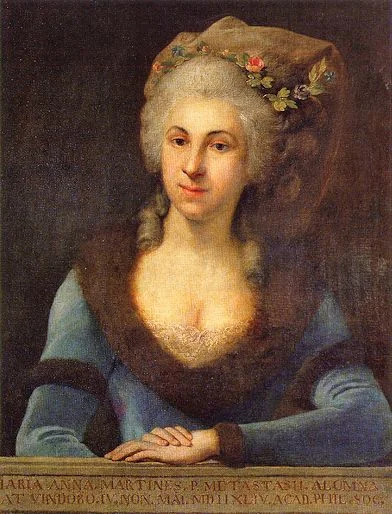
Image from Wikipedia
Image from Wikipedia
Marianna von Martines – the Viennese Composer between Glory, Scholarship, and Rediscovery
An Extraordinary Voice of the Viennese Classical Era
Marianna von Martines is considered one of the most fascinating figures in Viennese music history. Born in Vienna in 1744 and dying there in 1812, she embodied the roles of composer, harpsichordist, pianist, singer, and music teacher at a time when women rarely had access to the compositional center of European high culture. Today, her name represents an artistic biography that combines courtly education, musical excellence, and remarkable stylistic versatility. ([deutsche-biographie.de](https://www.deutsche-biographie.de/gnd118937359.html?language=de))
Background, Education, and Early Access to Music
Martines was raised in an intellectually and culturally privileged environment. Her father, Nicolò Martines, served as the master of ceremonies to the papal nuncio, and the family lived in close connection with the Viennese court and the poetic-musical milieu surrounding Pietro Metastasio. He recognized the talent of young Marianne early on, took charge of her education, and ensured she received singing and composition lessons. Her primary teachers were Niccolò Porpora for singing and Joseph Haydn for the harpsichord or piano; Metastasio himself provided her general education in languages, literature, and culture. ([deutsche-biographie.de](https://www.deutsche-biographie.de/gnd118937359.html?language=de))
This education shaped an artist who was not only technically brilliant but also exceptionally intellectually well-rounded. From the very beginning, Martines moved in the highest circles of Vienna and was recognized there as a musical talent convincing through singing, composition, and instrumental virtuosity. Contemporary voices described her as a favorite of the high society; even Empress Maria Theresa showed interest in her abilities. Thus, her start into a music career was characterized by support, visibility, and a remarkably extensive network for her time. ([deutsche-biographie.de](https://www.deutsche-biographie.de/gnd118937359.html?language=de))
The Rise in Viennese Musical Life
Martines quickly developed into a central figure in Viennese musical life. The combination of Italian singing culture and Viennese counterpoint became a hallmark of her artistic development. The British music historian Charles Burney heard her sing in Vienna in 1772; Adolf Hasse, Abbot Gerbert, and Mozart are also said to have recognized her stature. Such reactions show that Martines not only shone in the salons of an educated elite but also established herself as a serious musician in the artistic memory of the era. ([deutsche-biographie.de](https://www.deutsche-biographie.de/gnd118937359.html?language=de))
Particularly important for her status was her admission to the Accademia Filarmonica di Bologna in 1773. This made her the first woman ever to be accepted into this prestigious circle, a step of considerable cultural-historical significance. This honor marked her rank as a composer far beyond the borders of Vienna. Martines was not only part of a regional music center but also an internationally recognized artist of the Viennese Classical era. ([berliner-philharmoniker.de](https://www.berliner-philharmoniker.de/stories/marianna-martines/))
Compositional Profile: Between Church, Concert Hall, and Chamber Music
The oeuvre of Marianna von Martines included sacred and secular music, including a mass, oratorios, psalms, solo motets, arias, cantatas, concertos, sonatas, a symphony, and several overtures. The preserved works reveal a composer who worked with clear form, melodic elegance, and contrapuntal discipline. The sources also emphasize that some of her works were retained in the archive of the Gesellschaft der Musikfreunde in Vienna, while much else has been lost. It is precisely this mixture of preservation and loss that today shapes the reception of her art. ([deutsche-biographie.de](https://www.deutsche-biographie.de/gnd118937359.html?language=de))
Her oratorio Isacco figura del Redentore occupies a key position in this context. The work was composed in 1781 and performed in 1782, showcasing Martines at a compositional peak. In musical analysis, the score is described as dramatically convincing, expressive, and intended for large ensembles. The combination of soloists, choir, and orchestra gives the oratorio a theatrical proximity that makes new performance formats appealing today. ([deutsche-biographie.de](https://www.deutsche-biographie.de/gnd118937359.html?language=de))
Musical Language and Stylistic Signature
Martines' style brings together two great forces of 18th-century European music: the contrapuntal tradition of the Viennese school and Italian melodic lines. In Vienna, she absorbed the aesthetics of singing conveyed through Porpora and Metastasio and combined them with a keen sense of structure, compositional technique, and harmonic balance. The Viennese dialogue between erudition and expressiveness continues to characterize the appeal of her music to this day. ([magazin.wienmuseum.at](https://magazin.wienmuseum.at/wiederbegegnung-mit-der-wiener-komponistin-marianna-martines))
Musicological classification also emphasizes that Martines’ works have long been underestimated. The ZKM refers to a tradition of devaluation where female composers were generally portrayed as inferior without their music being systematically examined. That is why Martines today appears as a rediscovery with a cultural-political dimension: Her compositions demonstrate that the Viennese Classical era was shaped not only by canonical names but also by highly educated women who contributed to the style. ([zkm.de](https://zkm.de/de/marianna-von-martines))
Oblivion, Rediscovery, and Scholarly Reconstruction
After her death in 1812, Martines fell into obscurity for a long time. A significant reason for this was that only a few of her works were published, and much circulated only in manuscript form. When these manuscripts disappeared from active musical life, her oeuvre lost presence as well. Additionally, the historical narratives of the 19th century often ignored or devalued female composers. ([magazin.wienmuseum.at](https://magazin.wienmuseum.at/wiederbegegnung-mit-der-wiener-komponistin-marianna-martines))
It was not until the 20th century that the systematic rediscovery of historical female composers began, and Martines reappeared in research. The Wien Museum describes how her works are now being critically edited, with the first modern performances and recordings taking place. The Austrian Academy of Sciences even refers to a festival dedicated to her in 2025, including performances of harpsichord concertos and editorial work on the sources. This demonstrates that Martines is no longer just a name in music history but an active field of research and performance. ([magazin.wienmuseum.at](https://magazin.wienmuseum.at/wiederbegegnung-mit-der-wiener-komponistin-marianna-martines))
Current Projects, Editions, and New Recordings
The recent reception is particularly visible in the edition and recording of her works. In 2025, the Austrian Academy of Sciences announced that in June a festival entirely dedicated to Marianna Martines took place and that four concerts by Melanie Unseld were published in Volume 165 of Denkmäler der Tonkunst in Österreich. Additionally, the SWR reported in 2026 on a new recording of the preserved piano works with Idith Meshulam Korman and the Oxford Philharmonic Orchestra, released by Signum. This underscores the current significance of Martines in the concert and recording context. ([oeaw.ac.at](https://www.oeaw.ac.at/de/acdh/detail/news/marianna-martines-im-fokus))
This has led to the creation of a new discography of rediscovery around Martines: not as a popular chart artist, but as a historical composer whose music is becoming audible again in the 21st century. For music journalism, this is particularly exciting as it intertwines musicological research, editorial practice, and artistic interpretation. Martines is thus increasingly liberated from the shadow of preservation and brought back into an active cultural discourse. ([oeaw.ac.at](https://www.oeaw.ac.at/de/acdh/detail/news/marianna-martines-im-fokus))
Cultural Influence and Historical Importance
Marianna von Martines exemplifies the contradictory position of women in 18th-century music. On one hand, she managed to establish herself in Vienna's elite, gain access to excellent education, and achieve recognition from prominent contemporaries. On the other hand, her visibility diminished after her death due to printing practices, canon formation, and institutions of the music business that systematically disadvantaged women. This tension makes her biography so illuminating. ([deutsche-biographie.de](https://www.deutsche-biographie.de/gnd118937359.html?language=de))
Today, Martines holds significant cultural-historical value, as her work demonstrates how rich and varied female composing was during the Viennese Classical era. Her music connects courtly representation, ecclesiastical formality, and Italian cantability with the intellectual atmosphere of the Viennese salon. For lovers of classical music, she is not only a rediscovery but also an expansion of the perspective on the era itself. ([berliner-philharmoniker.de](https://www.berliner-philharmoniker.de/stories/marianna-martines/))
Conclusion: Why Marianna von Martines Captivates Today
Marianna von Martines is a composer of extraordinary stylistic maturity, historical significance, and biographical brilliance. Her career showcases a rare combination of education, talent, networking, and independence; her works reflect the spectrum of the Viennese Classical era between church music, chamber music, and grand oratorios. Those interested in the hidden centers of music history will find here a figure who must be heard and reread. Experiencing Martines live means encountering not only a composer of the past but a vibrant voice in European music history. ([deutsche-biographie.de](https://www.deutsche-biographie.de/gnd118937359.html?language=de))
Official Channels of Marianna von Martines:
- Instagram: No official profile found
- Facebook: No official profile found
- YouTube: No official profile found
- Spotify: No official profile found
- TikTok: No official profile found
Sources:
- Deutsche Biographie – Martines, Marianne
- Wien Museum Magazine – Rediscovery of the Viennese Composer Marianna Martines
- Austrian Academy of Sciences – Focusing on Marianna Martines
- SWR Culture – Incredible Ease: Piano Works by Marianna Martines
- Berlin Philharmonic – The Composer Marianna Martines
- ZKM – Marianna von Martines
- Wikipedia: Image and text source