
Max Bill
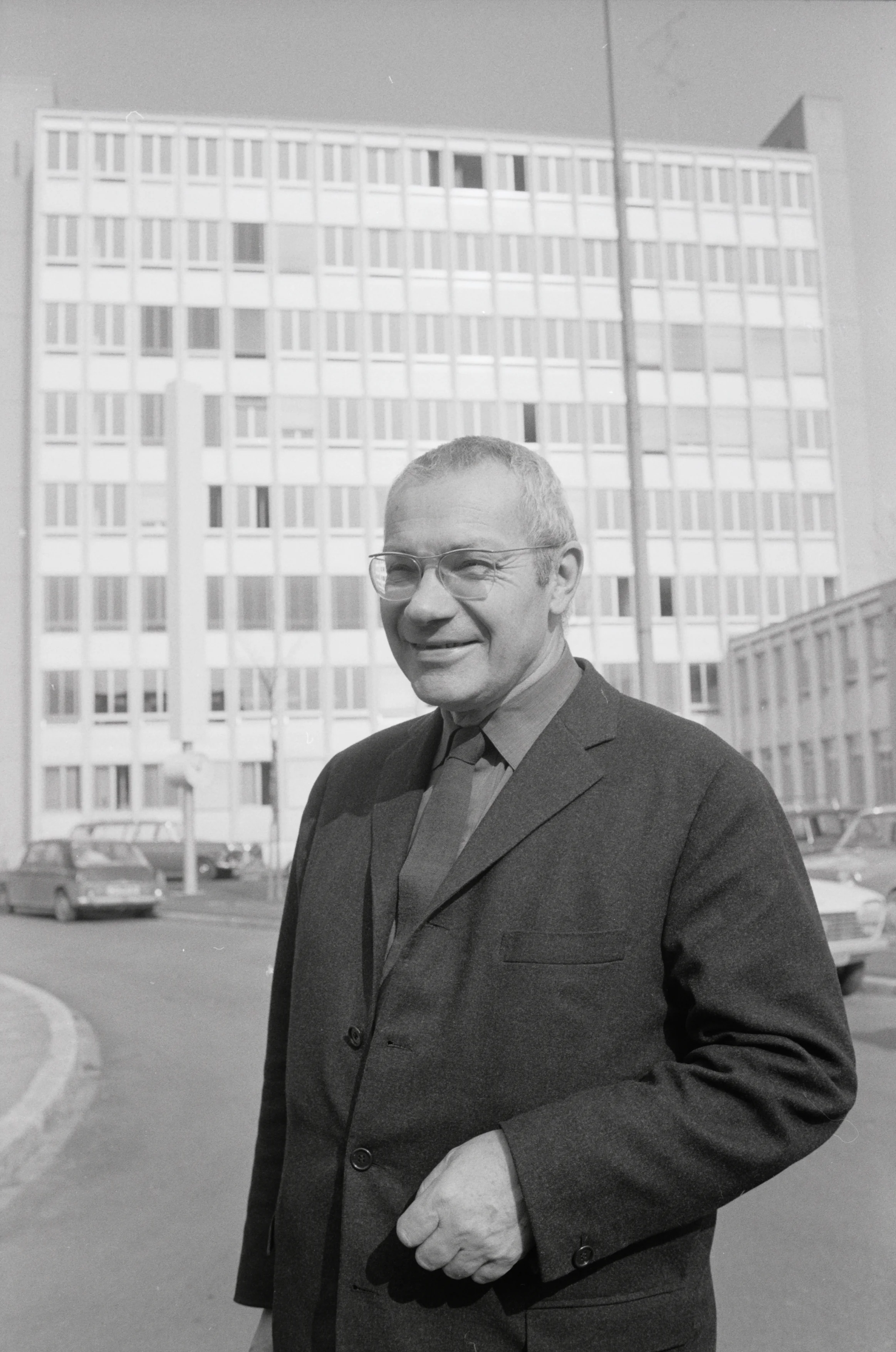
Image from Wikipedia
Image from Wikipedia
Max Bill – the designer of strict harmony between art, architecture, and design
A Swiss century artist between Bauhaus, concrete art, and political thought
Max Bill was one of the most influential figures of European modernism. As an architect, sculptor, painter, graphic artist, typographer, designer, and theorist, he combined artistic practice with intellectual precision, creating works of extraordinary clarity. Born in 1908 in Winterthur and passing away in Berlin in 1994, he became a significant representative of the Zurich School of Concrete Art and a key figure in concrete art. ([de.wikipedia.org](https://de.wikipedia.org/wiki/Max_Bill?utm_source=openai))
His importance extends far beyond individual objects or paintings. Bill understood design as a cultural attitude: a quest for order, measure, function, and aesthetic truth. This consistent connection between form and thought made him an artist whose influence remains visible today in architecture, product design, typography, and modern exhibition culture. ([zuerich.com](https://www.zuerich.com/en/max-bill?utm_source=openai))
Biography: From Winterthur beginnings to international modernist
Max Bill grew up in Winterthur and developed an early strong interest in design and visual structure. His education took him to the Bauhaus in Dessau, where his attitude towards art was decisively shaped. There, he encountered an environment that closely intertwined craftsmanship, technology, theory, and experimentation – an influence that marked all of his later work. ([zuerich.com](https://www.zuerich.com/en/max-bill?utm_source=openai))
After his studies, Bill worked in Zurich and soon moved in circles that significantly shaped modern art in Switzerland. He became a central voice of the constructivist-concrete movement and counted among the key protagonists of Zurich Concrete Art. His roles as a teacher, organizer, theorist, and practical designer made him an exceptional figure in the art scene of the 20th century. ([zuerich.com](https://www.zuerich.com/en/max-bill?utm_source=openai))
The breakthrough: Concrete art as radical clarity
Bill gained international recognition because he understood the idea of concrete art not as a mere style but as a mental discipline. Works like the Infinite Loop and the later sculpture Continuity exemplify his pursuit of mathematical precision, formal purity, and spatial tension. In these works, his thinking in lines, volumes, and movement patterns actively directs the viewer's gaze. ([hls-dhs-dss.ch](https://hls-dhs-dss.ch/de/articles/006183/2025-11-24/?utm_source=openai))
His international reputation was strengthened through exhibitions, collections, and awards. In 1951, he received recognition for both the Swiss Pavilion at the Triennale in Milan and the award for sculpture at the São Paulo Triennale. Such milestones not only mark successes but also the public acknowledgment of an artist who understood design as a universal language. ([hls-dhs-dss.ch](https://hls-dhs-dss.ch/de/articles/006183/2025-11-24/?utm_source=openai))
Architecture, design, and the idea of good design
As an architect and designer, Bill thought in systems. His work combined space, function, and visual order in a way that became exemplary for modernity. He designed buildings, residential and studio houses, exhibition architecture, as well as everyday objects that transferred his clear design language into daily life. ([zuerich.com](https://www.zuerich.com/en/max-bill?utm_source=openai))
His role as a co-founder of the HfG Ulm (University of Design) in 1950 was particularly impactful. There, he also served as the first rector and influenced a generation of designers who carried forward his idea of functionally, logically, and culturally grounded design. In Ulm, his theory connected with institutional effectiveness – a rare example of how an artist actively shaped the canon of post-war design. ([hls-dhs-dss.ch](https://hls-dhs-dss.ch/de/articles/006183/2025-11-24/?utm_source=openai))
Painting and sculpture: Geometry as a poetic discipline
As a painter, Bill also developed a distinctive visual language. His works from the realm of concrete art do not follow any narrative drama, but rather a precise order of color, surface, and relation. It is precisely in this aspect that their tension lies: the works appear austere yet full of inner movement, as if they were visible thought processes. ([zuerich.com](https://www.zuerich.com/en/max-bill?utm_source=openai))
His sculptures exhibit the same will for clarity but are experienced more immediately in space. The famous Infinite Loop and its developments demonstrate how Bill translated mathematical form principles into a sensual, almost musical movement. This connection of construction and dynamics is one of the strongest qualities of his artistic development. ([hls-dhs-dss.ch](https://hls-dhs-dss.ch/de/articles/006183/2025-11-24/?utm_source=openai))
Theory, writing, and intellectual authority
Max Bill was not only a creator of forms but also a precise thinker. His important texts include writings on abstract and concrete art as well as on the mathematical mindset in the art of his time. This provided his work with a theoretical foundation that extended far beyond his own practice. ([ostendorff.de](https://www.ostendorff.de/kuenstler/max-bill/biographie.html?utm_source=openai))
This intellectual rigor gave him authority in the international art dialogue. Bill did not work from the impulse of chance but from the conviction that good design arises from comprehensible principles. His position made him a reference point for art historians, designers, and architects alike. ([zuerich.com](https://www.zuerich.com/en/max-bill?utm_source=openai))
Political and cultural responsibility
Bill always considered design as a societal task. From 1967 to 1971, he was a member of the National Council of the Swiss Confederation, thereby bringing his cultural perspective into politics. This rare connection between art and public mandate underscores his claim not only to create works but also to think about cultural frameworks. ([de.wikipedia.org](https://de.wikipedia.org/wiki/Max_Bill?utm_source=openai))
His significance was further secured through foundations, archives, and museums that continue to preserve his work to this day. The max, binia + jakob bill foundation and institutions like MoMA or SFMOMA document his relevance in international collection and exhibition contexts. This keeps his oeuvre alive and present in a vibrant art historical discussion. ([bill-stiftung.ch](https://www.bill-stiftung.ch/?utm_source=openai))
Cultural influence: A legacy that continues to shape modernity
Max Bill is among those artists whose work has sustainably organized the visual culture of the 20th century. His aesthetics influenced not only art and architecture but also industrial design, exhibition design, and typographic systems. In Zurich, Ulm, and beyond, his attitude has become a benchmark for a modernity that understands clarity not as coldness but as a mental discipline. ([zuerich.com](https://www.zuerich.com/en/max-bill?utm_source=openai))
Especially today, his work seems remarkably relevant. In a time of visual excess, Bill offers a counter position: reduction, precision, and a design language that seeks permanence instead of effect. His art remains compelling because it does not need to be loud to have a lasting impact – and because it sharpens the gaze on the essential. ([collection.pictet](https://www.collection.pictet/artist/bill?utm_source=openai))
Conclusion: Why Max Bill fascinates to this day
Max Bill is fascinating because he connected art, architecture, and design into a single, coherent thought. His works demonstrate how strictly composed forms can still appear poetic, open, and emotional. Anyone wanting to understand modernity cannot overlook Bill: he represents an attitude in which beauty emerges from order, intelligence, and design responsibility. ([zuerich.com](https://www.zuerich.com/en/max-bill?utm_source=openai))
A visit to his works, exhibitions, or collections is always worthwhile because they unfold their impact strongly in space and through direct observation. Experiencing Max Bill live means encountering the precision of modernity in its full visual consequence. His art remains a powerful plea for clarity, quality, and cultural depth. ([moma.org](https://www.moma.org/artists/559-max-bill?utm_source=openai))
Official Channels of Max Bill:
- Instagram: No official profile found
- Facebook: No official profile found
- YouTube: No official profile found
- Spotify: No official profile found
- TikTok: No official profile found