
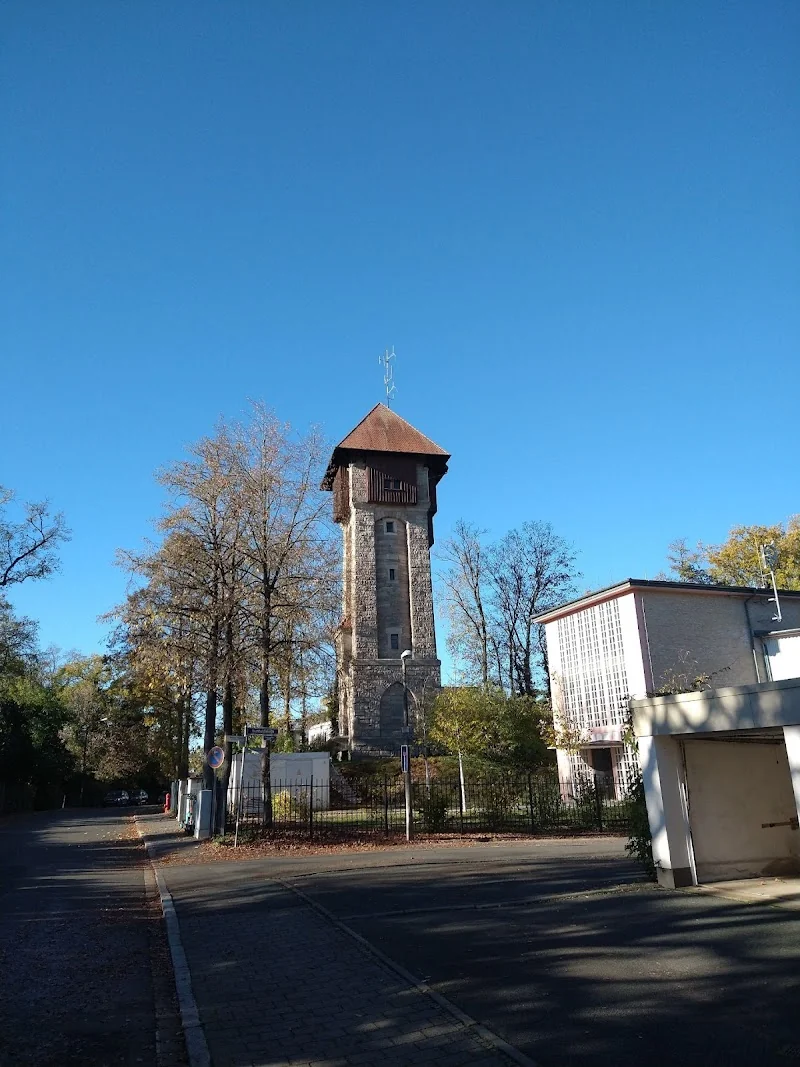
Erlangen
Burgberg, 91054 Erlangen, Germany
Burgberg Erlangen | Bergkirchweih & Parking
Burgberg Erlangen is not just a name on the map, but a place with multiple levels: district, landscape, festival grounds, and memorial site at the same time. The northeastern part of Erlangen has around 4,400 inhabitants and is under a preservation statute due to its special character. Those who visit Burgberg do not experience just any hill, but an area where residential streets, historic beer cellars, public art, and wide vistas come together in a small space. The tourism page of the city describes Burgberg as a mountain without a castle, rising high above the roofs of Erlangen and forming a very unique atmosphere from sandstone, gardens, and villas. This is particularly appealing to visitors because here history, everyday life, and leisure do not separate but rather enhance each other. This mixture makes Burgberg one of the most distinctive places in Erlangen and a destination that can be chosen for both a short walk and a longer day of exploration. ([erlangen.de](https://erlangen.de/en/aktuelles/stadtteil-burgberg?utm_source=openai))
Bergkirchweih, Beer Cellars, and the History of Burgberg
The most important search impulse around Burgberg for many people is the Bergkirchweih, and this is historically well-founded. The city museum explains that the rock cellars at Burgberg made it possible to store beer over the summer and also helped preserve ice that was previously needed to cool the wort. From this connection between brewing culture and hillside location, a Pentecost tradition developed that is now considered one of the most traditional beer festivals in southern Germany. Particularly impressive is the number of cellars: A total of 16 rock cellars still form a far-reaching system under Burgberg, with the oldest dating back to 1675. The largest, the Henninger cellar, was expanded in 1883/84 as an 861-meter-long tunnel. Thus, Burgberg is not only a festival backdrop but also a living piece of economic and urban history, whose underground structures have directly shaped the development of Erlangen. ([stadtmuseum-erlangen.de](https://stadtmuseum-erlangen.de/de/english/d.-industry/d.4-the-breweries))
On the official city page, the individual cellars and hosts are presented as separate chapters of this development. There, Entla's cellar is described as the central crystallization point of Erlangen's beer history, while the Henninger cellar is highlighted as the largest Burgberg cellar. The Goldmann cellar with its special beer selection, the Erich cellar as the heart of the Bergkirchweih, the Steinbach cellar with its storks, and the historic Altstädter shooting house complex also make it clear how strongly identity and gastronomy are interconnected here. Therefore, those who visit Burgberg do not enter an anonymous event location but an ensemble of names, buildings, rituals, and stories that have been passed down through generations. This is exactly why Burgberg works so well as a search term for local users: It stands for real places, not for an abstract event space. The Bergkirchweih here is not a contrived program but the continuation of a centuries-old use of the hillside. ([erlangen.de](https://erlangen.de/en/aktuelles/keller-bergkirchweih))
Access, Parking, and Public Transport to Burgberg
Those who wish to visit Burgberg for the Bergkirchweih or for a walk benefit today from a clearly described traffic situation. The city recommends parking garages and underground garages in the city center for arriving by car, such as Henkestraße, Sedanstraße, Eisert, or Neuer Markt. From there, shops, cultural institutions, and the way towards Burgberg are easily reachable on foot or by bus. Since January 1, 2024, all bus rides within the free city center area are also free, allowing one to travel between many stops without a ticket. For the Bergkirchweih, the city also mentions special buses from Hugenottenplatz as well as additional connections through the city center. The free CityLine takes visitors to Martin-Luther-Platz, from where the mountain can be easily reached on foot. Those who plan practically thus have several options and can choose between bus, walking, and parking garage depending on the time of day, weather, and personal preference. ([erlangen.de](https://erlangen.de/en/aktuelles/parken-in-erlangen))
It is also important to note the parking prohibition zone for sharing e-scooters: From June 5 to June 16, it applies not only in the city center but also at Burgberg. Those planning a visit should therefore not rely on spontaneous scooter parking options but rather plan for the official parking garages or public transport. The city emphasizes that additional parking zones have been established at the edges of the prohibition zone and that the providers will remove the vehicles from the area in advance. This has an advantage for guests: The visit becomes clearer because the paths during the festival time are clearly directed. Additionally, Burgberg can be easily combined with a walk, as it is not far from the center to the hillside. Thus, the excursion does not begin only at the destination but already upon arriving in the city and on the way through the free city center. ([erlangen.de](https://erlangen.de/aktuelles/bergkirchweih-parkverbotszone-fuer-e-scooter?utm_source=openai))
Sculpture Garden, Art, and View at Burgberg
Away from the festival operations, Burgberg is primarily a place for art, gardens, and open vistas. The city of Erlangen explicitly highlights the bronze sculptures of Heinrich Kirchner in the sculpture garden on Burgberg in the Art Guide and places the location within a network of over 300 art objects in public space. This is precisely the charm of this place: The art is not in a closed exhibition but in a landscape that one discovers while walking. Therefore, those who visit Burgberg do not experience a classic museum atmosphere but a walk where sculptures, trees, paths, and city views interact with each other. This fits very well with how Erlangen understands its public spaces, as Burgberg is a particularly visible anchor point of this culture. The impact of the art here arises not only from the sculpture itself but also from the framework of hillside, sky, light, and city panorama. ([erlangen.de](https://erlangen.de/aktuelles/kunstguide?utm_source=openai))
The official tourism page describes Burgberg as a place that lies high above the roofs of Erlangen, once served as a quarry, and today surprises with idyllic paths, gardens, and villas. This tension makes the excursion so attractive: One moves through a space that is historically charged yet pleasantly quiet. The city even offers guided discovery tours; the current tour description states that prior registration is not necessary and tickets can also be purchased directly at the tour. For visitors experiencing Burgberg for the first time, this is a good opportunity to learn about the background while also perceiving the view, the paths, and the hidden corners with professional guidance. Therefore, those searching for terms like view Erlangen, Burgberg tour, or sculpture garden will not find a coincidence here but a truly independent experience. ([en.visit-erlangen.de](https://en.visit-erlangen.de/veranstaltungen/auf_entdeckungstour_um_den_bur-732559-12637583/))
History, Sandstone, and Monument Protection around Burgberg
The history of Burgberg does not begin with a castle but with sandstone, quarries, and urban use. The tourism page explicitly calls it a mountain without a castle and reminds us that sandstone was once extracted here for buildings. The city museum adds that Erlangen's brewing history is closely linked to the rock cellars on the hillside and that the underground rooms made the storage and cooling of beer possible for many years. Together, these sources show: Burgberg was simultaneously a workplace, storage space, source of construction, and later festival grounds. Therefore, it is not just a landscape elevation for Erlangen but a historical functional area that has directly supported the development of the city. Today, those walking through Burgberg are thus moving through a place whose topography has influenced use for centuries and whose visible structure is the result of very different historical layers. ([en.visit-erlangen.de](https://en.visit-erlangen.de/veranstaltungen/auf_entdeckungstour_um_den_bur-732559-12637583/))
This historical and design significance is also the reason why the city has enacted a preservation statute for Burgberg. According to the city of Erlangen, the statute dates from September 1, 1989, and was further developed in its version from November 29, 2001; it emphasizes the shaping of the urban form, the local and landscape image, as well as the historical significance of the area. This is interesting for visitors because the preservation statute aims to maintain the special mix of villas, greenery, hillside location, and historical structures at Burgberg. The statute thus protects not only individual houses but the overall image of a neighborhood that consciously differs from an anonymous new construction area. This way, the character of the place remains recognizable even when visited multiple times and experienced in different seasons. Therefore, those searching for Burgberg history will find here not only dates but a concrete urban planning attitude that is still visible today. ([erlangen.de](https://erlangen.de/en/aktuelles/erhaltungssatzung-burgberg?utm_source=openai))
Living at Burgberg: Villas, Greenery, and Community Life
As a residential area, Burgberg is still a rather quiet, landscape-shaped part of Erlangen. The city describes the district as a northeastern district with around 4,400 inhabitants; in an urban planning concept, it is also depicted as a topographically elevated area predominantly characterized by single-family homes and villas, which also includes the forest hospital. This explains why Burgberg does not feel like an inner-city shopping area but rather like a high-quality residential and walking district with short distances to the city. This is exactly what makes it attractive: Those living here are close to the center but with significantly more hillside location, greenery, and tranquility. For guests, this creates the impression of a fine boundary between everyday life and excursion destination. Thus, Burgberg is not only a backdrop for visitors but also a normal living space with streets, houses, neighborhoods, and a very conscious urban identity. ([erlangen.de](https://erlangen.de/en/aktuelles/stadtteil-burgberg?utm_source=openai))
The official citizen participation of the city also shows that practical topics such as childcare, bus connections, and shopping opportunities are being discussed at Burgberg. This is an important indication that the place should not only be perceived through festival images but as a normal, vibrant district with families, paths to school, neighborhoods, and the usual questions of urban everyday life. It is precisely this normality that creates the charm: Below the well-known beer cellars lies an area where people live permanently, bring their children for care, travel by bus, and experience the slopes of the mountain as a living environment. Burgberg thus serves as both a symbol and everyday life, and this dual role shapes its identity to this day. Those who engage with the place quickly understand that its attractiveness consists not only of history and views but also of lived urban culture and a quiet, well-embedded neighborhood. ([erlangen.de](https://erlangen.de/en/aktuelles/stadtteil-burgberg?utm_source=openai))
Experience Burgberg: Walks, Tours, and Practical Tips
For good planning, it is worthwhile to take a look at the different uses of Burgberg throughout the year. During the Bergkirchweih, the area is a densely frequented festival site with historic cellars, special buses, and clear traffic rules; outside of the festival time, it transforms into a quieter excursion and residential area with walking paths, art, and views. This versatility makes the location interesting for various target groups: Families come for the paths and open spaces, culture enthusiasts for the sculptures and city history, and beer and festival lovers for the Bergkirchweih. Therefore, those visiting Burgberg for the first time should not only search for the event name but also for terms like access, parking, art, and history, as this is where the most important information lies. Burgberg is not a quick photo stop but a place where one should take the time to understand the individual levels. ([erlangen.de](https://erlangen.de/en/aktuelles/parken-in-erlangen))
Burgberg is particularly suitable for people looking for a compact place with many levels: a bit of city, a bit of landscape, a bit of festival culture, and a bit of quiet quality. The city does not randomly describe the area with terms like preservation, historical significance, and local image. In practice, this means: Burgberg remains readable, charming, and unmistakable. Those walking along the paths see not only beautiful views but also how Erlangen translates its history into the present. This is the strength of this place - it is not a single monument but a living ensemble. For a first visit, often just a few hours are enough to grasp the beer cellars, the art, and the character of the city edge. Those who return usually discover new perspectives because Burgberg always appears different depending on the light, season, and event. ([erlangen.de](https://erlangen.de/en/aktuelles/erhaltungssatzung-burgberg?utm_source=openai))
Sources:
- City of Erlangen - Cellars and Hosts of the Erlangen Bergkirchweih
- City of Erlangen - Your way to the Bergkirchweih
- City of Erlangen - Parking in Erlangen
- City of Erlangen - Preservation Statute Burgberg
- City of Erlangen - Erlangen Art Guide
- Visit Erlangen - On a Discovery Tour around Burgberg
- City Museum Erlangen - The Breweries
Mehr anzeigenWeniger anzeigen
Burgberg Erlangen | Bergkirchweih & Parking
Burgberg Erlangen is not just a name on the map, but a place with multiple levels: district, landscape, festival grounds, and memorial site at the same time. The northeastern part of Erlangen has around 4,400 inhabitants and is under a preservation statute due to its special character. Those who visit Burgberg do not experience just any hill, but an area where residential streets, historic beer cellars, public art, and wide vistas come together in a small space. The tourism page of the city describes Burgberg as a mountain without a castle, rising high above the roofs of Erlangen and forming a very unique atmosphere from sandstone, gardens, and villas. This is particularly appealing to visitors because here history, everyday life, and leisure do not separate but rather enhance each other. This mixture makes Burgberg one of the most distinctive places in Erlangen and a destination that can be chosen for both a short walk and a longer day of exploration. ([erlangen.de](https://erlangen.de/en/aktuelles/stadtteil-burgberg?utm_source=openai))
Bergkirchweih, Beer Cellars, and the History of Burgberg
The most important search impulse around Burgberg for many people is the Bergkirchweih, and this is historically well-founded. The city museum explains that the rock cellars at Burgberg made it possible to store beer over the summer and also helped preserve ice that was previously needed to cool the wort. From this connection between brewing culture and hillside location, a Pentecost tradition developed that is now considered one of the most traditional beer festivals in southern Germany. Particularly impressive is the number of cellars: A total of 16 rock cellars still form a far-reaching system under Burgberg, with the oldest dating back to 1675. The largest, the Henninger cellar, was expanded in 1883/84 as an 861-meter-long tunnel. Thus, Burgberg is not only a festival backdrop but also a living piece of economic and urban history, whose underground structures have directly shaped the development of Erlangen. ([stadtmuseum-erlangen.de](https://stadtmuseum-erlangen.de/de/english/d.-industry/d.4-the-breweries))
On the official city page, the individual cellars and hosts are presented as separate chapters of this development. There, Entla's cellar is described as the central crystallization point of Erlangen's beer history, while the Henninger cellar is highlighted as the largest Burgberg cellar. The Goldmann cellar with its special beer selection, the Erich cellar as the heart of the Bergkirchweih, the Steinbach cellar with its storks, and the historic Altstädter shooting house complex also make it clear how strongly identity and gastronomy are interconnected here. Therefore, those who visit Burgberg do not enter an anonymous event location but an ensemble of names, buildings, rituals, and stories that have been passed down through generations. This is exactly why Burgberg works so well as a search term for local users: It stands for real places, not for an abstract event space. The Bergkirchweih here is not a contrived program but the continuation of a centuries-old use of the hillside. ([erlangen.de](https://erlangen.de/en/aktuelles/keller-bergkirchweih))
Access, Parking, and Public Transport to Burgberg
Those who wish to visit Burgberg for the Bergkirchweih or for a walk benefit today from a clearly described traffic situation. The city recommends parking garages and underground garages in the city center for arriving by car, such as Henkestraße, Sedanstraße, Eisert, or Neuer Markt. From there, shops, cultural institutions, and the way towards Burgberg are easily reachable on foot or by bus. Since January 1, 2024, all bus rides within the free city center area are also free, allowing one to travel between many stops without a ticket. For the Bergkirchweih, the city also mentions special buses from Hugenottenplatz as well as additional connections through the city center. The free CityLine takes visitors to Martin-Luther-Platz, from where the mountain can be easily reached on foot. Those who plan practically thus have several options and can choose between bus, walking, and parking garage depending on the time of day, weather, and personal preference. ([erlangen.de](https://erlangen.de/en/aktuelles/parken-in-erlangen))
It is also important to note the parking prohibition zone for sharing e-scooters: From June 5 to June 16, it applies not only in the city center but also at Burgberg. Those planning a visit should therefore not rely on spontaneous scooter parking options but rather plan for the official parking garages or public transport. The city emphasizes that additional parking zones have been established at the edges of the prohibition zone and that the providers will remove the vehicles from the area in advance. This has an advantage for guests: The visit becomes clearer because the paths during the festival time are clearly directed. Additionally, Burgberg can be easily combined with a walk, as it is not far from the center to the hillside. Thus, the excursion does not begin only at the destination but already upon arriving in the city and on the way through the free city center. ([erlangen.de](https://erlangen.de/aktuelles/bergkirchweih-parkverbotszone-fuer-e-scooter?utm_source=openai))
Sculpture Garden, Art, and View at Burgberg
Away from the festival operations, Burgberg is primarily a place for art, gardens, and open vistas. The city of Erlangen explicitly highlights the bronze sculptures of Heinrich Kirchner in the sculpture garden on Burgberg in the Art Guide and places the location within a network of over 300 art objects in public space. This is precisely the charm of this place: The art is not in a closed exhibition but in a landscape that one discovers while walking. Therefore, those who visit Burgberg do not experience a classic museum atmosphere but a walk where sculptures, trees, paths, and city views interact with each other. This fits very well with how Erlangen understands its public spaces, as Burgberg is a particularly visible anchor point of this culture. The impact of the art here arises not only from the sculpture itself but also from the framework of hillside, sky, light, and city panorama. ([erlangen.de](https://erlangen.de/aktuelles/kunstguide?utm_source=openai))
The official tourism page describes Burgberg as a place that lies high above the roofs of Erlangen, once served as a quarry, and today surprises with idyllic paths, gardens, and villas. This tension makes the excursion so attractive: One moves through a space that is historically charged yet pleasantly quiet. The city even offers guided discovery tours; the current tour description states that prior registration is not necessary and tickets can also be purchased directly at the tour. For visitors experiencing Burgberg for the first time, this is a good opportunity to learn about the background while also perceiving the view, the paths, and the hidden corners with professional guidance. Therefore, those searching for terms like view Erlangen, Burgberg tour, or sculpture garden will not find a coincidence here but a truly independent experience. ([en.visit-erlangen.de](https://en.visit-erlangen.de/veranstaltungen/auf_entdeckungstour_um_den_bur-732559-12637583/))
History, Sandstone, and Monument Protection around Burgberg
The history of Burgberg does not begin with a castle but with sandstone, quarries, and urban use. The tourism page explicitly calls it a mountain without a castle and reminds us that sandstone was once extracted here for buildings. The city museum adds that Erlangen's brewing history is closely linked to the rock cellars on the hillside and that the underground rooms made the storage and cooling of beer possible for many years. Together, these sources show: Burgberg was simultaneously a workplace, storage space, source of construction, and later festival grounds. Therefore, it is not just a landscape elevation for Erlangen but a historical functional area that has directly supported the development of the city. Today, those walking through Burgberg are thus moving through a place whose topography has influenced use for centuries and whose visible structure is the result of very different historical layers. ([en.visit-erlangen.de](https://en.visit-erlangen.de/veranstaltungen/auf_entdeckungstour_um_den_bur-732559-12637583/))
This historical and design significance is also the reason why the city has enacted a preservation statute for Burgberg. According to the city of Erlangen, the statute dates from September 1, 1989, and was further developed in its version from November 29, 2001; it emphasizes the shaping of the urban form, the local and landscape image, as well as the historical significance of the area. This is interesting for visitors because the preservation statute aims to maintain the special mix of villas, greenery, hillside location, and historical structures at Burgberg. The statute thus protects not only individual houses but the overall image of a neighborhood that consciously differs from an anonymous new construction area. This way, the character of the place remains recognizable even when visited multiple times and experienced in different seasons. Therefore, those searching for Burgberg history will find here not only dates but a concrete urban planning attitude that is still visible today. ([erlangen.de](https://erlangen.de/en/aktuelles/erhaltungssatzung-burgberg?utm_source=openai))
Living at Burgberg: Villas, Greenery, and Community Life
As a residential area, Burgberg is still a rather quiet, landscape-shaped part of Erlangen. The city describes the district as a northeastern district with around 4,400 inhabitants; in an urban planning concept, it is also depicted as a topographically elevated area predominantly characterized by single-family homes and villas, which also includes the forest hospital. This explains why Burgberg does not feel like an inner-city shopping area but rather like a high-quality residential and walking district with short distances to the city. This is exactly what makes it attractive: Those living here are close to the center but with significantly more hillside location, greenery, and tranquility. For guests, this creates the impression of a fine boundary between everyday life and excursion destination. Thus, Burgberg is not only a backdrop for visitors but also a normal living space with streets, houses, neighborhoods, and a very conscious urban identity. ([erlangen.de](https://erlangen.de/en/aktuelles/stadtteil-burgberg?utm_source=openai))
The official citizen participation of the city also shows that practical topics such as childcare, bus connections, and shopping opportunities are being discussed at Burgberg. This is an important indication that the place should not only be perceived through festival images but as a normal, vibrant district with families, paths to school, neighborhoods, and the usual questions of urban everyday life. It is precisely this normality that creates the charm: Below the well-known beer cellars lies an area where people live permanently, bring their children for care, travel by bus, and experience the slopes of the mountain as a living environment. Burgberg thus serves as both a symbol and everyday life, and this dual role shapes its identity to this day. Those who engage with the place quickly understand that its attractiveness consists not only of history and views but also of lived urban culture and a quiet, well-embedded neighborhood. ([erlangen.de](https://erlangen.de/en/aktuelles/stadtteil-burgberg?utm_source=openai))
Experience Burgberg: Walks, Tours, and Practical Tips
For good planning, it is worthwhile to take a look at the different uses of Burgberg throughout the year. During the Bergkirchweih, the area is a densely frequented festival site with historic cellars, special buses, and clear traffic rules; outside of the festival time, it transforms into a quieter excursion and residential area with walking paths, art, and views. This versatility makes the location interesting for various target groups: Families come for the paths and open spaces, culture enthusiasts for the sculptures and city history, and beer and festival lovers for the Bergkirchweih. Therefore, those visiting Burgberg for the first time should not only search for the event name but also for terms like access, parking, art, and history, as this is where the most important information lies. Burgberg is not a quick photo stop but a place where one should take the time to understand the individual levels. ([erlangen.de](https://erlangen.de/en/aktuelles/parken-in-erlangen))
Burgberg is particularly suitable for people looking for a compact place with many levels: a bit of city, a bit of landscape, a bit of festival culture, and a bit of quiet quality. The city does not randomly describe the area with terms like preservation, historical significance, and local image. In practice, this means: Burgberg remains readable, charming, and unmistakable. Those walking along the paths see not only beautiful views but also how Erlangen translates its history into the present. This is the strength of this place - it is not a single monument but a living ensemble. For a first visit, often just a few hours are enough to grasp the beer cellars, the art, and the character of the city edge. Those who return usually discover new perspectives because Burgberg always appears different depending on the light, season, and event. ([erlangen.de](https://erlangen.de/en/aktuelles/erhaltungssatzung-burgberg?utm_source=openai))
Sources:
- City of Erlangen - Cellars and Hosts of the Erlangen Bergkirchweih
- City of Erlangen - Your way to the Bergkirchweih
- City of Erlangen - Parking in Erlangen
- City of Erlangen - Preservation Statute Burgberg
- City of Erlangen - Erlangen Art Guide
- Visit Erlangen - On a Discovery Tour around Burgberg
- City Museum Erlangen - The Breweries
Burgberg Erlangen | Bergkirchweih & Parking
Burgberg Erlangen is not just a name on the map, but a place with multiple levels: district, landscape, festival grounds, and memorial site at the same time. The northeastern part of Erlangen has around 4,400 inhabitants and is under a preservation statute due to its special character. Those who visit Burgberg do not experience just any hill, but an area where residential streets, historic beer cellars, public art, and wide vistas come together in a small space. The tourism page of the city describes Burgberg as a mountain without a castle, rising high above the roofs of Erlangen and forming a very unique atmosphere from sandstone, gardens, and villas. This is particularly appealing to visitors because here history, everyday life, and leisure do not separate but rather enhance each other. This mixture makes Burgberg one of the most distinctive places in Erlangen and a destination that can be chosen for both a short walk and a longer day of exploration. ([erlangen.de](https://erlangen.de/en/aktuelles/stadtteil-burgberg?utm_source=openai))
Bergkirchweih, Beer Cellars, and the History of Burgberg
The most important search impulse around Burgberg for many people is the Bergkirchweih, and this is historically well-founded. The city museum explains that the rock cellars at Burgberg made it possible to store beer over the summer and also helped preserve ice that was previously needed to cool the wort. From this connection between brewing culture and hillside location, a Pentecost tradition developed that is now considered one of the most traditional beer festivals in southern Germany. Particularly impressive is the number of cellars: A total of 16 rock cellars still form a far-reaching system under Burgberg, with the oldest dating back to 1675. The largest, the Henninger cellar, was expanded in 1883/84 as an 861-meter-long tunnel. Thus, Burgberg is not only a festival backdrop but also a living piece of economic and urban history, whose underground structures have directly shaped the development of Erlangen. ([stadtmuseum-erlangen.de](https://stadtmuseum-erlangen.de/de/english/d.-industry/d.4-the-breweries))
On the official city page, the individual cellars and hosts are presented as separate chapters of this development. There, Entla's cellar is described as the central crystallization point of Erlangen's beer history, while the Henninger cellar is highlighted as the largest Burgberg cellar. The Goldmann cellar with its special beer selection, the Erich cellar as the heart of the Bergkirchweih, the Steinbach cellar with its storks, and the historic Altstädter shooting house complex also make it clear how strongly identity and gastronomy are interconnected here. Therefore, those who visit Burgberg do not enter an anonymous event location but an ensemble of names, buildings, rituals, and stories that have been passed down through generations. This is exactly why Burgberg works so well as a search term for local users: It stands for real places, not for an abstract event space. The Bergkirchweih here is not a contrived program but the continuation of a centuries-old use of the hillside. ([erlangen.de](https://erlangen.de/en/aktuelles/keller-bergkirchweih))
Access, Parking, and Public Transport to Burgberg
Those who wish to visit Burgberg for the Bergkirchweih or for a walk benefit today from a clearly described traffic situation. The city recommends parking garages and underground garages in the city center for arriving by car, such as Henkestraße, Sedanstraße, Eisert, or Neuer Markt. From there, shops, cultural institutions, and the way towards Burgberg are easily reachable on foot or by bus. Since January 1, 2024, all bus rides within the free city center area are also free, allowing one to travel between many stops without a ticket. For the Bergkirchweih, the city also mentions special buses from Hugenottenplatz as well as additional connections through the city center. The free CityLine takes visitors to Martin-Luther-Platz, from where the mountain can be easily reached on foot. Those who plan practically thus have several options and can choose between bus, walking, and parking garage depending on the time of day, weather, and personal preference. ([erlangen.de](https://erlangen.de/en/aktuelles/parken-in-erlangen))
It is also important to note the parking prohibition zone for sharing e-scooters: From June 5 to June 16, it applies not only in the city center but also at Burgberg. Those planning a visit should therefore not rely on spontaneous scooter parking options but rather plan for the official parking garages or public transport. The city emphasizes that additional parking zones have been established at the edges of the prohibition zone and that the providers will remove the vehicles from the area in advance. This has an advantage for guests: The visit becomes clearer because the paths during the festival time are clearly directed. Additionally, Burgberg can be easily combined with a walk, as it is not far from the center to the hillside. Thus, the excursion does not begin only at the destination but already upon arriving in the city and on the way through the free city center. ([erlangen.de](https://erlangen.de/aktuelles/bergkirchweih-parkverbotszone-fuer-e-scooter?utm_source=openai))
Sculpture Garden, Art, and View at Burgberg
Away from the festival operations, Burgberg is primarily a place for art, gardens, and open vistas. The city of Erlangen explicitly highlights the bronze sculptures of Heinrich Kirchner in the sculpture garden on Burgberg in the Art Guide and places the location within a network of over 300 art objects in public space. This is precisely the charm of this place: The art is not in a closed exhibition but in a landscape that one discovers while walking. Therefore, those who visit Burgberg do not experience a classic museum atmosphere but a walk where sculptures, trees, paths, and city views interact with each other. This fits very well with how Erlangen understands its public spaces, as Burgberg is a particularly visible anchor point of this culture. The impact of the art here arises not only from the sculpture itself but also from the framework of hillside, sky, light, and city panorama. ([erlangen.de](https://erlangen.de/aktuelles/kunstguide?utm_source=openai))
The official tourism page describes Burgberg as a place that lies high above the roofs of Erlangen, once served as a quarry, and today surprises with idyllic paths, gardens, and villas. This tension makes the excursion so attractive: One moves through a space that is historically charged yet pleasantly quiet. The city even offers guided discovery tours; the current tour description states that prior registration is not necessary and tickets can also be purchased directly at the tour. For visitors experiencing Burgberg for the first time, this is a good opportunity to learn about the background while also perceiving the view, the paths, and the hidden corners with professional guidance. Therefore, those searching for terms like view Erlangen, Burgberg tour, or sculpture garden will not find a coincidence here but a truly independent experience. ([en.visit-erlangen.de](https://en.visit-erlangen.de/veranstaltungen/auf_entdeckungstour_um_den_bur-732559-12637583/))
History, Sandstone, and Monument Protection around Burgberg
The history of Burgberg does not begin with a castle but with sandstone, quarries, and urban use. The tourism page explicitly calls it a mountain without a castle and reminds us that sandstone was once extracted here for buildings. The city museum adds that Erlangen's brewing history is closely linked to the rock cellars on the hillside and that the underground rooms made the storage and cooling of beer possible for many years. Together, these sources show: Burgberg was simultaneously a workplace, storage space, source of construction, and later festival grounds. Therefore, it is not just a landscape elevation for Erlangen but a historical functional area that has directly supported the development of the city. Today, those walking through Burgberg are thus moving through a place whose topography has influenced use for centuries and whose visible structure is the result of very different historical layers. ([en.visit-erlangen.de](https://en.visit-erlangen.de/veranstaltungen/auf_entdeckungstour_um_den_bur-732559-12637583/))
This historical and design significance is also the reason why the city has enacted a preservation statute for Burgberg. According to the city of Erlangen, the statute dates from September 1, 1989, and was further developed in its version from November 29, 2001; it emphasizes the shaping of the urban form, the local and landscape image, as well as the historical significance of the area. This is interesting for visitors because the preservation statute aims to maintain the special mix of villas, greenery, hillside location, and historical structures at Burgberg. The statute thus protects not only individual houses but the overall image of a neighborhood that consciously differs from an anonymous new construction area. This way, the character of the place remains recognizable even when visited multiple times and experienced in different seasons. Therefore, those searching for Burgberg history will find here not only dates but a concrete urban planning attitude that is still visible today. ([erlangen.de](https://erlangen.de/en/aktuelles/erhaltungssatzung-burgberg?utm_source=openai))
Living at Burgberg: Villas, Greenery, and Community Life
As a residential area, Burgberg is still a rather quiet, landscape-shaped part of Erlangen. The city describes the district as a northeastern district with around 4,400 inhabitants; in an urban planning concept, it is also depicted as a topographically elevated area predominantly characterized by single-family homes and villas, which also includes the forest hospital. This explains why Burgberg does not feel like an inner-city shopping area but rather like a high-quality residential and walking district with short distances to the city. This is exactly what makes it attractive: Those living here are close to the center but with significantly more hillside location, greenery, and tranquility. For guests, this creates the impression of a fine boundary between everyday life and excursion destination. Thus, Burgberg is not only a backdrop for visitors but also a normal living space with streets, houses, neighborhoods, and a very conscious urban identity. ([erlangen.de](https://erlangen.de/en/aktuelles/stadtteil-burgberg?utm_source=openai))
The official citizen participation of the city also shows that practical topics such as childcare, bus connections, and shopping opportunities are being discussed at Burgberg. This is an important indication that the place should not only be perceived through festival images but as a normal, vibrant district with families, paths to school, neighborhoods, and the usual questions of urban everyday life. It is precisely this normality that creates the charm: Below the well-known beer cellars lies an area where people live permanently, bring their children for care, travel by bus, and experience the slopes of the mountain as a living environment. Burgberg thus serves as both a symbol and everyday life, and this dual role shapes its identity to this day. Those who engage with the place quickly understand that its attractiveness consists not only of history and views but also of lived urban culture and a quiet, well-embedded neighborhood. ([erlangen.de](https://erlangen.de/en/aktuelles/stadtteil-burgberg?utm_source=openai))
Experience Burgberg: Walks, Tours, and Practical Tips
For good planning, it is worthwhile to take a look at the different uses of Burgberg throughout the year. During the Bergkirchweih, the area is a densely frequented festival site with historic cellars, special buses, and clear traffic rules; outside of the festival time, it transforms into a quieter excursion and residential area with walking paths, art, and views. This versatility makes the location interesting for various target groups: Families come for the paths and open spaces, culture enthusiasts for the sculptures and city history, and beer and festival lovers for the Bergkirchweih. Therefore, those visiting Burgberg for the first time should not only search for the event name but also for terms like access, parking, art, and history, as this is where the most important information lies. Burgberg is not a quick photo stop but a place where one should take the time to understand the individual levels. ([erlangen.de](https://erlangen.de/en/aktuelles/parken-in-erlangen))
Burgberg is particularly suitable for people looking for a compact place with many levels: a bit of city, a bit of landscape, a bit of festival culture, and a bit of quiet quality. The city does not randomly describe the area with terms like preservation, historical significance, and local image. In practice, this means: Burgberg remains readable, charming, and unmistakable. Those walking along the paths see not only beautiful views but also how Erlangen translates its history into the present. This is the strength of this place - it is not a single monument but a living ensemble. For a first visit, often just a few hours are enough to grasp the beer cellars, the art, and the character of the city edge. Those who return usually discover new perspectives because Burgberg always appears different depending on the light, season, and event. ([erlangen.de](https://erlangen.de/en/aktuelles/erhaltungssatzung-burgberg?utm_source=openai))
Sources:
- City of Erlangen - Cellars and Hosts of the Erlangen Bergkirchweih
- City of Erlangen - Your way to the Bergkirchweih
- City of Erlangen - Parking in Erlangen
- City of Erlangen - Preservation Statute Burgberg
- City of Erlangen - Erlangen Art Guide
- Visit Erlangen - On a Discovery Tour around Burgberg
- City Museum Erlangen - The Breweries
Upcoming Events
No events found
Frequently Asked Questions
Reviews
Ilse Huber
24. September 2023