
Erlangen
Hugenottenpl., 91054 Erlangen, Germany
Hugenottenplatz | Directions & Parking in Erlangen
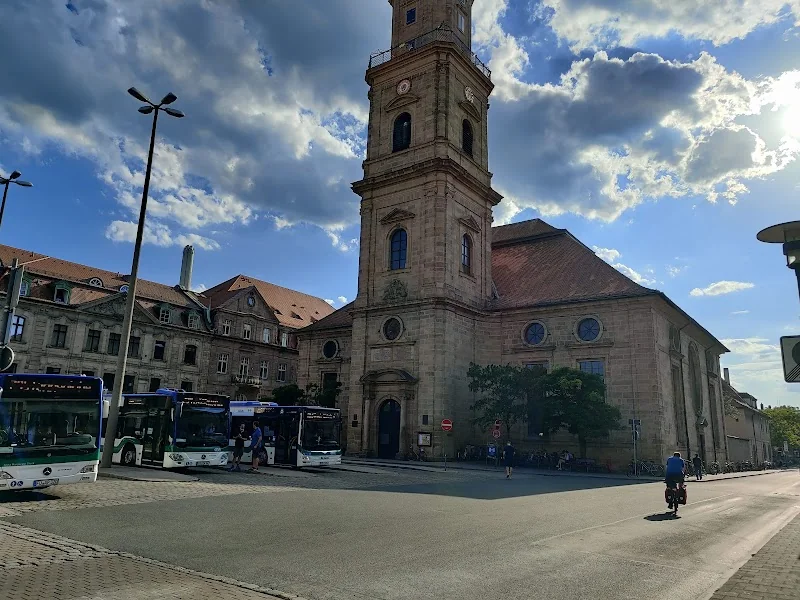
The Hugenottenplatz is one of the most important landmarks in Erlangen and is simply referred to as Hugo by many locals. Those searching for Hugenottenplatz Erlangen, the best route, parking, or a specific address like Hugenottenplatz 1, 4, or 6 usually refer to the vibrant center between baroque history, daily mobility, and urban life. Directly at the square, the Hugenottenkirche shapes the cityscape; at the same time, paths to the main train station, pedestrian zone, shops, service providers, and cultural destinations converge here. Thus, the Hugenottenplatz is not just a destination but an urban hub where arrival, transfer, shopping, city strolls, and historical interest come together. The official tourism and city communication describes Erlangen's baroque planned city as a result of the Huguenot settlement starting in 1686, and it is from this historical core that the special status of the square is explained to this day. ([visit-erlangen.de](https://www.visit-erlangen.de/hohenzollern/))
Directions to Hugenottenplatz by Bus and Train
Traveling by public transport is the most convenient option if you want to reach Hugenottenplatz quickly and without detours. The official stop schedule of Erlangen shows the hub Hugenottenplatz together with the main train station; numerous lines converge there, including 30, 284, 285, 286, 287, 289, 290, 293, 294, 295, and 299. For many visitors, this is crucial because the square is not isolated at the edge but functions as a directly connected city center point. Particularly useful is line 295, which connects Hugenottenplatz with the main train station and continues through Arcaden, Neuer Markt, and other stops into the eastern city area. Those arriving by train can reach the square very quickly and then switch to walking in the city center. Even more practical for short distances is the City Line 299: The city of Erlangen describes it as free to use within the free city center area, as a ring connection with regular services, and as a link to important inner-city points. Since January 1, 2024, free bus travel applies within this area, allowing you to board without a ticket. For queries like Hugenottenplatz route, this advantage is crucial, as the square is integrated into a tightly scheduled network that connects the train station, city center, clinics, parking areas, and shopping zones. The color-coded stop signs and the official stop plan also make orientation easier on-site. So, whether planning an appointment, a shopping trip, or a city stroll, Hugenottenplatz offers a particularly intuitive and easily readable starting point. ([stadtbus.estw.de](https://stadtbus.estw.de/de/Haltestellen-Linien/Haltestellenshyuebersichtsplaene/Haltestellenuebersichtsplaene/ER-Hbf-Hugo.pdf))
Parking around Hugenottenplatz
For drivers, it is especially important that the Erlangen city center has several clearly designated parking options and that the paths from there to the city are short. The city of Erlangen states that there are free capacities available during the day in the parking garages and underground garages around the center and that shops, restaurants, and cultural institutions are easily reachable on foot or by bus in the free city center area. The central collection point is the large parking lot on Parkplatzstraße, located between A73 and the train station. From there, the City Line 299 travels for free through the city center, which is a very comfortable combination of parking and onward travel, especially for guests of Hugenottenplatz. Additionally, the city mentions several fixed facilities in the northern and southern city center area: the Henkestraße parking garage with about 438 spaces, the Sedanstraße underground garage with about 280 spaces, the Eisert underground garage with around 115 spaces, the Neuer Markt parking garage with about 680 spaces, the Kaufland parking lot Fuchsenwiese with about 490 spaces, the Altstadt Ost parking lot with about 80 spaces, and the Theaterplatz parking lot with about 153 spaces. For fees, a clear regulation has been in place in the center since March 2024: In public city center parking spaces, the first half hour costs 1 Euro, each additional hour 2.60 Euros, and the large parking lot 1.50 Euros per hour. Additionally, payment via mobile phone with mobilet is possible citywide. Since April 1, 2025, there is also a special regulation with a parking disc for the first three hours for appropriately marked electric vehicles. Therefore, if you drive to Hugenottenplatz, you should not hope for a single spot directly at the square but think strategically about the city center: park, walk a short distance, or use the free City Line. This way, the visit remains manageable, even when there is a lot going on in the center. ([erlangen.de](https://erlangen.de/en/aktuelles/parken-in-erlangen))
Hugenottenplatz and the History of the Huguenot City
The Hugenottenplatz is historically much more than just a street space. It belongs to the baroque cityscape that emerged after 1686 for the reception of French religious refugees. The official Hohenzollern page of Visit Erlangen describes how Margrave Christian Ernst promoted the settlement of the Huguenots after the years of hunger and the political upheavals of the time to strengthen Erlangen economically. This led to the planned city of Christian Erlang, whose symmetrical structure still forms the basis of the Erlangen city center today. The first building of this new city was the current Hugenottenkirche, built between 1686 and 1693 according to plans by Johann Moritz Richter. It is considered the first church of the Huguenots outside France and shaped the neighborhood so strongly that the square is affectionately called Hugo in the city. It is precisely this combination of religious history, urban order, and urban memory that makes the place special. The church was a gift from the Margrave, the tower was added only between 1732 and 1736, and the building still stands today as a symbol of the origin of the new town. The city's retail planning also emphasizes the special role of the square: Hugenottenplatz takes on a distribution and hinge function in the main business location, meaning it serves as a transitional space between the most important axes of the city center. For visitors, this means that standing at Hugenottenplatz also places them at a historical reading point of the city. The square connects the memory of the Huguenots, the baroque city model, and today's everyday use, where history does not isolate itself in a museum-like manner but continues to resonate in urban life. This is precisely why Hugenottenplatz is also interesting for people who are only looking for an address or a route, as here, the guidance always also reflects city history. ([visit-erlangen.de](https://www.visit-erlangen.de/hohenzollern/))
Shopping, Services, and Daily Life at the Square
The Hugenottenplatz is not only a historical place but also a practical everyday space. The city of Erlangen describes the city center as an area where shops, restaurants, and cultural institutions are easily accessible, and this principle is particularly evident at Hugenottenplatz. A specific example is Thalia Erlangen at Hugenottenplatz 6: The official company page mentions a large bookstore over three floors that is anchored at the square, thus forming a well-visible point of orientation. For many queries regarding Hugenottenplatz 6, Hugenottenplatz 4, or Hugenottenplatz 1, it is precisely about such inner-city uses, i.e., paths to shops, offices, practices, and service addresses. The square is therefore useful for people with different goals: those with an appointment orient themselves by the address; those who want to shop use the square as a starting point; those who just want to quickly take care of something benefit from the dense city structure. The fact that Hugenottenplatz appears so frequently as a search term is no coincidence, as many everyday functions of the city center converge at this point. At the same time, the good public transport connection ensures that one does not have to rely on a car. Especially for search terms like Hugenottenplatz doctor, Hugenottenplatz pharmacy, or Hugenottenplatz dentist, the strength of the place as a central navigation anchor becomes evident: it usually does not refer to a single building but to the entire environment of a busy city center square, where one can get further with just a few steps. For visitors who do not know the city, this is an advantage because the square offers clear orientation and the surrounding destinations can be quickly understood. Thus, a single square becomes a functioning urban hinge between shopping, supply, and inner-city mobility. ([erlangen.de](https://erlangen.de/en/aktuelles/parken-in-erlangen))
Events, City Tours, and Seasonal Use
The Hugenottenplatz also plays an important role in events and city tours. For the Bergkirchweih 2025, the city of Erlangen explicitly points out that the BERG-SHUTTLE is ready at the south side of the Hugenottenplatz stop and takes visitors conveniently to the festival grounds. This clearly shows that the square is not only a place of history but an active mobility hub for large city festivals. The tourism page also regularly uses Hugenottenplatz as a meeting point for tours: The tour Christian Erlang - The Huguenot City Erlangen starts at the entrance of the Hugenottenkirche at Hugenottenplatz and introduces the history of the baroque new town. This makes the square the starting point for a very direct city mediation, where architecture, confession, and urban development come together. In the winter season, another function is added: The official Erlangen page for the Winter Magic mentions that the festive children's parade passes through Hugenottenplatz and is part of the Christmas city experience. For visitors, this means that the square takes on a new role throughout the year, sometimes as a transfer point, sometimes as a historical meeting place, and sometimes as part of a family program. This makes it particularly interesting for search queries that refer not only to an address but also to an activity. Those looking for a program, tour, route, or event will find themselves at a place that functions in different contexts while still marking the same urban center. Thus, Hugenottenplatz remains a place that is not just passed through but experienced. ([erlangen.de](https://erlangen.de/zh/aktuelles/busfahren-waehrend-der-bergkirchweih-2025?utm_source=openai))
Practical Tips for Your Visit to Hugenottenplatz
Those visiting Hugenottenplatz for the first time should think of it as part of the entire Erlangen city center. The fastest solution is usually to travel by bus or train, as the stops are directly coordinated with city center traffic, and the free city center area can be used without a ticket since January 1, 2024. Those coming by car should sensibly park in one of the official parking garages or in the large parking lot and then walk the last few minutes or use the City Line 299. For navigation and appointment planning, it is helpful to check the house numbers at the square carefully, as Hugenottenplatz often serves as a collective term for several adjacent buildings and service providers. Those who want to see the Hugenottenkirche should also pay attention to the current notices: According to Visit Erlangen, the church is currently not accessible for visits during its three-year renovation. This is especially important if the visit is specifically planned historically and is not just meant to be a short stop. For people using the square as a reference point for medical or commercial addresses, the same advice applies: check the exact target address as much as possible and understand Hugenottenplatz only as a starting marker. This way, misunderstandings can be avoided, as a central square bundles many functions and is not a single building. However, therein lies its strength. Hugenottenplatz is one of those places where practical paths, urban density, and history overlap. Those arriving here are quickly in the city center, have good connections in all directions, and are at one of the most important historical points in Erlangen. Therefore, the square is as useful for everyday routes as it is for a consciously planned city tour. ([erlangen.de](https://erlangen.de/en/aktuelles/parken-in-erlangen))
Sources:
Mehr anzeigenWeniger anzeigen
Hugenottenplatz | Directions & Parking in Erlangen
The Hugenottenplatz is one of the most important landmarks in Erlangen and is simply referred to as Hugo by many locals. Those searching for Hugenottenplatz Erlangen, the best route, parking, or a specific address like Hugenottenplatz 1, 4, or 6 usually refer to the vibrant center between baroque history, daily mobility, and urban life. Directly at the square, the Hugenottenkirche shapes the cityscape; at the same time, paths to the main train station, pedestrian zone, shops, service providers, and cultural destinations converge here. Thus, the Hugenottenplatz is not just a destination but an urban hub where arrival, transfer, shopping, city strolls, and historical interest come together. The official tourism and city communication describes Erlangen's baroque planned city as a result of the Huguenot settlement starting in 1686, and it is from this historical core that the special status of the square is explained to this day. ([visit-erlangen.de](https://www.visit-erlangen.de/hohenzollern/))
Directions to Hugenottenplatz by Bus and Train
Traveling by public transport is the most convenient option if you want to reach Hugenottenplatz quickly and without detours. The official stop schedule of Erlangen shows the hub Hugenottenplatz together with the main train station; numerous lines converge there, including 30, 284, 285, 286, 287, 289, 290, 293, 294, 295, and 299. For many visitors, this is crucial because the square is not isolated at the edge but functions as a directly connected city center point. Particularly useful is line 295, which connects Hugenottenplatz with the main train station and continues through Arcaden, Neuer Markt, and other stops into the eastern city area. Those arriving by train can reach the square very quickly and then switch to walking in the city center. Even more practical for short distances is the City Line 299: The city of Erlangen describes it as free to use within the free city center area, as a ring connection with regular services, and as a link to important inner-city points. Since January 1, 2024, free bus travel applies within this area, allowing you to board without a ticket. For queries like Hugenottenplatz route, this advantage is crucial, as the square is integrated into a tightly scheduled network that connects the train station, city center, clinics, parking areas, and shopping zones. The color-coded stop signs and the official stop plan also make orientation easier on-site. So, whether planning an appointment, a shopping trip, or a city stroll, Hugenottenplatz offers a particularly intuitive and easily readable starting point. ([stadtbus.estw.de](https://stadtbus.estw.de/de/Haltestellen-Linien/Haltestellenshyuebersichtsplaene/Haltestellenuebersichtsplaene/ER-Hbf-Hugo.pdf))
Parking around Hugenottenplatz
For drivers, it is especially important that the Erlangen city center has several clearly designated parking options and that the paths from there to the city are short. The city of Erlangen states that there are free capacities available during the day in the parking garages and underground garages around the center and that shops, restaurants, and cultural institutions are easily reachable on foot or by bus in the free city center area. The central collection point is the large parking lot on Parkplatzstraße, located between A73 and the train station. From there, the City Line 299 travels for free through the city center, which is a very comfortable combination of parking and onward travel, especially for guests of Hugenottenplatz. Additionally, the city mentions several fixed facilities in the northern and southern city center area: the Henkestraße parking garage with about 438 spaces, the Sedanstraße underground garage with about 280 spaces, the Eisert underground garage with around 115 spaces, the Neuer Markt parking garage with about 680 spaces, the Kaufland parking lot Fuchsenwiese with about 490 spaces, the Altstadt Ost parking lot with about 80 spaces, and the Theaterplatz parking lot with about 153 spaces. For fees, a clear regulation has been in place in the center since March 2024: In public city center parking spaces, the first half hour costs 1 Euro, each additional hour 2.60 Euros, and the large parking lot 1.50 Euros per hour. Additionally, payment via mobile phone with mobilet is possible citywide. Since April 1, 2025, there is also a special regulation with a parking disc for the first three hours for appropriately marked electric vehicles. Therefore, if you drive to Hugenottenplatz, you should not hope for a single spot directly at the square but think strategically about the city center: park, walk a short distance, or use the free City Line. This way, the visit remains manageable, even when there is a lot going on in the center. ([erlangen.de](https://erlangen.de/en/aktuelles/parken-in-erlangen))
Hugenottenplatz and the History of the Huguenot City
The Hugenottenplatz is historically much more than just a street space. It belongs to the baroque cityscape that emerged after 1686 for the reception of French religious refugees. The official Hohenzollern page of Visit Erlangen describes how Margrave Christian Ernst promoted the settlement of the Huguenots after the years of hunger and the political upheavals of the time to strengthen Erlangen economically. This led to the planned city of Christian Erlang, whose symmetrical structure still forms the basis of the Erlangen city center today. The first building of this new city was the current Hugenottenkirche, built between 1686 and 1693 according to plans by Johann Moritz Richter. It is considered the first church of the Huguenots outside France and shaped the neighborhood so strongly that the square is affectionately called Hugo in the city. It is precisely this combination of religious history, urban order, and urban memory that makes the place special. The church was a gift from the Margrave, the tower was added only between 1732 and 1736, and the building still stands today as a symbol of the origin of the new town. The city's retail planning also emphasizes the special role of the square: Hugenottenplatz takes on a distribution and hinge function in the main business location, meaning it serves as a transitional space between the most important axes of the city center. For visitors, this means that standing at Hugenottenplatz also places them at a historical reading point of the city. The square connects the memory of the Huguenots, the baroque city model, and today's everyday use, where history does not isolate itself in a museum-like manner but continues to resonate in urban life. This is precisely why Hugenottenplatz is also interesting for people who are only looking for an address or a route, as here, the guidance always also reflects city history. ([visit-erlangen.de](https://www.visit-erlangen.de/hohenzollern/))
Shopping, Services, and Daily Life at the Square
The Hugenottenplatz is not only a historical place but also a practical everyday space. The city of Erlangen describes the city center as an area where shops, restaurants, and cultural institutions are easily accessible, and this principle is particularly evident at Hugenottenplatz. A specific example is Thalia Erlangen at Hugenottenplatz 6: The official company page mentions a large bookstore over three floors that is anchored at the square, thus forming a well-visible point of orientation. For many queries regarding Hugenottenplatz 6, Hugenottenplatz 4, or Hugenottenplatz 1, it is precisely about such inner-city uses, i.e., paths to shops, offices, practices, and service addresses. The square is therefore useful for people with different goals: those with an appointment orient themselves by the address; those who want to shop use the square as a starting point; those who just want to quickly take care of something benefit from the dense city structure. The fact that Hugenottenplatz appears so frequently as a search term is no coincidence, as many everyday functions of the city center converge at this point. At the same time, the good public transport connection ensures that one does not have to rely on a car. Especially for search terms like Hugenottenplatz doctor, Hugenottenplatz pharmacy, or Hugenottenplatz dentist, the strength of the place as a central navigation anchor becomes evident: it usually does not refer to a single building but to the entire environment of a busy city center square, where one can get further with just a few steps. For visitors who do not know the city, this is an advantage because the square offers clear orientation and the surrounding destinations can be quickly understood. Thus, a single square becomes a functioning urban hinge between shopping, supply, and inner-city mobility. ([erlangen.de](https://erlangen.de/en/aktuelles/parken-in-erlangen))
Events, City Tours, and Seasonal Use
The Hugenottenplatz also plays an important role in events and city tours. For the Bergkirchweih 2025, the city of Erlangen explicitly points out that the BERG-SHUTTLE is ready at the south side of the Hugenottenplatz stop and takes visitors conveniently to the festival grounds. This clearly shows that the square is not only a place of history but an active mobility hub for large city festivals. The tourism page also regularly uses Hugenottenplatz as a meeting point for tours: The tour Christian Erlang - The Huguenot City Erlangen starts at the entrance of the Hugenottenkirche at Hugenottenplatz and introduces the history of the baroque new town. This makes the square the starting point for a very direct city mediation, where architecture, confession, and urban development come together. In the winter season, another function is added: The official Erlangen page for the Winter Magic mentions that the festive children's parade passes through Hugenottenplatz and is part of the Christmas city experience. For visitors, this means that the square takes on a new role throughout the year, sometimes as a transfer point, sometimes as a historical meeting place, and sometimes as part of a family program. This makes it particularly interesting for search queries that refer not only to an address but also to an activity. Those looking for a program, tour, route, or event will find themselves at a place that functions in different contexts while still marking the same urban center. Thus, Hugenottenplatz remains a place that is not just passed through but experienced. ([erlangen.de](https://erlangen.de/zh/aktuelles/busfahren-waehrend-der-bergkirchweih-2025?utm_source=openai))
Practical Tips for Your Visit to Hugenottenplatz
Those visiting Hugenottenplatz for the first time should think of it as part of the entire Erlangen city center. The fastest solution is usually to travel by bus or train, as the stops are directly coordinated with city center traffic, and the free city center area can be used without a ticket since January 1, 2024. Those coming by car should sensibly park in one of the official parking garages or in the large parking lot and then walk the last few minutes or use the City Line 299. For navigation and appointment planning, it is helpful to check the house numbers at the square carefully, as Hugenottenplatz often serves as a collective term for several adjacent buildings and service providers. Those who want to see the Hugenottenkirche should also pay attention to the current notices: According to Visit Erlangen, the church is currently not accessible for visits during its three-year renovation. This is especially important if the visit is specifically planned historically and is not just meant to be a short stop. For people using the square as a reference point for medical or commercial addresses, the same advice applies: check the exact target address as much as possible and understand Hugenottenplatz only as a starting marker. This way, misunderstandings can be avoided, as a central square bundles many functions and is not a single building. However, therein lies its strength. Hugenottenplatz is one of those places where practical paths, urban density, and history overlap. Those arriving here are quickly in the city center, have good connections in all directions, and are at one of the most important historical points in Erlangen. Therefore, the square is as useful for everyday routes as it is for a consciously planned city tour. ([erlangen.de](https://erlangen.de/en/aktuelles/parken-in-erlangen))
Sources:
Hugenottenplatz | Directions & Parking in Erlangen
The Hugenottenplatz is one of the most important landmarks in Erlangen and is simply referred to as Hugo by many locals. Those searching for Hugenottenplatz Erlangen, the best route, parking, or a specific address like Hugenottenplatz 1, 4, or 6 usually refer to the vibrant center between baroque history, daily mobility, and urban life. Directly at the square, the Hugenottenkirche shapes the cityscape; at the same time, paths to the main train station, pedestrian zone, shops, service providers, and cultural destinations converge here. Thus, the Hugenottenplatz is not just a destination but an urban hub where arrival, transfer, shopping, city strolls, and historical interest come together. The official tourism and city communication describes Erlangen's baroque planned city as a result of the Huguenot settlement starting in 1686, and it is from this historical core that the special status of the square is explained to this day. ([visit-erlangen.de](https://www.visit-erlangen.de/hohenzollern/))
Directions to Hugenottenplatz by Bus and Train
Traveling by public transport is the most convenient option if you want to reach Hugenottenplatz quickly and without detours. The official stop schedule of Erlangen shows the hub Hugenottenplatz together with the main train station; numerous lines converge there, including 30, 284, 285, 286, 287, 289, 290, 293, 294, 295, and 299. For many visitors, this is crucial because the square is not isolated at the edge but functions as a directly connected city center point. Particularly useful is line 295, which connects Hugenottenplatz with the main train station and continues through Arcaden, Neuer Markt, and other stops into the eastern city area. Those arriving by train can reach the square very quickly and then switch to walking in the city center. Even more practical for short distances is the City Line 299: The city of Erlangen describes it as free to use within the free city center area, as a ring connection with regular services, and as a link to important inner-city points. Since January 1, 2024, free bus travel applies within this area, allowing you to board without a ticket. For queries like Hugenottenplatz route, this advantage is crucial, as the square is integrated into a tightly scheduled network that connects the train station, city center, clinics, parking areas, and shopping zones. The color-coded stop signs and the official stop plan also make orientation easier on-site. So, whether planning an appointment, a shopping trip, or a city stroll, Hugenottenplatz offers a particularly intuitive and easily readable starting point. ([stadtbus.estw.de](https://stadtbus.estw.de/de/Haltestellen-Linien/Haltestellenshyuebersichtsplaene/Haltestellenuebersichtsplaene/ER-Hbf-Hugo.pdf))
Parking around Hugenottenplatz
For drivers, it is especially important that the Erlangen city center has several clearly designated parking options and that the paths from there to the city are short. The city of Erlangen states that there are free capacities available during the day in the parking garages and underground garages around the center and that shops, restaurants, and cultural institutions are easily reachable on foot or by bus in the free city center area. The central collection point is the large parking lot on Parkplatzstraße, located between A73 and the train station. From there, the City Line 299 travels for free through the city center, which is a very comfortable combination of parking and onward travel, especially for guests of Hugenottenplatz. Additionally, the city mentions several fixed facilities in the northern and southern city center area: the Henkestraße parking garage with about 438 spaces, the Sedanstraße underground garage with about 280 spaces, the Eisert underground garage with around 115 spaces, the Neuer Markt parking garage with about 680 spaces, the Kaufland parking lot Fuchsenwiese with about 490 spaces, the Altstadt Ost parking lot with about 80 spaces, and the Theaterplatz parking lot with about 153 spaces. For fees, a clear regulation has been in place in the center since March 2024: In public city center parking spaces, the first half hour costs 1 Euro, each additional hour 2.60 Euros, and the large parking lot 1.50 Euros per hour. Additionally, payment via mobile phone with mobilet is possible citywide. Since April 1, 2025, there is also a special regulation with a parking disc for the first three hours for appropriately marked electric vehicles. Therefore, if you drive to Hugenottenplatz, you should not hope for a single spot directly at the square but think strategically about the city center: park, walk a short distance, or use the free City Line. This way, the visit remains manageable, even when there is a lot going on in the center. ([erlangen.de](https://erlangen.de/en/aktuelles/parken-in-erlangen))
Hugenottenplatz and the History of the Huguenot City
The Hugenottenplatz is historically much more than just a street space. It belongs to the baroque cityscape that emerged after 1686 for the reception of French religious refugees. The official Hohenzollern page of Visit Erlangen describes how Margrave Christian Ernst promoted the settlement of the Huguenots after the years of hunger and the political upheavals of the time to strengthen Erlangen economically. This led to the planned city of Christian Erlang, whose symmetrical structure still forms the basis of the Erlangen city center today. The first building of this new city was the current Hugenottenkirche, built between 1686 and 1693 according to plans by Johann Moritz Richter. It is considered the first church of the Huguenots outside France and shaped the neighborhood so strongly that the square is affectionately called Hugo in the city. It is precisely this combination of religious history, urban order, and urban memory that makes the place special. The church was a gift from the Margrave, the tower was added only between 1732 and 1736, and the building still stands today as a symbol of the origin of the new town. The city's retail planning also emphasizes the special role of the square: Hugenottenplatz takes on a distribution and hinge function in the main business location, meaning it serves as a transitional space between the most important axes of the city center. For visitors, this means that standing at Hugenottenplatz also places them at a historical reading point of the city. The square connects the memory of the Huguenots, the baroque city model, and today's everyday use, where history does not isolate itself in a museum-like manner but continues to resonate in urban life. This is precisely why Hugenottenplatz is also interesting for people who are only looking for an address or a route, as here, the guidance always also reflects city history. ([visit-erlangen.de](https://www.visit-erlangen.de/hohenzollern/))
Shopping, Services, and Daily Life at the Square
The Hugenottenplatz is not only a historical place but also a practical everyday space. The city of Erlangen describes the city center as an area where shops, restaurants, and cultural institutions are easily accessible, and this principle is particularly evident at Hugenottenplatz. A specific example is Thalia Erlangen at Hugenottenplatz 6: The official company page mentions a large bookstore over three floors that is anchored at the square, thus forming a well-visible point of orientation. For many queries regarding Hugenottenplatz 6, Hugenottenplatz 4, or Hugenottenplatz 1, it is precisely about such inner-city uses, i.e., paths to shops, offices, practices, and service addresses. The square is therefore useful for people with different goals: those with an appointment orient themselves by the address; those who want to shop use the square as a starting point; those who just want to quickly take care of something benefit from the dense city structure. The fact that Hugenottenplatz appears so frequently as a search term is no coincidence, as many everyday functions of the city center converge at this point. At the same time, the good public transport connection ensures that one does not have to rely on a car. Especially for search terms like Hugenottenplatz doctor, Hugenottenplatz pharmacy, or Hugenottenplatz dentist, the strength of the place as a central navigation anchor becomes evident: it usually does not refer to a single building but to the entire environment of a busy city center square, where one can get further with just a few steps. For visitors who do not know the city, this is an advantage because the square offers clear orientation and the surrounding destinations can be quickly understood. Thus, a single square becomes a functioning urban hinge between shopping, supply, and inner-city mobility. ([erlangen.de](https://erlangen.de/en/aktuelles/parken-in-erlangen))
Events, City Tours, and Seasonal Use
The Hugenottenplatz also plays an important role in events and city tours. For the Bergkirchweih 2025, the city of Erlangen explicitly points out that the BERG-SHUTTLE is ready at the south side of the Hugenottenplatz stop and takes visitors conveniently to the festival grounds. This clearly shows that the square is not only a place of history but an active mobility hub for large city festivals. The tourism page also regularly uses Hugenottenplatz as a meeting point for tours: The tour Christian Erlang - The Huguenot City Erlangen starts at the entrance of the Hugenottenkirche at Hugenottenplatz and introduces the history of the baroque new town. This makes the square the starting point for a very direct city mediation, where architecture, confession, and urban development come together. In the winter season, another function is added: The official Erlangen page for the Winter Magic mentions that the festive children's parade passes through Hugenottenplatz and is part of the Christmas city experience. For visitors, this means that the square takes on a new role throughout the year, sometimes as a transfer point, sometimes as a historical meeting place, and sometimes as part of a family program. This makes it particularly interesting for search queries that refer not only to an address but also to an activity. Those looking for a program, tour, route, or event will find themselves at a place that functions in different contexts while still marking the same urban center. Thus, Hugenottenplatz remains a place that is not just passed through but experienced. ([erlangen.de](https://erlangen.de/zh/aktuelles/busfahren-waehrend-der-bergkirchweih-2025?utm_source=openai))
Practical Tips for Your Visit to Hugenottenplatz
Those visiting Hugenottenplatz for the first time should think of it as part of the entire Erlangen city center. The fastest solution is usually to travel by bus or train, as the stops are directly coordinated with city center traffic, and the free city center area can be used without a ticket since January 1, 2024. Those coming by car should sensibly park in one of the official parking garages or in the large parking lot and then walk the last few minutes or use the City Line 299. For navigation and appointment planning, it is helpful to check the house numbers at the square carefully, as Hugenottenplatz often serves as a collective term for several adjacent buildings and service providers. Those who want to see the Hugenottenkirche should also pay attention to the current notices: According to Visit Erlangen, the church is currently not accessible for visits during its three-year renovation. This is especially important if the visit is specifically planned historically and is not just meant to be a short stop. For people using the square as a reference point for medical or commercial addresses, the same advice applies: check the exact target address as much as possible and understand Hugenottenplatz only as a starting marker. This way, misunderstandings can be avoided, as a central square bundles many functions and is not a single building. However, therein lies its strength. Hugenottenplatz is one of those places where practical paths, urban density, and history overlap. Those arriving here are quickly in the city center, have good connections in all directions, and are at one of the most important historical points in Erlangen. Therefore, the square is as useful for everyday routes as it is for a consciously planned city tour. ([erlangen.de](https://erlangen.de/en/aktuelles/parken-in-erlangen))
Sources:

Frequently Asked Questions
Reviews
No reviews found