
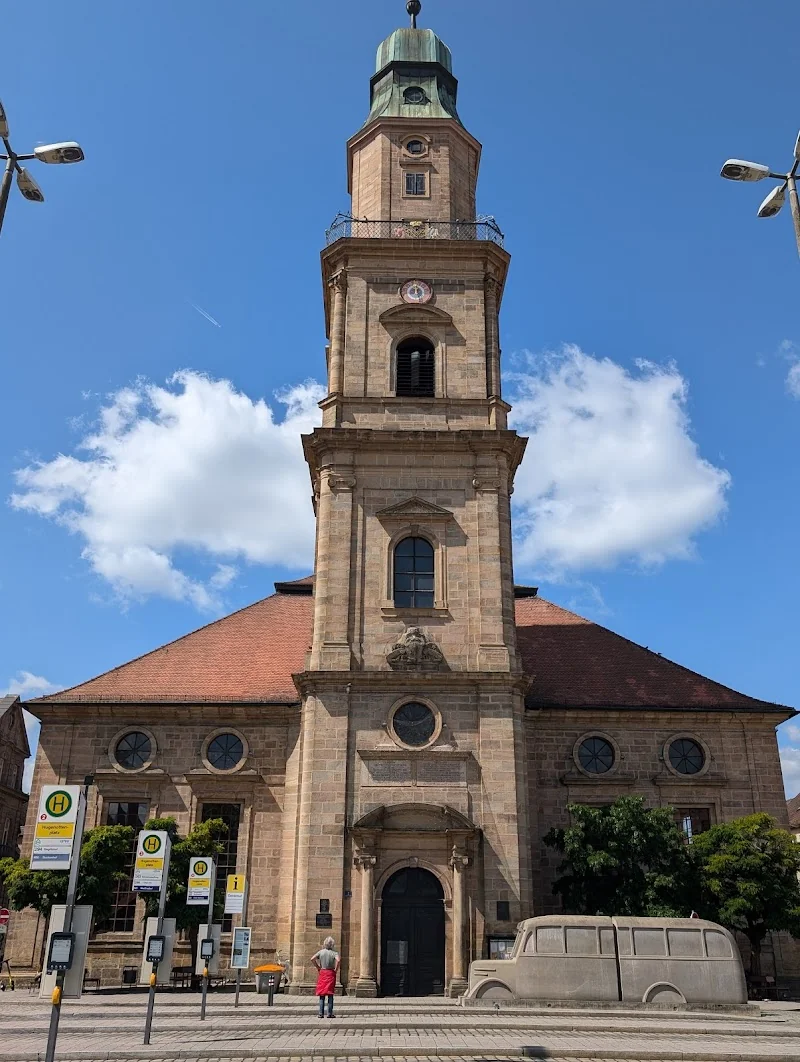
Hugenottenpl. 2, Erlangen
Hugenottenpl. 2, 91054 Erlangen, Germany
Huguenot Church Erlangen | History & Directions
The Huguenot Church Erlangen represents a remarkable connection of faith history, urban development, and Baroque architecture. Those searching for this location are not just looking for a church, but a key place of Erlangen's identity: Here, with the laying of the foundation stone on July 14, 1686, the development of the new town began, here one can understand why Erlangen is still considered a Huguenot city, and here reformed simplicity meets a surprisingly strong historical presence. The current perception of the church is shaped by its role as the first Huguenot place of worship outside France, its location at Hugenottenplatz, and the fact that it continues to make visible the history of a religious minority that found a new home in Franconia. For visitors, the place is therefore both a monument, a point of orientation, and an entry into the Baroque cityscape. The search intents behind the present keywords revolve mainly around history, faith, location, and practical visitor questions. These themes make the Huguenot Church Erlangen so exciting: It is not only a beautiful building but a place where historical turning points, religious beliefs, and urban planning can be read very concretely. ([visit-erlangen.de](https://www.visit-erlangen.de/poi/hugenottenkirche-27250/))
Why the Huguenot Church Erlangen is a Key Place in the City’s History
The history of the Huguenot Church is inseparably linked to the history of present-day Erlangen. In the 17th century, French religious refugees, the Huguenots, sought new safe havens in Protestant areas after the revocation of the Edict of Nantes in France. Margrave Christian Ernst of Brandenburg-Bayreuth took advantage of this historical situation and invited the refugees to settle in his territory. According to the tourism and community website, the church was a gift from the margrave; with its construction, he wanted to provide people not only with religious freedom but also a new urban perspective. The laying of the foundation stone on July 14, 1686, therefore marked not only the beginning of the construction of a house of worship but also the founding act of the Erlangen new town. This makes the Huguenot Church a rare example of how closely church construction, migration history, and urban planning can intertwine. The church was built between 1686 and 1693 according to plans by Johann Moritz Richter, with the tower being added only between 1732 and 1736. This time span already shows how the place developed over decades and was repeatedly adapted to changing needs. For the city of Erlangen, the church remains a point of identification to this day, as it makes the Baroque planning of the new town visible and succinctly highlights the special role of the Huguenots in the city’s history. Anyone who wants to understand the history of the city cannot overlook this church. ([visit-erlangen.de](https://www.visit-erlangen.de/poi/hugenottenkirche-27250/))
It is particularly impressive that the Huguenot Church cannot be viewed in isolation but is embedded in a larger historical process. The Erlangen new town was conceived as a Baroque planned city, and the construction of the church was the first visible step of this project. The city did not develop organically in small stages but arose from a conscious political and religious decision. This is exactly what makes it appealing to visitors searching for Huguenot church, Huguenottenkirche, or Huguenot churches in a historical context: The term stands in Erlangen for a very real chapter of European migration and religious history. The city museum contents emphasize that the new town was founded in 1686 to accommodate French religious refugees and that the memory of this event has remained alive in the cityscape to this day. The tourism site also describes the Huguenot Church as a visible starting point of the new city. Therefore, anyone walking through Erlangen sees at Hugenottenplatz not just a single sight but the center of a city model that was designed for symmetry, order, and integration. For this reason, the Huguenot Church is much more than a house of worship: It is an architectural document for the reception of refugees, for religious freedom, and for the claim to create something forward-looking from a difficult historical situation. ([hugenottenkirche.de](https://www.hugenottenkirche.de/geschichte))
What Shapes the Reformed Church Space and the Huguenot Confession
To understand the Huguenot Church Erlangen, one should not only look at the external appearance of the building but also at its inner character. The congregation describes the space as deliberately simple and reformed: Neither cross nor candle is at the center, religious art is omitted, and nothing should distract from the sermon and the word of God. This attitude is not a decorative detail but an expression of a faith tradition that emphasizes listening, thinking, and community more than symbolic overload. The church sees itself as a space that allows for concentration while remaining inviting. This is reflected in the seating arrangement, which, according to the congregation, was intended from the beginning to reflect the idea of a lively community. The Lord's Supper is also understood in an open, community-oriented manner; the congregation explicitly emphasizes ecumenical brotherhood. For people searching for Huguenot church beliefs or the religious nature of reformed churches, Erlangen is therefore a particularly vivid example. The space tells of a tradition in which the spoken word and the gathered congregation are at the center, not a magnificent liturgical staging. This restraint creates a strong effect because it clearly structures the historical space while also making it appear very focused. The church thus serves as a counter-design to many Baroque sacred spaces without sacrificing their architectural quality. This makes it so interesting for visitors: Here they experience not only history but also a visible philosophy of faith. ([hugenottenkirche.de](https://www.hugenottenkirche.de/))
That the church functions as a reformed space is also evident in the details. The congregation points to the impressive acoustics of the space and the renovated Ritter organ, which supports the liturgical framework with its sound. At the same time, it is explained that the church is not understood as sacred in the sense of an ornament-rich sacred space but as a place that should facilitate access to faith. This balance of simplicity and effect makes the Huguenot Church a special destination for those interested in Huguenot churches, Huguenot church beliefs, or the history of reformed congregations. The furnishings are not determined by opulent images but by a clear spatial concept. This, in turn, connects to the historical conditions of the Huguenots, who found not only protection in Erlangen but also the opportunity to shape their form of faith and lifestyle themselves. Therefore, when visiting the place, one sees a church that is neither a museum nor a pure monument but is still understood as a living community space. This is precisely where its special strength lies: It is historically deeply rooted and at the same time liturgically clearly profiled. For many visitors, this connection of modesty, identity, and spiritual concentration is the reason why the place has such a lasting impact. ([hugenottenkirche.de](https://www.hugenottenkirche.de/))
Huguenot Church Erlangen Today: Renovation, Visits, and Community Life
Currently, the Huguenot Church Erlangen is not simply an open sight that can be entered at any time. The tourist information points out that the church is not accessible for visits during a three-year renovation. The congregation itself describes the renovation very openly as a major challenge and speaks of significant roof damage. At the same time, it becomes clear how seriously the preservation of the building is taken: An inventory of the damages has been completed, funding applications have been submitted, and financing is supported by donations, grants, and assistance from the synodal association. For visitors, this means: The church is a historically significant place that is actively protected and secured. This situation is important because it shows that the building represents not only past history but is a living monument that must be maintained in the present and future. Therefore, anyone looking for current visiting information will find the most reliable information directly from the Evangelical-Reformed Congregation Erlangen. The congregation also emphasizes on its website that there are various offers surrounding faith, community life, and pastoral care. The church is thus not only a building with a renovated roof but continues to be a spiritual center. For people searching for a location for historical research, church architecture, or local city history, this current renovation is also a sign of appreciation for the existing structure. One can see how closely monument protection, community work, and city identity are interconnected. ([visit-erlangen.de](https://www.visit-erlangen.de/poi/hugenottenkirche-27250/))
Practically important is also that the congregation lists contact options on its website. There, office hours, a phone number, and an email address are provided so that interested parties can directly inquire about the building, services, or the renovation. This is relevant for anyone searching for Huguenot church near me or expecting information on-site spontaneously. Instead of a classic opening hours situation, there is currently more of an information and support structure that is aligned with the renovation phase. At the same time, the congregation makes it clear that the church remains at the center of its work despite the construction work. This is evident in the care of community life, the communication surrounding the renovation, and the desire to actively involve supporters. From an SEO perspective, this is also important: A location page should not only provide historical facts but also accurately reflect the current status. In the case of the Huguenot Church, the situation is clear: historically significant, structurally in progress, currently not open as a regular sightseeing location. This honest information builds trust. Visitors then know whether they should plan for an exterior visit, a city tour, or a later return visit. The combination of monument protection and community life makes the place particularly credible and lively. ([visit-erlangen.de](https://www.visit-erlangen.de/poi/hugenottenkirche-27250/))
Directions, Parking, and Public Transport at Hugenottenplatz
The Huguenot Church is located at Hugenottenplatz in 91054 Erlangen, thus in a very central location within the city center. For visitors, this is a great advantage because the place can be easily integrated into a city tour, and several mobility options are available. The city of Erlangen points out that there are free capacities in the parking garages and underground garages around the city center during the day. Additionally, since January 1, 2024, the use of all bus lines within the free city center area is free. Therefore, anyone coming from outside can conveniently utilize the central location without being directly reliant on a complicated search for parking. Especially in a Baroque city center with many sights, this is a real plus. For the Huguenot Church, this means: The journey can be planned on foot, by bus, or by car, with the city center regulation significantly facilitating the visit. The city describes the inner area as a free bus zone; there, the stops are recognizable by the yellow and orange markings. Thus, Hugenottenplatz is part of a well-connected inner-city network. Anyone arriving by car should generally pay attention to the city’s guidelines on parking management and fees. For visitors, it is important that Erlangen offers a compact city center with short distances overall. This particularly benefits places like the Huguenot Church, which are located in the historical center and can be excellently connected with other destinations. ([visit-erlangen.de](https://www.visit-erlangen.de/poi/hugenottenkirche-27250/))
Even without a precise parking garage address directly at the church, practical orientation can be well planned. The official tourism site clearly anchors the Huguenot Church at Hugenottenplatz, and the audio guide lists this place as the first station of the Huguenot city routes. This shows that the square is not only a geographical point but an established starting point for city explorations. For visitors searching for Huguenot church near me, Huguenot church London, or other local references, this is interesting in that Erlangen itself is very clearly staged as a Huguenot city. Anyone arriving can thus understand the church as part of a larger path: Hugenottenplatz, Schlossgarten, Hugenottenbrunnen, Marktplatz, and other Baroque points are arranged in a meaningful inner-city sequence. The city also states that bus travel within the city center is possible without a ticket as long as one stays in the free area. This makes spontaneous visits particularly easy. At the same time, the location remains historically coherent: The church stands at the entrance to the Baroque new town and is therefore both a tourist and urban planning anchor point. Practically, this means: First arrive, then explore the surroundings on foot at leisure. This is exactly what makes Hugenottenplatz ideal. ([visit-erlangen.de](https://www.visit-erlangen.de/poi/hugenottenkirche-27250/))
Pulpit, Baroque Organ, and Architectural Features at a Glance
Among the most important reasons why the Huguenot Church Erlangen continues to receive so much attention are its special furnishings. The tourist information highlights the valuable pulpit from 1700 and the Baroque organ by Johann Nikolaus Ritter, which was created between 1755 and 1764. Together with the later erected tower from 1732 to 1736, these elements decisively shape the character of the building. The church is therefore important not only as a historical site but also as a space with a well-readable history of furnishings. Those interested in Baroque church architecture will find here a beautiful example of how construction time, liturgical use, and later additions come together into a coherent whole. It is particularly striking that the reformed design does not rely on splendor but on clarity. This makes the pulpit stand out even more, as it marks the center of the word service. The tower, which was added later, gives the building a silhouette that is familiar today and underscores its presence in the cityscape. The congregation also describes that the church, with its acoustics and the renovated Ritter organ, offers a special atmosphere. Thus, the Huguenot Church is perceived not only as a monument but also as a thoughtfully designed place in terms of sound and space. For search queries regarding seating plans, furnishings, or features of a location, this is not a multipurpose hall but a church with a strong spatial identity. This makes it interesting for a broad audience: Historians, architecture enthusiasts, city explorers, and those interested in religion each find a different access here without the place losing its clarity. ([visit-erlangen.de](https://www.visit-erlangen.de/poi/hugenottenkirche-27250/))
The architectural significance of the building is also evident in that it has had a special role in the cityscape from the very beginning. The tourism site describes that the margrave couple attended the service in their own box. This refers to the close connection between power, religion, and representation. At the same time, the church space remained reformed and deliberately restrained, which makes the historical contrast particularly interesting: externally a prominent Baroque building, internally a concentration on the essentials. In the combination of tower, pulpit, organ, and simple spatial concept lies the actual strength of the Huguenot Church. It does not tell of abundance but of order, function, and spiritual orientation. Therefore, anyone who views the church as a Huguenot church or Hugenottenkirche discovers more than just a beautiful photo opportunity. It is a building that extends its history into the present and thus offers exactly that mix of authenticity and character that good location pages need. Especially in comparison to other Huguenot churches in Europe or America, it becomes clear how independently Erlangen has shaped this type. The church stands in an urban ensemble that still lives from the Baroque planning idea. And for this reason, it remains a place that one does not just visit but also understands. ([visit-erlangen.de](https://www.visit-erlangen.de/poi/hugenottenkirche-27250/))
Experience Huguenot City Erlangen: Audio Guide, Tour, and Nearby Attractions
The Huguenot Church is not only interesting as a standalone building but also as a starting point for an entire city discovery. The official audio guide of the city of Erlangen lists Hugenottenplatz with the Huguenot Church as the first station of both the quick and the more detailed tour. Anyone who wants to explore the city on their own thus receives a very clear path through the Huguenot city. The audio guide can be used via landline, smartphone, or as an mp3, making it an accessible companion for visitors who want to experience historical places in a meaningful sequence. The connection of the Huguenot Church, Hugenottenplatz, Schlossplatz, Marktplatz, and Schlossgarten makes it clear how strongly the Baroque center is concentrated in a small area. The tourism site also refers to events and city tours around the Huguenot Church. This shows that the place functions not only as a station for individual visits but also as part of a thematic network. For people searching for Huguenot churches in America or Huguenot church USA, Erlangen is particularly interesting in that a European origin story can be experienced directly here. The city museum contents emphasize that the memory of the Huguenots is still alive in the cityscape today. This includes the Huguenot Church at Hugenottenplatz as well as the Huguenot Fountain in the Schlossgarten. Thus, a route is created for visitors that does not explain history abstractly but makes it spatially tangible. ([visit-erlangen.de](https://www.visit-erlangen.de/audioguide/))
The surroundings of the church are also worth exploring. The Erlangen tourism and city pages show how strongly the Huguenot Church, Schlossgarten, and Baroque city center are interconnected. The Schlossgarten is one of the earliest Baroque garden designs in Franconia and offers with the Huguenot Fountain another reference to Huguenot history. Anyone who still has time after the church can continue through the center and thus experience the history of the new town as a whole. Particularly valuable is that the city makes the historical places easily accessible: on foot, with free inner-city buses, and via the audio guide. For visitors looking for a compact but content-rich sight, the Huguenot Church is therefore ideal. It does not offer a loud event staging but a quiet, concentrated, and historically rich access to Erlangen. This is precisely its strength compared to many other search results around Huguenot church London, Huguenot church Berlin, or Huguenot church Charleston: In Erlangen, the term is directly connected to a lively urban space where origin, faith, and urban planning converge. Therefore, when visiting the church, one discovers not just a building but an attitude towards history. And this attitude is still visible, tangible, and of lasting significance to the city. ([visit-erlangen.de](https://www.visit-erlangen.de/audioguide/))
Sources:
- Evangelical Reformed Congregation Erlangen - Official Website
- Evangelical Reformed Congregation Erlangen - Building History
- Evangelical Reformed Congregation Erlangen - Renovation of the Church
- Visit Erlangen - Huguenot Church
- Visit Erlangen - Audio Guide: The Huguenot City
- City Erlangen - Parking in Erlangen
- City Erlangen - Free public transport in the city center
- Visit Erlangen - Erlangen, home of the Hohenzollerns
- City Museum Erlangen - Erlangen, a Huguenot Town
Mehr anzeigenWeniger anzeigen
Huguenot Church Erlangen | History & Directions
The Huguenot Church Erlangen represents a remarkable connection of faith history, urban development, and Baroque architecture. Those searching for this location are not just looking for a church, but a key place of Erlangen's identity: Here, with the laying of the foundation stone on July 14, 1686, the development of the new town began, here one can understand why Erlangen is still considered a Huguenot city, and here reformed simplicity meets a surprisingly strong historical presence. The current perception of the church is shaped by its role as the first Huguenot place of worship outside France, its location at Hugenottenplatz, and the fact that it continues to make visible the history of a religious minority that found a new home in Franconia. For visitors, the place is therefore both a monument, a point of orientation, and an entry into the Baroque cityscape. The search intents behind the present keywords revolve mainly around history, faith, location, and practical visitor questions. These themes make the Huguenot Church Erlangen so exciting: It is not only a beautiful building but a place where historical turning points, religious beliefs, and urban planning can be read very concretely. ([visit-erlangen.de](https://www.visit-erlangen.de/poi/hugenottenkirche-27250/))
Why the Huguenot Church Erlangen is a Key Place in the City’s History
The history of the Huguenot Church is inseparably linked to the history of present-day Erlangen. In the 17th century, French religious refugees, the Huguenots, sought new safe havens in Protestant areas after the revocation of the Edict of Nantes in France. Margrave Christian Ernst of Brandenburg-Bayreuth took advantage of this historical situation and invited the refugees to settle in his territory. According to the tourism and community website, the church was a gift from the margrave; with its construction, he wanted to provide people not only with religious freedom but also a new urban perspective. The laying of the foundation stone on July 14, 1686, therefore marked not only the beginning of the construction of a house of worship but also the founding act of the Erlangen new town. This makes the Huguenot Church a rare example of how closely church construction, migration history, and urban planning can intertwine. The church was built between 1686 and 1693 according to plans by Johann Moritz Richter, with the tower being added only between 1732 and 1736. This time span already shows how the place developed over decades and was repeatedly adapted to changing needs. For the city of Erlangen, the church remains a point of identification to this day, as it makes the Baroque planning of the new town visible and succinctly highlights the special role of the Huguenots in the city’s history. Anyone who wants to understand the history of the city cannot overlook this church. ([visit-erlangen.de](https://www.visit-erlangen.de/poi/hugenottenkirche-27250/))
It is particularly impressive that the Huguenot Church cannot be viewed in isolation but is embedded in a larger historical process. The Erlangen new town was conceived as a Baroque planned city, and the construction of the church was the first visible step of this project. The city did not develop organically in small stages but arose from a conscious political and religious decision. This is exactly what makes it appealing to visitors searching for Huguenot church, Huguenottenkirche, or Huguenot churches in a historical context: The term stands in Erlangen for a very real chapter of European migration and religious history. The city museum contents emphasize that the new town was founded in 1686 to accommodate French religious refugees and that the memory of this event has remained alive in the cityscape to this day. The tourism site also describes the Huguenot Church as a visible starting point of the new city. Therefore, anyone walking through Erlangen sees at Hugenottenplatz not just a single sight but the center of a city model that was designed for symmetry, order, and integration. For this reason, the Huguenot Church is much more than a house of worship: It is an architectural document for the reception of refugees, for religious freedom, and for the claim to create something forward-looking from a difficult historical situation. ([hugenottenkirche.de](https://www.hugenottenkirche.de/geschichte))
What Shapes the Reformed Church Space and the Huguenot Confession
To understand the Huguenot Church Erlangen, one should not only look at the external appearance of the building but also at its inner character. The congregation describes the space as deliberately simple and reformed: Neither cross nor candle is at the center, religious art is omitted, and nothing should distract from the sermon and the word of God. This attitude is not a decorative detail but an expression of a faith tradition that emphasizes listening, thinking, and community more than symbolic overload. The church sees itself as a space that allows for concentration while remaining inviting. This is reflected in the seating arrangement, which, according to the congregation, was intended from the beginning to reflect the idea of a lively community. The Lord's Supper is also understood in an open, community-oriented manner; the congregation explicitly emphasizes ecumenical brotherhood. For people searching for Huguenot church beliefs or the religious nature of reformed churches, Erlangen is therefore a particularly vivid example. The space tells of a tradition in which the spoken word and the gathered congregation are at the center, not a magnificent liturgical staging. This restraint creates a strong effect because it clearly structures the historical space while also making it appear very focused. The church thus serves as a counter-design to many Baroque sacred spaces without sacrificing their architectural quality. This makes it so interesting for visitors: Here they experience not only history but also a visible philosophy of faith. ([hugenottenkirche.de](https://www.hugenottenkirche.de/))
That the church functions as a reformed space is also evident in the details. The congregation points to the impressive acoustics of the space and the renovated Ritter organ, which supports the liturgical framework with its sound. At the same time, it is explained that the church is not understood as sacred in the sense of an ornament-rich sacred space but as a place that should facilitate access to faith. This balance of simplicity and effect makes the Huguenot Church a special destination for those interested in Huguenot churches, Huguenot church beliefs, or the history of reformed congregations. The furnishings are not determined by opulent images but by a clear spatial concept. This, in turn, connects to the historical conditions of the Huguenots, who found not only protection in Erlangen but also the opportunity to shape their form of faith and lifestyle themselves. Therefore, when visiting the place, one sees a church that is neither a museum nor a pure monument but is still understood as a living community space. This is precisely where its special strength lies: It is historically deeply rooted and at the same time liturgically clearly profiled. For many visitors, this connection of modesty, identity, and spiritual concentration is the reason why the place has such a lasting impact. ([hugenottenkirche.de](https://www.hugenottenkirche.de/))
Huguenot Church Erlangen Today: Renovation, Visits, and Community Life
Currently, the Huguenot Church Erlangen is not simply an open sight that can be entered at any time. The tourist information points out that the church is not accessible for visits during a three-year renovation. The congregation itself describes the renovation very openly as a major challenge and speaks of significant roof damage. At the same time, it becomes clear how seriously the preservation of the building is taken: An inventory of the damages has been completed, funding applications have been submitted, and financing is supported by donations, grants, and assistance from the synodal association. For visitors, this means: The church is a historically significant place that is actively protected and secured. This situation is important because it shows that the building represents not only past history but is a living monument that must be maintained in the present and future. Therefore, anyone looking for current visiting information will find the most reliable information directly from the Evangelical-Reformed Congregation Erlangen. The congregation also emphasizes on its website that there are various offers surrounding faith, community life, and pastoral care. The church is thus not only a building with a renovated roof but continues to be a spiritual center. For people searching for a location for historical research, church architecture, or local city history, this current renovation is also a sign of appreciation for the existing structure. One can see how closely monument protection, community work, and city identity are interconnected. ([visit-erlangen.de](https://www.visit-erlangen.de/poi/hugenottenkirche-27250/))
Practically important is also that the congregation lists contact options on its website. There, office hours, a phone number, and an email address are provided so that interested parties can directly inquire about the building, services, or the renovation. This is relevant for anyone searching for Huguenot church near me or expecting information on-site spontaneously. Instead of a classic opening hours situation, there is currently more of an information and support structure that is aligned with the renovation phase. At the same time, the congregation makes it clear that the church remains at the center of its work despite the construction work. This is evident in the care of community life, the communication surrounding the renovation, and the desire to actively involve supporters. From an SEO perspective, this is also important: A location page should not only provide historical facts but also accurately reflect the current status. In the case of the Huguenot Church, the situation is clear: historically significant, structurally in progress, currently not open as a regular sightseeing location. This honest information builds trust. Visitors then know whether they should plan for an exterior visit, a city tour, or a later return visit. The combination of monument protection and community life makes the place particularly credible and lively. ([visit-erlangen.de](https://www.visit-erlangen.de/poi/hugenottenkirche-27250/))
Directions, Parking, and Public Transport at Hugenottenplatz
The Huguenot Church is located at Hugenottenplatz in 91054 Erlangen, thus in a very central location within the city center. For visitors, this is a great advantage because the place can be easily integrated into a city tour, and several mobility options are available. The city of Erlangen points out that there are free capacities in the parking garages and underground garages around the city center during the day. Additionally, since January 1, 2024, the use of all bus lines within the free city center area is free. Therefore, anyone coming from outside can conveniently utilize the central location without being directly reliant on a complicated search for parking. Especially in a Baroque city center with many sights, this is a real plus. For the Huguenot Church, this means: The journey can be planned on foot, by bus, or by car, with the city center regulation significantly facilitating the visit. The city describes the inner area as a free bus zone; there, the stops are recognizable by the yellow and orange markings. Thus, Hugenottenplatz is part of a well-connected inner-city network. Anyone arriving by car should generally pay attention to the city’s guidelines on parking management and fees. For visitors, it is important that Erlangen offers a compact city center with short distances overall. This particularly benefits places like the Huguenot Church, which are located in the historical center and can be excellently connected with other destinations. ([visit-erlangen.de](https://www.visit-erlangen.de/poi/hugenottenkirche-27250/))
Even without a precise parking garage address directly at the church, practical orientation can be well planned. The official tourism site clearly anchors the Huguenot Church at Hugenottenplatz, and the audio guide lists this place as the first station of the Huguenot city routes. This shows that the square is not only a geographical point but an established starting point for city explorations. For visitors searching for Huguenot church near me, Huguenot church London, or other local references, this is interesting in that Erlangen itself is very clearly staged as a Huguenot city. Anyone arriving can thus understand the church as part of a larger path: Hugenottenplatz, Schlossgarten, Hugenottenbrunnen, Marktplatz, and other Baroque points are arranged in a meaningful inner-city sequence. The city also states that bus travel within the city center is possible without a ticket as long as one stays in the free area. This makes spontaneous visits particularly easy. At the same time, the location remains historically coherent: The church stands at the entrance to the Baroque new town and is therefore both a tourist and urban planning anchor point. Practically, this means: First arrive, then explore the surroundings on foot at leisure. This is exactly what makes Hugenottenplatz ideal. ([visit-erlangen.de](https://www.visit-erlangen.de/poi/hugenottenkirche-27250/))
Pulpit, Baroque Organ, and Architectural Features at a Glance
Among the most important reasons why the Huguenot Church Erlangen continues to receive so much attention are its special furnishings. The tourist information highlights the valuable pulpit from 1700 and the Baroque organ by Johann Nikolaus Ritter, which was created between 1755 and 1764. Together with the later erected tower from 1732 to 1736, these elements decisively shape the character of the building. The church is therefore important not only as a historical site but also as a space with a well-readable history of furnishings. Those interested in Baroque church architecture will find here a beautiful example of how construction time, liturgical use, and later additions come together into a coherent whole. It is particularly striking that the reformed design does not rely on splendor but on clarity. This makes the pulpit stand out even more, as it marks the center of the word service. The tower, which was added later, gives the building a silhouette that is familiar today and underscores its presence in the cityscape. The congregation also describes that the church, with its acoustics and the renovated Ritter organ, offers a special atmosphere. Thus, the Huguenot Church is perceived not only as a monument but also as a thoughtfully designed place in terms of sound and space. For search queries regarding seating plans, furnishings, or features of a location, this is not a multipurpose hall but a church with a strong spatial identity. This makes it interesting for a broad audience: Historians, architecture enthusiasts, city explorers, and those interested in religion each find a different access here without the place losing its clarity. ([visit-erlangen.de](https://www.visit-erlangen.de/poi/hugenottenkirche-27250/))
The architectural significance of the building is also evident in that it has had a special role in the cityscape from the very beginning. The tourism site describes that the margrave couple attended the service in their own box. This refers to the close connection between power, religion, and representation. At the same time, the church space remained reformed and deliberately restrained, which makes the historical contrast particularly interesting: externally a prominent Baroque building, internally a concentration on the essentials. In the combination of tower, pulpit, organ, and simple spatial concept lies the actual strength of the Huguenot Church. It does not tell of abundance but of order, function, and spiritual orientation. Therefore, anyone who views the church as a Huguenot church or Hugenottenkirche discovers more than just a beautiful photo opportunity. It is a building that extends its history into the present and thus offers exactly that mix of authenticity and character that good location pages need. Especially in comparison to other Huguenot churches in Europe or America, it becomes clear how independently Erlangen has shaped this type. The church stands in an urban ensemble that still lives from the Baroque planning idea. And for this reason, it remains a place that one does not just visit but also understands. ([visit-erlangen.de](https://www.visit-erlangen.de/poi/hugenottenkirche-27250/))
Experience Huguenot City Erlangen: Audio Guide, Tour, and Nearby Attractions
The Huguenot Church is not only interesting as a standalone building but also as a starting point for an entire city discovery. The official audio guide of the city of Erlangen lists Hugenottenplatz with the Huguenot Church as the first station of both the quick and the more detailed tour. Anyone who wants to explore the city on their own thus receives a very clear path through the Huguenot city. The audio guide can be used via landline, smartphone, or as an mp3, making it an accessible companion for visitors who want to experience historical places in a meaningful sequence. The connection of the Huguenot Church, Hugenottenplatz, Schlossplatz, Marktplatz, and Schlossgarten makes it clear how strongly the Baroque center is concentrated in a small area. The tourism site also refers to events and city tours around the Huguenot Church. This shows that the place functions not only as a station for individual visits but also as part of a thematic network. For people searching for Huguenot churches in America or Huguenot church USA, Erlangen is particularly interesting in that a European origin story can be experienced directly here. The city museum contents emphasize that the memory of the Huguenots is still alive in the cityscape today. This includes the Huguenot Church at Hugenottenplatz as well as the Huguenot Fountain in the Schlossgarten. Thus, a route is created for visitors that does not explain history abstractly but makes it spatially tangible. ([visit-erlangen.de](https://www.visit-erlangen.de/audioguide/))
The surroundings of the church are also worth exploring. The Erlangen tourism and city pages show how strongly the Huguenot Church, Schlossgarten, and Baroque city center are interconnected. The Schlossgarten is one of the earliest Baroque garden designs in Franconia and offers with the Huguenot Fountain another reference to Huguenot history. Anyone who still has time after the church can continue through the center and thus experience the history of the new town as a whole. Particularly valuable is that the city makes the historical places easily accessible: on foot, with free inner-city buses, and via the audio guide. For visitors looking for a compact but content-rich sight, the Huguenot Church is therefore ideal. It does not offer a loud event staging but a quiet, concentrated, and historically rich access to Erlangen. This is precisely its strength compared to many other search results around Huguenot church London, Huguenot church Berlin, or Huguenot church Charleston: In Erlangen, the term is directly connected to a lively urban space where origin, faith, and urban planning converge. Therefore, when visiting the church, one discovers not just a building but an attitude towards history. And this attitude is still visible, tangible, and of lasting significance to the city. ([visit-erlangen.de](https://www.visit-erlangen.de/audioguide/))
Sources:
- Evangelical Reformed Congregation Erlangen - Official Website
- Evangelical Reformed Congregation Erlangen - Building History
- Evangelical Reformed Congregation Erlangen - Renovation of the Church
- Visit Erlangen - Huguenot Church
- Visit Erlangen - Audio Guide: The Huguenot City
- City Erlangen - Parking in Erlangen
- City Erlangen - Free public transport in the city center
- Visit Erlangen - Erlangen, home of the Hohenzollerns
- City Museum Erlangen - Erlangen, a Huguenot Town
Huguenot Church Erlangen | History & Directions
The Huguenot Church Erlangen represents a remarkable connection of faith history, urban development, and Baroque architecture. Those searching for this location are not just looking for a church, but a key place of Erlangen's identity: Here, with the laying of the foundation stone on July 14, 1686, the development of the new town began, here one can understand why Erlangen is still considered a Huguenot city, and here reformed simplicity meets a surprisingly strong historical presence. The current perception of the church is shaped by its role as the first Huguenot place of worship outside France, its location at Hugenottenplatz, and the fact that it continues to make visible the history of a religious minority that found a new home in Franconia. For visitors, the place is therefore both a monument, a point of orientation, and an entry into the Baroque cityscape. The search intents behind the present keywords revolve mainly around history, faith, location, and practical visitor questions. These themes make the Huguenot Church Erlangen so exciting: It is not only a beautiful building but a place where historical turning points, religious beliefs, and urban planning can be read very concretely. ([visit-erlangen.de](https://www.visit-erlangen.de/poi/hugenottenkirche-27250/))
Why the Huguenot Church Erlangen is a Key Place in the City’s History
The history of the Huguenot Church is inseparably linked to the history of present-day Erlangen. In the 17th century, French religious refugees, the Huguenots, sought new safe havens in Protestant areas after the revocation of the Edict of Nantes in France. Margrave Christian Ernst of Brandenburg-Bayreuth took advantage of this historical situation and invited the refugees to settle in his territory. According to the tourism and community website, the church was a gift from the margrave; with its construction, he wanted to provide people not only with religious freedom but also a new urban perspective. The laying of the foundation stone on July 14, 1686, therefore marked not only the beginning of the construction of a house of worship but also the founding act of the Erlangen new town. This makes the Huguenot Church a rare example of how closely church construction, migration history, and urban planning can intertwine. The church was built between 1686 and 1693 according to plans by Johann Moritz Richter, with the tower being added only between 1732 and 1736. This time span already shows how the place developed over decades and was repeatedly adapted to changing needs. For the city of Erlangen, the church remains a point of identification to this day, as it makes the Baroque planning of the new town visible and succinctly highlights the special role of the Huguenots in the city’s history. Anyone who wants to understand the history of the city cannot overlook this church. ([visit-erlangen.de](https://www.visit-erlangen.de/poi/hugenottenkirche-27250/))
It is particularly impressive that the Huguenot Church cannot be viewed in isolation but is embedded in a larger historical process. The Erlangen new town was conceived as a Baroque planned city, and the construction of the church was the first visible step of this project. The city did not develop organically in small stages but arose from a conscious political and religious decision. This is exactly what makes it appealing to visitors searching for Huguenot church, Huguenottenkirche, or Huguenot churches in a historical context: The term stands in Erlangen for a very real chapter of European migration and religious history. The city museum contents emphasize that the new town was founded in 1686 to accommodate French religious refugees and that the memory of this event has remained alive in the cityscape to this day. The tourism site also describes the Huguenot Church as a visible starting point of the new city. Therefore, anyone walking through Erlangen sees at Hugenottenplatz not just a single sight but the center of a city model that was designed for symmetry, order, and integration. For this reason, the Huguenot Church is much more than a house of worship: It is an architectural document for the reception of refugees, for religious freedom, and for the claim to create something forward-looking from a difficult historical situation. ([hugenottenkirche.de](https://www.hugenottenkirche.de/geschichte))
What Shapes the Reformed Church Space and the Huguenot Confession
To understand the Huguenot Church Erlangen, one should not only look at the external appearance of the building but also at its inner character. The congregation describes the space as deliberately simple and reformed: Neither cross nor candle is at the center, religious art is omitted, and nothing should distract from the sermon and the word of God. This attitude is not a decorative detail but an expression of a faith tradition that emphasizes listening, thinking, and community more than symbolic overload. The church sees itself as a space that allows for concentration while remaining inviting. This is reflected in the seating arrangement, which, according to the congregation, was intended from the beginning to reflect the idea of a lively community. The Lord's Supper is also understood in an open, community-oriented manner; the congregation explicitly emphasizes ecumenical brotherhood. For people searching for Huguenot church beliefs or the religious nature of reformed churches, Erlangen is therefore a particularly vivid example. The space tells of a tradition in which the spoken word and the gathered congregation are at the center, not a magnificent liturgical staging. This restraint creates a strong effect because it clearly structures the historical space while also making it appear very focused. The church thus serves as a counter-design to many Baroque sacred spaces without sacrificing their architectural quality. This makes it so interesting for visitors: Here they experience not only history but also a visible philosophy of faith. ([hugenottenkirche.de](https://www.hugenottenkirche.de/))
That the church functions as a reformed space is also evident in the details. The congregation points to the impressive acoustics of the space and the renovated Ritter organ, which supports the liturgical framework with its sound. At the same time, it is explained that the church is not understood as sacred in the sense of an ornament-rich sacred space but as a place that should facilitate access to faith. This balance of simplicity and effect makes the Huguenot Church a special destination for those interested in Huguenot churches, Huguenot church beliefs, or the history of reformed congregations. The furnishings are not determined by opulent images but by a clear spatial concept. This, in turn, connects to the historical conditions of the Huguenots, who found not only protection in Erlangen but also the opportunity to shape their form of faith and lifestyle themselves. Therefore, when visiting the place, one sees a church that is neither a museum nor a pure monument but is still understood as a living community space. This is precisely where its special strength lies: It is historically deeply rooted and at the same time liturgically clearly profiled. For many visitors, this connection of modesty, identity, and spiritual concentration is the reason why the place has such a lasting impact. ([hugenottenkirche.de](https://www.hugenottenkirche.de/))
Huguenot Church Erlangen Today: Renovation, Visits, and Community Life
Currently, the Huguenot Church Erlangen is not simply an open sight that can be entered at any time. The tourist information points out that the church is not accessible for visits during a three-year renovation. The congregation itself describes the renovation very openly as a major challenge and speaks of significant roof damage. At the same time, it becomes clear how seriously the preservation of the building is taken: An inventory of the damages has been completed, funding applications have been submitted, and financing is supported by donations, grants, and assistance from the synodal association. For visitors, this means: The church is a historically significant place that is actively protected and secured. This situation is important because it shows that the building represents not only past history but is a living monument that must be maintained in the present and future. Therefore, anyone looking for current visiting information will find the most reliable information directly from the Evangelical-Reformed Congregation Erlangen. The congregation also emphasizes on its website that there are various offers surrounding faith, community life, and pastoral care. The church is thus not only a building with a renovated roof but continues to be a spiritual center. For people searching for a location for historical research, church architecture, or local city history, this current renovation is also a sign of appreciation for the existing structure. One can see how closely monument protection, community work, and city identity are interconnected. ([visit-erlangen.de](https://www.visit-erlangen.de/poi/hugenottenkirche-27250/))
Practically important is also that the congregation lists contact options on its website. There, office hours, a phone number, and an email address are provided so that interested parties can directly inquire about the building, services, or the renovation. This is relevant for anyone searching for Huguenot church near me or expecting information on-site spontaneously. Instead of a classic opening hours situation, there is currently more of an information and support structure that is aligned with the renovation phase. At the same time, the congregation makes it clear that the church remains at the center of its work despite the construction work. This is evident in the care of community life, the communication surrounding the renovation, and the desire to actively involve supporters. From an SEO perspective, this is also important: A location page should not only provide historical facts but also accurately reflect the current status. In the case of the Huguenot Church, the situation is clear: historically significant, structurally in progress, currently not open as a regular sightseeing location. This honest information builds trust. Visitors then know whether they should plan for an exterior visit, a city tour, or a later return visit. The combination of monument protection and community life makes the place particularly credible and lively. ([visit-erlangen.de](https://www.visit-erlangen.de/poi/hugenottenkirche-27250/))
Directions, Parking, and Public Transport at Hugenottenplatz
The Huguenot Church is located at Hugenottenplatz in 91054 Erlangen, thus in a very central location within the city center. For visitors, this is a great advantage because the place can be easily integrated into a city tour, and several mobility options are available. The city of Erlangen points out that there are free capacities in the parking garages and underground garages around the city center during the day. Additionally, since January 1, 2024, the use of all bus lines within the free city center area is free. Therefore, anyone coming from outside can conveniently utilize the central location without being directly reliant on a complicated search for parking. Especially in a Baroque city center with many sights, this is a real plus. For the Huguenot Church, this means: The journey can be planned on foot, by bus, or by car, with the city center regulation significantly facilitating the visit. The city describes the inner area as a free bus zone; there, the stops are recognizable by the yellow and orange markings. Thus, Hugenottenplatz is part of a well-connected inner-city network. Anyone arriving by car should generally pay attention to the city’s guidelines on parking management and fees. For visitors, it is important that Erlangen offers a compact city center with short distances overall. This particularly benefits places like the Huguenot Church, which are located in the historical center and can be excellently connected with other destinations. ([visit-erlangen.de](https://www.visit-erlangen.de/poi/hugenottenkirche-27250/))
Even without a precise parking garage address directly at the church, practical orientation can be well planned. The official tourism site clearly anchors the Huguenot Church at Hugenottenplatz, and the audio guide lists this place as the first station of the Huguenot city routes. This shows that the square is not only a geographical point but an established starting point for city explorations. For visitors searching for Huguenot church near me, Huguenot church London, or other local references, this is interesting in that Erlangen itself is very clearly staged as a Huguenot city. Anyone arriving can thus understand the church as part of a larger path: Hugenottenplatz, Schlossgarten, Hugenottenbrunnen, Marktplatz, and other Baroque points are arranged in a meaningful inner-city sequence. The city also states that bus travel within the city center is possible without a ticket as long as one stays in the free area. This makes spontaneous visits particularly easy. At the same time, the location remains historically coherent: The church stands at the entrance to the Baroque new town and is therefore both a tourist and urban planning anchor point. Practically, this means: First arrive, then explore the surroundings on foot at leisure. This is exactly what makes Hugenottenplatz ideal. ([visit-erlangen.de](https://www.visit-erlangen.de/poi/hugenottenkirche-27250/))
Pulpit, Baroque Organ, and Architectural Features at a Glance
Among the most important reasons why the Huguenot Church Erlangen continues to receive so much attention are its special furnishings. The tourist information highlights the valuable pulpit from 1700 and the Baroque organ by Johann Nikolaus Ritter, which was created between 1755 and 1764. Together with the later erected tower from 1732 to 1736, these elements decisively shape the character of the building. The church is therefore important not only as a historical site but also as a space with a well-readable history of furnishings. Those interested in Baroque church architecture will find here a beautiful example of how construction time, liturgical use, and later additions come together into a coherent whole. It is particularly striking that the reformed design does not rely on splendor but on clarity. This makes the pulpit stand out even more, as it marks the center of the word service. The tower, which was added later, gives the building a silhouette that is familiar today and underscores its presence in the cityscape. The congregation also describes that the church, with its acoustics and the renovated Ritter organ, offers a special atmosphere. Thus, the Huguenot Church is perceived not only as a monument but also as a thoughtfully designed place in terms of sound and space. For search queries regarding seating plans, furnishings, or features of a location, this is not a multipurpose hall but a church with a strong spatial identity. This makes it interesting for a broad audience: Historians, architecture enthusiasts, city explorers, and those interested in religion each find a different access here without the place losing its clarity. ([visit-erlangen.de](https://www.visit-erlangen.de/poi/hugenottenkirche-27250/))
The architectural significance of the building is also evident in that it has had a special role in the cityscape from the very beginning. The tourism site describes that the margrave couple attended the service in their own box. This refers to the close connection between power, religion, and representation. At the same time, the church space remained reformed and deliberately restrained, which makes the historical contrast particularly interesting: externally a prominent Baroque building, internally a concentration on the essentials. In the combination of tower, pulpit, organ, and simple spatial concept lies the actual strength of the Huguenot Church. It does not tell of abundance but of order, function, and spiritual orientation. Therefore, anyone who views the church as a Huguenot church or Hugenottenkirche discovers more than just a beautiful photo opportunity. It is a building that extends its history into the present and thus offers exactly that mix of authenticity and character that good location pages need. Especially in comparison to other Huguenot churches in Europe or America, it becomes clear how independently Erlangen has shaped this type. The church stands in an urban ensemble that still lives from the Baroque planning idea. And for this reason, it remains a place that one does not just visit but also understands. ([visit-erlangen.de](https://www.visit-erlangen.de/poi/hugenottenkirche-27250/))
Experience Huguenot City Erlangen: Audio Guide, Tour, and Nearby Attractions
The Huguenot Church is not only interesting as a standalone building but also as a starting point for an entire city discovery. The official audio guide of the city of Erlangen lists Hugenottenplatz with the Huguenot Church as the first station of both the quick and the more detailed tour. Anyone who wants to explore the city on their own thus receives a very clear path through the Huguenot city. The audio guide can be used via landline, smartphone, or as an mp3, making it an accessible companion for visitors who want to experience historical places in a meaningful sequence. The connection of the Huguenot Church, Hugenottenplatz, Schlossplatz, Marktplatz, and Schlossgarten makes it clear how strongly the Baroque center is concentrated in a small area. The tourism site also refers to events and city tours around the Huguenot Church. This shows that the place functions not only as a station for individual visits but also as part of a thematic network. For people searching for Huguenot churches in America or Huguenot church USA, Erlangen is particularly interesting in that a European origin story can be experienced directly here. The city museum contents emphasize that the memory of the Huguenots is still alive in the cityscape today. This includes the Huguenot Church at Hugenottenplatz as well as the Huguenot Fountain in the Schlossgarten. Thus, a route is created for visitors that does not explain history abstractly but makes it spatially tangible. ([visit-erlangen.de](https://www.visit-erlangen.de/audioguide/))
The surroundings of the church are also worth exploring. The Erlangen tourism and city pages show how strongly the Huguenot Church, Schlossgarten, and Baroque city center are interconnected. The Schlossgarten is one of the earliest Baroque garden designs in Franconia and offers with the Huguenot Fountain another reference to Huguenot history. Anyone who still has time after the church can continue through the center and thus experience the history of the new town as a whole. Particularly valuable is that the city makes the historical places easily accessible: on foot, with free inner-city buses, and via the audio guide. For visitors looking for a compact but content-rich sight, the Huguenot Church is therefore ideal. It does not offer a loud event staging but a quiet, concentrated, and historically rich access to Erlangen. This is precisely its strength compared to many other search results around Huguenot church London, Huguenot church Berlin, or Huguenot church Charleston: In Erlangen, the term is directly connected to a lively urban space where origin, faith, and urban planning converge. Therefore, when visiting the church, one discovers not just a building but an attitude towards history. And this attitude is still visible, tangible, and of lasting significance to the city. ([visit-erlangen.de](https://www.visit-erlangen.de/audioguide/))
Sources:
- Evangelical Reformed Congregation Erlangen - Official Website
- Evangelical Reformed Congregation Erlangen - Building History
- Evangelical Reformed Congregation Erlangen - Renovation of the Church
- Visit Erlangen - Huguenot Church
- Visit Erlangen - Audio Guide: The Huguenot City
- City Erlangen - Parking in Erlangen
- City Erlangen - Free public transport in the city center
- Visit Erlangen - Erlangen, home of the Hohenzollerns
- City Museum Erlangen - Erlangen, a Huguenot Town
Upcoming Events
No events found
Frequently Asked Questions
Reviews
david antoun
16. September 2025
17th century baroque church.
Paul Ciprian
12. October 2024
Beautiful church.
Oan De Waal
31. March 2024
Reformed Church Erlangen.
Jismin Poulose
2. July 2023
Great feel.
Aphikrom Buaplang
13. January 2019
Nice.