Nürnberger Str. 9, Erlangen
Nürnberger Str. 9, 91052 Erlangen, Germany
Kunstmuseum Erlangen | Opening Hours & Current Exhibition
The Kunstmuseum Erlangen in the Loewenich Palace is a city-run museum for regional art after 1945, consciously focusing on proximity to its own region rather than overwhelming visitors with size. Those heading to Nürnberger Straße 9 in Erlangen do not visit an anonymous exhibition space, but a historically grown palace with a clear thematic focus: regional positions are displayed, along with changing solo and group exhibitions, thematic and memorial exhibitions, as well as photography and art from regional collectors. Open access is particularly important for visitors: admission is free, opening hours are clearly defined, and the current exhibition “what lies behind” runs from March 29, 2026, to May 17, 2026. This combination of baroque architecture, contemporary art, and regular program changes makes the Kunstmuseum Erlangen a place where a short visit can be as meaningful as a deliberately planned exhibition tour. Those looking for photos, opening hours, reviews, directions, or the friends' circle will find not just a name here, but a vibrant cultural address with a clear orientation. ([museen-in-bayern.de](https://museen-in-bayern.de/museen/detailseite-museum/kunstmuseum-erlangen))
Current Exhibition and Opening Hours at the Kunstmuseum Erlangen
The currently most prominent search query regarding the Kunstmuseum Erlangen revolves around the ongoing exhibition. The museum is currently presenting “what lies behind,” a show featuring works by Meike Lohmann, Jochen Pankrath, Gerhard Rießbeck, and Ute Wältring. According to museum data, it runs from March 29 to May 17, 2026. The exhibition invites visitors not to take the first impression as an endpoint but to look closer: behind the figuration may lie dreams, memories, secrets, or pure imagination, and these layers shape the displayed works. This is typical for the Kunstmuseum Erlangen, as the museum does not work with a static permanent presentation but with a program that continually reconfigures its content. In 2025, the exhibition “Standpoints – Landscape in Contemporary Art” was already the subject of a curator-led tour, which well illustrates the thematic breadth of the museum: landscape, figuration, abstraction, and regional contemporary art do not stand isolated next to each other but are curatorially related. For search queries like current exhibition, exhibition 2026, or standpoints, this is important as it shows that the museum regularly works with new perspectives and does not just display a fixed collection. Visitors should also note the opening hours: Tuesday, Wednesday, and Friday from 11 AM to 3 PM, Thursday from 11 AM to 7 PM, Saturday from 11 AM to 3 PM, Sunday from 11 AM to 4 PM; closed on Mondays and public holidays. According to the museum, the opening hours apply only during exhibition periods, thus not as a permanent standard rule without a program. ([museum.de](https://www.museum.de/events/vor--und-fr%25C3%25BChgeschichtliches-museum))
For practical planning, it is also important that the Kunstmuseum Erlangen is not a place that operates with a huge, confusing event business. Rather, its appeal arises precisely from the concentration on selected exhibitions and a clear regional reference. Therefore, those searching for “kunstmuseum erlangen exhibition” or “kunstmuseum erlangen current exhibition” often do not expect a massive blockbuster program but curated content with a comprehensible narrative. The current exhibition concept fulfills exactly that: four artistic positions, a thematic framework, and a focus on what lies behind the visible surface. This is also relevant for repeat visits, as the museum is regularly reconfigured, offering different impressions at each visit. The combination of free admission, clear opening hours, and changing themes is one of the strongest reasons why the Kunstmuseum Erlangen is so often associated with opening hours, exhibitions, and reviews in search engines. Therefore, those planning a reliable cultural appointment in Erlangen can directly combine the opening hours with a visit to the exhibition and should keep in mind that the thematic setup can change significantly from season to season. ([museen-in-bayern.de](https://museen-in-bayern.de/museen/detailseite-museum/kunstmuseum-erlangen))
Photos, Images, and First Impressions Before the Visit
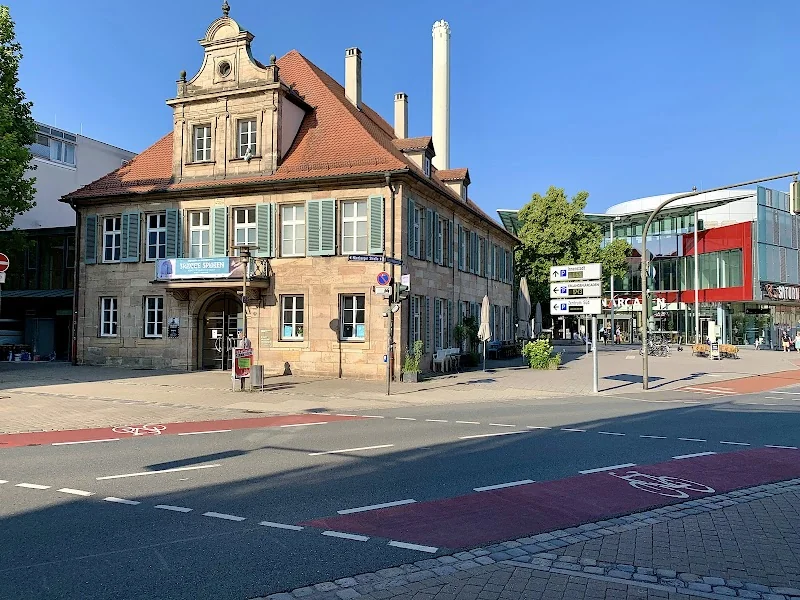
Many users search not only for facts but first for images. That is why the search intent “kunstmuseum erlangen photos” or “kunstmuseum erlangen images” is so important. For the Kunstmuseum Erlangen, there are several image motifs on the tourism page of Visit Erlangen that cover the first impression very well: a front view of the Loewenich Palace, an image of the building with the museum, a sign of the museum, as well as several shots from exhibitions like “interwoven” and “space for painting.” These images not only show the building from the outside but also the atmosphere of the exhibition space. This is helpful because the palace itself is part of the visitor experience. One immediately sees that it is a historical building in a central location that does not appear like a modern functional building but like a place with history and character. For people who want to know in advance if the trip is worth it, such images provide real added value: they show the facade, the relationship to the street, and the character of the rooms before one is even on site. The official museum and museum entry pages also support this impression, as they document the building, location, and changing exhibitions. ([visit-erlangen.de](https://www.visit-erlangen.de/poi/loewenichsches_palaiskunstmuse-27366/))
Those searching for photos are often also interested in the spatial scale. The Kunstmuseum Erlangen appears in the imagery rather compact and focused than monumental; this fits well with the focus on regional art, individual positions, and thematically condensed exhibitions. The exterior images on Visit Erlangen make it clear that the museum is embedded in a baroque palace, while the exhibition images convey an impression of how the works are presented in the space. For search engines, this is relevant not only for the keyword “photos” but also for “images of kunstmuseum erlangen” or “kunstmuseum erlangen erlangen,” as many users simply want a visual comparison before planning a visit. Especially for cultural institutions, this first visual impression is crucial: it often says more about the character of the house than a purely technical description. Here, the selection of images conveys a historical, calm, and curatorially clear framework. Therefore, those wanting to know what the Kunstmuseum looks like should not view the available image sources as mere accessories but as part of the information search. This is also sensible because the exhibitions change regularly, and the images of the house simultaneously show its architecture, location, and curatorial profile. ([visit-erlangen.de](https://www.visit-erlangen.de/poi/loewenichsches_palaiskunstmuse-27366/))
Reviews and Visitor Experience at the Kunstmuseum Erlangen
In the reviews, it is noticeable that the Kunstmuseum Erlangen is not a place that automatically leaves the same impression on all visitors. This is not unusual for art museums and fits quite well with a place that works with changing exhibitions. The provided evaluation dataset shows a mixed picture: one visitor describes the museum as potentially very interesting for art lovers, another is pleased to receive new impressions with repeated visits, and a further feedback is noticeably more critical. For SEO searches for “kunstmuseum erlangen reviews,” this mixture is relevant because it shows that the museum is more of a destination for people with genuine interest in art than a random obligatory stop. Those who enjoy exhibition art, regional positions, and curatorial themes can discover a lot here; those who expect a quick, spectacular effect may react more reservedly. This range also explains why reviews related to art museums often strongly depend on the exhibition being shown. ([museen-in-bayern.de](https://museen-in-bayern.de/museen/detailseite-museum/kunstmuseum-erlangen))
From the perspective of the visitor experience, the Kunstmuseum Erlangen has several characteristics that are often positively or at least very concretely reflected in reviews: free admission, changing exhibitions, and a historical place with its own character. At the same time, there are practical limitations that should be honestly mentioned. The museum data notes that the house is not barrier-free; however, seating is available. Both affect the experience on-site. Those visiting the museum should therefore think less of a large experience world and more of a concentrated art place where content and spaces closely interact. Especially since the exhibitions change regularly, a second visit can feel completely different from the first. This is a plus for return visitors and a plausible reason why some reviews are very positive while others are more reserved. At its core, it is about the commitment to engage with regional art and changing perspectives. This is precisely what makes the Kunstmuseum Erlangen attractive for lovers of exhibition art. ([museen-in-bayern.de](https://museen-in-bayern.de/museen/detailseite-museum/kunstmuseum-erlangen))
Friends of the Kunstmuseum Erlangen e.V. and the Role of the Association
The Friends of the Kunstmuseum Erlangen e.V. is not just a peripheral topic for the museum but a central part of its development. The history begins with a civic initiative: According to the Kunstverein Erlangen, the establishment of a support association for the Kunstmuseum was initiated in 1989, from which the independent and now city-anchored Kunstmuseum later emerged. This origin explains why the term “e.V.” appears so frequently in searches. The museum is city-run, but the association structure remains important for programming, engagement, and promotion. A city council document also describes that since September 1, 2016, the museum has been contractually operated by the city of Erlangen with two fixed exhibitions per year, while the Friends' circle can conduct up to three additional exhibitions in the rooms. For visitors, this is more than an administrative note: it shows that the density of exhibitions and the substantive work of the house are supported by an active network of the city and the support association. ([kunstverein-erlangen.de](https://www.kunstverein-erlangen.de/geschichte))
The request for donations for the Friends' circle is also explicitly mentioned in the current museum documents. This is typical for institutions that work with manageable but very committed structures: volunteer work, support associations, and institutional support interlock. Those searching for “friends of the kunstmuseum erlangen” often want to know whether it is a mere name or a real carrier structure. The answer is clear: the Friends' circle is a real, active player involved in exhibitions, sharing spaces, and supporting the programmatic development. That the association is also visible in the cultural environment of Erlangen is shown by collaborations and guest formats in other institutions. From the visitor's perspective, this means: The Kunstmuseum Erlangen is not an isolated place but part of a grown cultural ecosystem. Those who support the house or inform themselves about the association's activities better understand why the program changes so regularly and why the institution remains both regionally rooted and open to different themes. ([kunstmuseumerlangen.de](https://kunstmuseumerlangen.de/services/kkxqi/u4gj6?dl=1&id=c485e688-6db8-46b1-912b-b9b7853288de))
Directions, Parking, and Location in the Loewenich Palace
The location of the Kunstmuseum Erlangen is one of the practical advantages of the house. It is located at Nürnberger Straße 9 in the Loewenich Palace, and the tourism page explicitly points out that the Erlangen-Arcaden stop is located directly in front of the building. This is particularly convenient for arriving by public transport, as one disembarks very close to the museum and does not have to plan a long walk. For the search terms “kunstmuseum erlangen directions” and “kunstmuseum erlangen parking,” it is also important that the museum is situated in a very central urban area. The parking section of the Erlangen Tourist Information mentions, among other things, the Arcaden parking garage at Nägelsbachstraße 1, the Henkestraße parking garage, the Neuer Markt parking garage, and the large parking lot as downtown and central solutions. Thus, the museum is in an environment where several parking options are available within a short distance. Those arriving by car should therefore consider the downtown logic of Erlangen and not just search directly in front of the house. ([visit-erlangen.de](https://www.visit-erlangen.de/poi/loewenichsches_palaiskunstmuse-27366/))
Additionally, the city’s mobility structure helps with orientation. According to the official parking page, the downtown area has been connected to free bus transport since January 1, 2024, including the City Line 299, which links large parking lots, parking garages, and central destinations. This is practical for museum visits, as one can combine parking and further travel. The Arcaden parking garage is particularly obvious because it is located in the same downtown cluster as the museum and is explicitly mentioned as a parking option in the tourist information. From an SEO perspective, this is important because users rarely enter just the keyword “parking” but actually want a stress-free visit planning: Where do I get off, how far is the museum, where is the best place to park, and can I continue centrally later? The official Erlangen pages provide good hints on exactly this. The Kunstmuseum benefits from its location in the middle of Erlangen, between historical city structure and modern downtown connection. Therefore, those searching for directions and parking essentially have two good ways: directly by public transport to the Erlangen-Arcaden stop or by car to a central parking garage and from there with a short walk or free downtown bus onward. ([visit-erlangen.de](https://www.visit-erlangen.de/poi/loewenichsches_palaiskunstmuse-27366/))
History, Collection, and Regional Art After 1945
The building itself is an important part of the museum's profile. The Loewenich Palace was built in the mid-18th century in baroque style by Joachim Christoph Herr, according to Visit Erlangen. From 1817, it served the Loewenich family as a residential building and for tobacco manufacturing; it remained in family ownership until 1941. Today, the palace houses the Kunstmuseum Erlangen. This construction history is not just decorative embellishment but shapes the impact of the house to this day. When entering the museum, one does not only visit an exhibition but also a listed baroque palace that creates a strong framework for the art through its history. The official museum data describes the house as a place with free admission, seating, and currently not barrier-free access, which is also relevant for visit planning. Thus, the Kunstmuseum is a place where architecture and content work closely together. ([visit-erlangen.de](https://www.visit-erlangen.de/poi/loewenichsches_palaiskunstmuse-27366/))
Content-wise, the Kunstmuseum Erlangen focuses on regional art after 1945, with a special emphasis on artists from Erlangen and the metropolitan region of Nuremberg, as well as on Franconia and the Upper Palatinate. According to Museums in Bavaria, regularly changing solo, group, thematic, and memorial exhibitions are presented; the house also shows photographs and art from regional collections. This distinguishes the museum from many other art venues: the focus is not on international large formats but on a careful examination of regional developments, on relationships between generations, and on the question of how art from the region can be made visible and understandable. For visitors searching for “kunstmuseum erlangen exhibition” or “kunstmuseum erlangen e.v.,” this is an essential profile feature. The museum is not a static collection place but a curated space where regional art history and contemporary art intertwine. This also explains why changing exhibitions, photography, collector holdings, and thematic presentations are so central. Those who engage with this form of art experience a very credible, place-based museum visit in Erlangen that focuses not on effects but on substance. ([museen-in-bayern.de](https://museen-in-bayern.de/museen/detailseite-museum/kunstmuseum-erlangen))
The depth of content is also evidenced by the fact that the museum regularly works with different themes, thereby making a broad regional art landscape visible. Recent examples range from landscape-related positions to exhibitions that pose questions about figuration, imagination, and layers of meaning. This fits well with the current title “what lies behind,” as it symbolically shows how the museum understands its task: not just to show surfaces but to reveal artistic processes, regional networks, and layers of content. For the search query “kunstmuseum erlangen standpoints,” it is therefore relevant that the program already opened a thematic view on landscape and contemporary art in 2025. This programmatic openness is a strength of the house. It makes the museum attractive for return visits and gives the term “regional art” in Erlangen a clear face. Those who also appreciate the practical side will find with free admission, manageable opening hours, and a central location a place that fits very well into a city tour. Thus, the Kunstmuseum Erlangen does not become a one-time photo stop but a recurring cultural venue whose history, equipment, and program are closely intertwined. ([vhs-erlangen.de](https://www.vhs-erlangen.de/fileadmin/vhs-erlangen/Download_26S/Programmheft_26S_PDF/84045200-VHS-PROGRAMM-2026-WEB-PDF-148x210.pdf))
Sources:
Mehr anzeigenWeniger anzeigen
Kunstmuseum Erlangen | Opening Hours & Current Exhibition
The Kunstmuseum Erlangen in the Loewenich Palace is a city-run museum for regional art after 1945, consciously focusing on proximity to its own region rather than overwhelming visitors with size. Those heading to Nürnberger Straße 9 in Erlangen do not visit an anonymous exhibition space, but a historically grown palace with a clear thematic focus: regional positions are displayed, along with changing solo and group exhibitions, thematic and memorial exhibitions, as well as photography and art from regional collectors. Open access is particularly important for visitors: admission is free, opening hours are clearly defined, and the current exhibition “what lies behind” runs from March 29, 2026, to May 17, 2026. This combination of baroque architecture, contemporary art, and regular program changes makes the Kunstmuseum Erlangen a place where a short visit can be as meaningful as a deliberately planned exhibition tour. Those looking for photos, opening hours, reviews, directions, or the friends' circle will find not just a name here, but a vibrant cultural address with a clear orientation. ([museen-in-bayern.de](https://museen-in-bayern.de/museen/detailseite-museum/kunstmuseum-erlangen))
Current Exhibition and Opening Hours at the Kunstmuseum Erlangen
The currently most prominent search query regarding the Kunstmuseum Erlangen revolves around the ongoing exhibition. The museum is currently presenting “what lies behind,” a show featuring works by Meike Lohmann, Jochen Pankrath, Gerhard Rießbeck, and Ute Wältring. According to museum data, it runs from March 29 to May 17, 2026. The exhibition invites visitors not to take the first impression as an endpoint but to look closer: behind the figuration may lie dreams, memories, secrets, or pure imagination, and these layers shape the displayed works. This is typical for the Kunstmuseum Erlangen, as the museum does not work with a static permanent presentation but with a program that continually reconfigures its content. In 2025, the exhibition “Standpoints – Landscape in Contemporary Art” was already the subject of a curator-led tour, which well illustrates the thematic breadth of the museum: landscape, figuration, abstraction, and regional contemporary art do not stand isolated next to each other but are curatorially related. For search queries like current exhibition, exhibition 2026, or standpoints, this is important as it shows that the museum regularly works with new perspectives and does not just display a fixed collection. Visitors should also note the opening hours: Tuesday, Wednesday, and Friday from 11 AM to 3 PM, Thursday from 11 AM to 7 PM, Saturday from 11 AM to 3 PM, Sunday from 11 AM to 4 PM; closed on Mondays and public holidays. According to the museum, the opening hours apply only during exhibition periods, thus not as a permanent standard rule without a program. ([museum.de](https://www.museum.de/events/vor--und-fr%25C3%25BChgeschichtliches-museum))
For practical planning, it is also important that the Kunstmuseum Erlangen is not a place that operates with a huge, confusing event business. Rather, its appeal arises precisely from the concentration on selected exhibitions and a clear regional reference. Therefore, those searching for “kunstmuseum erlangen exhibition” or “kunstmuseum erlangen current exhibition” often do not expect a massive blockbuster program but curated content with a comprehensible narrative. The current exhibition concept fulfills exactly that: four artistic positions, a thematic framework, and a focus on what lies behind the visible surface. This is also relevant for repeat visits, as the museum is regularly reconfigured, offering different impressions at each visit. The combination of free admission, clear opening hours, and changing themes is one of the strongest reasons why the Kunstmuseum Erlangen is so often associated with opening hours, exhibitions, and reviews in search engines. Therefore, those planning a reliable cultural appointment in Erlangen can directly combine the opening hours with a visit to the exhibition and should keep in mind that the thematic setup can change significantly from season to season. ([museen-in-bayern.de](https://museen-in-bayern.de/museen/detailseite-museum/kunstmuseum-erlangen))
Photos, Images, and First Impressions Before the Visit
Many users search not only for facts but first for images. That is why the search intent “kunstmuseum erlangen photos” or “kunstmuseum erlangen images” is so important. For the Kunstmuseum Erlangen, there are several image motifs on the tourism page of Visit Erlangen that cover the first impression very well: a front view of the Loewenich Palace, an image of the building with the museum, a sign of the museum, as well as several shots from exhibitions like “interwoven” and “space for painting.” These images not only show the building from the outside but also the atmosphere of the exhibition space. This is helpful because the palace itself is part of the visitor experience. One immediately sees that it is a historical building in a central location that does not appear like a modern functional building but like a place with history and character. For people who want to know in advance if the trip is worth it, such images provide real added value: they show the facade, the relationship to the street, and the character of the rooms before one is even on site. The official museum and museum entry pages also support this impression, as they document the building, location, and changing exhibitions. ([visit-erlangen.de](https://www.visit-erlangen.de/poi/loewenichsches_palaiskunstmuse-27366/))
Those searching for photos are often also interested in the spatial scale. The Kunstmuseum Erlangen appears in the imagery rather compact and focused than monumental; this fits well with the focus on regional art, individual positions, and thematically condensed exhibitions. The exterior images on Visit Erlangen make it clear that the museum is embedded in a baroque palace, while the exhibition images convey an impression of how the works are presented in the space. For search engines, this is relevant not only for the keyword “photos” but also for “images of kunstmuseum erlangen” or “kunstmuseum erlangen erlangen,” as many users simply want a visual comparison before planning a visit. Especially for cultural institutions, this first visual impression is crucial: it often says more about the character of the house than a purely technical description. Here, the selection of images conveys a historical, calm, and curatorially clear framework. Therefore, those wanting to know what the Kunstmuseum looks like should not view the available image sources as mere accessories but as part of the information search. This is also sensible because the exhibitions change regularly, and the images of the house simultaneously show its architecture, location, and curatorial profile. ([visit-erlangen.de](https://www.visit-erlangen.de/poi/loewenichsches_palaiskunstmuse-27366/))
Reviews and Visitor Experience at the Kunstmuseum Erlangen
In the reviews, it is noticeable that the Kunstmuseum Erlangen is not a place that automatically leaves the same impression on all visitors. This is not unusual for art museums and fits quite well with a place that works with changing exhibitions. The provided evaluation dataset shows a mixed picture: one visitor describes the museum as potentially very interesting for art lovers, another is pleased to receive new impressions with repeated visits, and a further feedback is noticeably more critical. For SEO searches for “kunstmuseum erlangen reviews,” this mixture is relevant because it shows that the museum is more of a destination for people with genuine interest in art than a random obligatory stop. Those who enjoy exhibition art, regional positions, and curatorial themes can discover a lot here; those who expect a quick, spectacular effect may react more reservedly. This range also explains why reviews related to art museums often strongly depend on the exhibition being shown. ([museen-in-bayern.de](https://museen-in-bayern.de/museen/detailseite-museum/kunstmuseum-erlangen))
From the perspective of the visitor experience, the Kunstmuseum Erlangen has several characteristics that are often positively or at least very concretely reflected in reviews: free admission, changing exhibitions, and a historical place with its own character. At the same time, there are practical limitations that should be honestly mentioned. The museum data notes that the house is not barrier-free; however, seating is available. Both affect the experience on-site. Those visiting the museum should therefore think less of a large experience world and more of a concentrated art place where content and spaces closely interact. Especially since the exhibitions change regularly, a second visit can feel completely different from the first. This is a plus for return visitors and a plausible reason why some reviews are very positive while others are more reserved. At its core, it is about the commitment to engage with regional art and changing perspectives. This is precisely what makes the Kunstmuseum Erlangen attractive for lovers of exhibition art. ([museen-in-bayern.de](https://museen-in-bayern.de/museen/detailseite-museum/kunstmuseum-erlangen))
Friends of the Kunstmuseum Erlangen e.V. and the Role of the Association
The Friends of the Kunstmuseum Erlangen e.V. is not just a peripheral topic for the museum but a central part of its development. The history begins with a civic initiative: According to the Kunstverein Erlangen, the establishment of a support association for the Kunstmuseum was initiated in 1989, from which the independent and now city-anchored Kunstmuseum later emerged. This origin explains why the term “e.V.” appears so frequently in searches. The museum is city-run, but the association structure remains important for programming, engagement, and promotion. A city council document also describes that since September 1, 2016, the museum has been contractually operated by the city of Erlangen with two fixed exhibitions per year, while the Friends' circle can conduct up to three additional exhibitions in the rooms. For visitors, this is more than an administrative note: it shows that the density of exhibitions and the substantive work of the house are supported by an active network of the city and the support association. ([kunstverein-erlangen.de](https://www.kunstverein-erlangen.de/geschichte))
The request for donations for the Friends' circle is also explicitly mentioned in the current museum documents. This is typical for institutions that work with manageable but very committed structures: volunteer work, support associations, and institutional support interlock. Those searching for “friends of the kunstmuseum erlangen” often want to know whether it is a mere name or a real carrier structure. The answer is clear: the Friends' circle is a real, active player involved in exhibitions, sharing spaces, and supporting the programmatic development. That the association is also visible in the cultural environment of Erlangen is shown by collaborations and guest formats in other institutions. From the visitor's perspective, this means: The Kunstmuseum Erlangen is not an isolated place but part of a grown cultural ecosystem. Those who support the house or inform themselves about the association's activities better understand why the program changes so regularly and why the institution remains both regionally rooted and open to different themes. ([kunstmuseumerlangen.de](https://kunstmuseumerlangen.de/services/kkxqi/u4gj6?dl=1&id=c485e688-6db8-46b1-912b-b9b7853288de))
Directions, Parking, and Location in the Loewenich Palace
The location of the Kunstmuseum Erlangen is one of the practical advantages of the house. It is located at Nürnberger Straße 9 in the Loewenich Palace, and the tourism page explicitly points out that the Erlangen-Arcaden stop is located directly in front of the building. This is particularly convenient for arriving by public transport, as one disembarks very close to the museum and does not have to plan a long walk. For the search terms “kunstmuseum erlangen directions” and “kunstmuseum erlangen parking,” it is also important that the museum is situated in a very central urban area. The parking section of the Erlangen Tourist Information mentions, among other things, the Arcaden parking garage at Nägelsbachstraße 1, the Henkestraße parking garage, the Neuer Markt parking garage, and the large parking lot as downtown and central solutions. Thus, the museum is in an environment where several parking options are available within a short distance. Those arriving by car should therefore consider the downtown logic of Erlangen and not just search directly in front of the house. ([visit-erlangen.de](https://www.visit-erlangen.de/poi/loewenichsches_palaiskunstmuse-27366/))
Additionally, the city’s mobility structure helps with orientation. According to the official parking page, the downtown area has been connected to free bus transport since January 1, 2024, including the City Line 299, which links large parking lots, parking garages, and central destinations. This is practical for museum visits, as one can combine parking and further travel. The Arcaden parking garage is particularly obvious because it is located in the same downtown cluster as the museum and is explicitly mentioned as a parking option in the tourist information. From an SEO perspective, this is important because users rarely enter just the keyword “parking” but actually want a stress-free visit planning: Where do I get off, how far is the museum, where is the best place to park, and can I continue centrally later? The official Erlangen pages provide good hints on exactly this. The Kunstmuseum benefits from its location in the middle of Erlangen, between historical city structure and modern downtown connection. Therefore, those searching for directions and parking essentially have two good ways: directly by public transport to the Erlangen-Arcaden stop or by car to a central parking garage and from there with a short walk or free downtown bus onward. ([visit-erlangen.de](https://www.visit-erlangen.de/poi/loewenichsches_palaiskunstmuse-27366/))
History, Collection, and Regional Art After 1945
The building itself is an important part of the museum's profile. The Loewenich Palace was built in the mid-18th century in baroque style by Joachim Christoph Herr, according to Visit Erlangen. From 1817, it served the Loewenich family as a residential building and for tobacco manufacturing; it remained in family ownership until 1941. Today, the palace houses the Kunstmuseum Erlangen. This construction history is not just decorative embellishment but shapes the impact of the house to this day. When entering the museum, one does not only visit an exhibition but also a listed baroque palace that creates a strong framework for the art through its history. The official museum data describes the house as a place with free admission, seating, and currently not barrier-free access, which is also relevant for visit planning. Thus, the Kunstmuseum is a place where architecture and content work closely together. ([visit-erlangen.de](https://www.visit-erlangen.de/poi/loewenichsches_palaiskunstmuse-27366/))
Content-wise, the Kunstmuseum Erlangen focuses on regional art after 1945, with a special emphasis on artists from Erlangen and the metropolitan region of Nuremberg, as well as on Franconia and the Upper Palatinate. According to Museums in Bavaria, regularly changing solo, group, thematic, and memorial exhibitions are presented; the house also shows photographs and art from regional collections. This distinguishes the museum from many other art venues: the focus is not on international large formats but on a careful examination of regional developments, on relationships between generations, and on the question of how art from the region can be made visible and understandable. For visitors searching for “kunstmuseum erlangen exhibition” or “kunstmuseum erlangen e.v.,” this is an essential profile feature. The museum is not a static collection place but a curated space where regional art history and contemporary art intertwine. This also explains why changing exhibitions, photography, collector holdings, and thematic presentations are so central. Those who engage with this form of art experience a very credible, place-based museum visit in Erlangen that focuses not on effects but on substance. ([museen-in-bayern.de](https://museen-in-bayern.de/museen/detailseite-museum/kunstmuseum-erlangen))
The depth of content is also evidenced by the fact that the museum regularly works with different themes, thereby making a broad regional art landscape visible. Recent examples range from landscape-related positions to exhibitions that pose questions about figuration, imagination, and layers of meaning. This fits well with the current title “what lies behind,” as it symbolically shows how the museum understands its task: not just to show surfaces but to reveal artistic processes, regional networks, and layers of content. For the search query “kunstmuseum erlangen standpoints,” it is therefore relevant that the program already opened a thematic view on landscape and contemporary art in 2025. This programmatic openness is a strength of the house. It makes the museum attractive for return visits and gives the term “regional art” in Erlangen a clear face. Those who also appreciate the practical side will find with free admission, manageable opening hours, and a central location a place that fits very well into a city tour. Thus, the Kunstmuseum Erlangen does not become a one-time photo stop but a recurring cultural venue whose history, equipment, and program are closely intertwined. ([vhs-erlangen.de](https://www.vhs-erlangen.de/fileadmin/vhs-erlangen/Download_26S/Programmheft_26S_PDF/84045200-VHS-PROGRAMM-2026-WEB-PDF-148x210.pdf))
Sources:
Kunstmuseum Erlangen | Opening Hours & Current Exhibition
The Kunstmuseum Erlangen in the Loewenich Palace is a city-run museum for regional art after 1945, consciously focusing on proximity to its own region rather than overwhelming visitors with size. Those heading to Nürnberger Straße 9 in Erlangen do not visit an anonymous exhibition space, but a historically grown palace with a clear thematic focus: regional positions are displayed, along with changing solo and group exhibitions, thematic and memorial exhibitions, as well as photography and art from regional collectors. Open access is particularly important for visitors: admission is free, opening hours are clearly defined, and the current exhibition “what lies behind” runs from March 29, 2026, to May 17, 2026. This combination of baroque architecture, contemporary art, and regular program changes makes the Kunstmuseum Erlangen a place where a short visit can be as meaningful as a deliberately planned exhibition tour. Those looking for photos, opening hours, reviews, directions, or the friends' circle will find not just a name here, but a vibrant cultural address with a clear orientation. ([museen-in-bayern.de](https://museen-in-bayern.de/museen/detailseite-museum/kunstmuseum-erlangen))
Current Exhibition and Opening Hours at the Kunstmuseum Erlangen
The currently most prominent search query regarding the Kunstmuseum Erlangen revolves around the ongoing exhibition. The museum is currently presenting “what lies behind,” a show featuring works by Meike Lohmann, Jochen Pankrath, Gerhard Rießbeck, and Ute Wältring. According to museum data, it runs from March 29 to May 17, 2026. The exhibition invites visitors not to take the first impression as an endpoint but to look closer: behind the figuration may lie dreams, memories, secrets, or pure imagination, and these layers shape the displayed works. This is typical for the Kunstmuseum Erlangen, as the museum does not work with a static permanent presentation but with a program that continually reconfigures its content. In 2025, the exhibition “Standpoints – Landscape in Contemporary Art” was already the subject of a curator-led tour, which well illustrates the thematic breadth of the museum: landscape, figuration, abstraction, and regional contemporary art do not stand isolated next to each other but are curatorially related. For search queries like current exhibition, exhibition 2026, or standpoints, this is important as it shows that the museum regularly works with new perspectives and does not just display a fixed collection. Visitors should also note the opening hours: Tuesday, Wednesday, and Friday from 11 AM to 3 PM, Thursday from 11 AM to 7 PM, Saturday from 11 AM to 3 PM, Sunday from 11 AM to 4 PM; closed on Mondays and public holidays. According to the museum, the opening hours apply only during exhibition periods, thus not as a permanent standard rule without a program. ([museum.de](https://www.museum.de/events/vor--und-fr%25C3%25BChgeschichtliches-museum))
For practical planning, it is also important that the Kunstmuseum Erlangen is not a place that operates with a huge, confusing event business. Rather, its appeal arises precisely from the concentration on selected exhibitions and a clear regional reference. Therefore, those searching for “kunstmuseum erlangen exhibition” or “kunstmuseum erlangen current exhibition” often do not expect a massive blockbuster program but curated content with a comprehensible narrative. The current exhibition concept fulfills exactly that: four artistic positions, a thematic framework, and a focus on what lies behind the visible surface. This is also relevant for repeat visits, as the museum is regularly reconfigured, offering different impressions at each visit. The combination of free admission, clear opening hours, and changing themes is one of the strongest reasons why the Kunstmuseum Erlangen is so often associated with opening hours, exhibitions, and reviews in search engines. Therefore, those planning a reliable cultural appointment in Erlangen can directly combine the opening hours with a visit to the exhibition and should keep in mind that the thematic setup can change significantly from season to season. ([museen-in-bayern.de](https://museen-in-bayern.de/museen/detailseite-museum/kunstmuseum-erlangen))
Photos, Images, and First Impressions Before the Visit
Many users search not only for facts but first for images. That is why the search intent “kunstmuseum erlangen photos” or “kunstmuseum erlangen images” is so important. For the Kunstmuseum Erlangen, there are several image motifs on the tourism page of Visit Erlangen that cover the first impression very well: a front view of the Loewenich Palace, an image of the building with the museum, a sign of the museum, as well as several shots from exhibitions like “interwoven” and “space for painting.” These images not only show the building from the outside but also the atmosphere of the exhibition space. This is helpful because the palace itself is part of the visitor experience. One immediately sees that it is a historical building in a central location that does not appear like a modern functional building but like a place with history and character. For people who want to know in advance if the trip is worth it, such images provide real added value: they show the facade, the relationship to the street, and the character of the rooms before one is even on site. The official museum and museum entry pages also support this impression, as they document the building, location, and changing exhibitions. ([visit-erlangen.de](https://www.visit-erlangen.de/poi/loewenichsches_palaiskunstmuse-27366/))
Those searching for photos are often also interested in the spatial scale. The Kunstmuseum Erlangen appears in the imagery rather compact and focused than monumental; this fits well with the focus on regional art, individual positions, and thematically condensed exhibitions. The exterior images on Visit Erlangen make it clear that the museum is embedded in a baroque palace, while the exhibition images convey an impression of how the works are presented in the space. For search engines, this is relevant not only for the keyword “photos” but also for “images of kunstmuseum erlangen” or “kunstmuseum erlangen erlangen,” as many users simply want a visual comparison before planning a visit. Especially for cultural institutions, this first visual impression is crucial: it often says more about the character of the house than a purely technical description. Here, the selection of images conveys a historical, calm, and curatorially clear framework. Therefore, those wanting to know what the Kunstmuseum looks like should not view the available image sources as mere accessories but as part of the information search. This is also sensible because the exhibitions change regularly, and the images of the house simultaneously show its architecture, location, and curatorial profile. ([visit-erlangen.de](https://www.visit-erlangen.de/poi/loewenichsches_palaiskunstmuse-27366/))
Reviews and Visitor Experience at the Kunstmuseum Erlangen
In the reviews, it is noticeable that the Kunstmuseum Erlangen is not a place that automatically leaves the same impression on all visitors. This is not unusual for art museums and fits quite well with a place that works with changing exhibitions. The provided evaluation dataset shows a mixed picture: one visitor describes the museum as potentially very interesting for art lovers, another is pleased to receive new impressions with repeated visits, and a further feedback is noticeably more critical. For SEO searches for “kunstmuseum erlangen reviews,” this mixture is relevant because it shows that the museum is more of a destination for people with genuine interest in art than a random obligatory stop. Those who enjoy exhibition art, regional positions, and curatorial themes can discover a lot here; those who expect a quick, spectacular effect may react more reservedly. This range also explains why reviews related to art museums often strongly depend on the exhibition being shown. ([museen-in-bayern.de](https://museen-in-bayern.de/museen/detailseite-museum/kunstmuseum-erlangen))
From the perspective of the visitor experience, the Kunstmuseum Erlangen has several characteristics that are often positively or at least very concretely reflected in reviews: free admission, changing exhibitions, and a historical place with its own character. At the same time, there are practical limitations that should be honestly mentioned. The museum data notes that the house is not barrier-free; however, seating is available. Both affect the experience on-site. Those visiting the museum should therefore think less of a large experience world and more of a concentrated art place where content and spaces closely interact. Especially since the exhibitions change regularly, a second visit can feel completely different from the first. This is a plus for return visitors and a plausible reason why some reviews are very positive while others are more reserved. At its core, it is about the commitment to engage with regional art and changing perspectives. This is precisely what makes the Kunstmuseum Erlangen attractive for lovers of exhibition art. ([museen-in-bayern.de](https://museen-in-bayern.de/museen/detailseite-museum/kunstmuseum-erlangen))
Friends of the Kunstmuseum Erlangen e.V. and the Role of the Association
The Friends of the Kunstmuseum Erlangen e.V. is not just a peripheral topic for the museum but a central part of its development. The history begins with a civic initiative: According to the Kunstverein Erlangen, the establishment of a support association for the Kunstmuseum was initiated in 1989, from which the independent and now city-anchored Kunstmuseum later emerged. This origin explains why the term “e.V.” appears so frequently in searches. The museum is city-run, but the association structure remains important for programming, engagement, and promotion. A city council document also describes that since September 1, 2016, the museum has been contractually operated by the city of Erlangen with two fixed exhibitions per year, while the Friends' circle can conduct up to three additional exhibitions in the rooms. For visitors, this is more than an administrative note: it shows that the density of exhibitions and the substantive work of the house are supported by an active network of the city and the support association. ([kunstverein-erlangen.de](https://www.kunstverein-erlangen.de/geschichte))
The request for donations for the Friends' circle is also explicitly mentioned in the current museum documents. This is typical for institutions that work with manageable but very committed structures: volunteer work, support associations, and institutional support interlock. Those searching for “friends of the kunstmuseum erlangen” often want to know whether it is a mere name or a real carrier structure. The answer is clear: the Friends' circle is a real, active player involved in exhibitions, sharing spaces, and supporting the programmatic development. That the association is also visible in the cultural environment of Erlangen is shown by collaborations and guest formats in other institutions. From the visitor's perspective, this means: The Kunstmuseum Erlangen is not an isolated place but part of a grown cultural ecosystem. Those who support the house or inform themselves about the association's activities better understand why the program changes so regularly and why the institution remains both regionally rooted and open to different themes. ([kunstmuseumerlangen.de](https://kunstmuseumerlangen.de/services/kkxqi/u4gj6?dl=1&id=c485e688-6db8-46b1-912b-b9b7853288de))
Directions, Parking, and Location in the Loewenich Palace
The location of the Kunstmuseum Erlangen is one of the practical advantages of the house. It is located at Nürnberger Straße 9 in the Loewenich Palace, and the tourism page explicitly points out that the Erlangen-Arcaden stop is located directly in front of the building. This is particularly convenient for arriving by public transport, as one disembarks very close to the museum and does not have to plan a long walk. For the search terms “kunstmuseum erlangen directions” and “kunstmuseum erlangen parking,” it is also important that the museum is situated in a very central urban area. The parking section of the Erlangen Tourist Information mentions, among other things, the Arcaden parking garage at Nägelsbachstraße 1, the Henkestraße parking garage, the Neuer Markt parking garage, and the large parking lot as downtown and central solutions. Thus, the museum is in an environment where several parking options are available within a short distance. Those arriving by car should therefore consider the downtown logic of Erlangen and not just search directly in front of the house. ([visit-erlangen.de](https://www.visit-erlangen.de/poi/loewenichsches_palaiskunstmuse-27366/))
Additionally, the city’s mobility structure helps with orientation. According to the official parking page, the downtown area has been connected to free bus transport since January 1, 2024, including the City Line 299, which links large parking lots, parking garages, and central destinations. This is practical for museum visits, as one can combine parking and further travel. The Arcaden parking garage is particularly obvious because it is located in the same downtown cluster as the museum and is explicitly mentioned as a parking option in the tourist information. From an SEO perspective, this is important because users rarely enter just the keyword “parking” but actually want a stress-free visit planning: Where do I get off, how far is the museum, where is the best place to park, and can I continue centrally later? The official Erlangen pages provide good hints on exactly this. The Kunstmuseum benefits from its location in the middle of Erlangen, between historical city structure and modern downtown connection. Therefore, those searching for directions and parking essentially have two good ways: directly by public transport to the Erlangen-Arcaden stop or by car to a central parking garage and from there with a short walk or free downtown bus onward. ([visit-erlangen.de](https://www.visit-erlangen.de/poi/loewenichsches_palaiskunstmuse-27366/))
History, Collection, and Regional Art After 1945
The building itself is an important part of the museum's profile. The Loewenich Palace was built in the mid-18th century in baroque style by Joachim Christoph Herr, according to Visit Erlangen. From 1817, it served the Loewenich family as a residential building and for tobacco manufacturing; it remained in family ownership until 1941. Today, the palace houses the Kunstmuseum Erlangen. This construction history is not just decorative embellishment but shapes the impact of the house to this day. When entering the museum, one does not only visit an exhibition but also a listed baroque palace that creates a strong framework for the art through its history. The official museum data describes the house as a place with free admission, seating, and currently not barrier-free access, which is also relevant for visit planning. Thus, the Kunstmuseum is a place where architecture and content work closely together. ([visit-erlangen.de](https://www.visit-erlangen.de/poi/loewenichsches_palaiskunstmuse-27366/))
Content-wise, the Kunstmuseum Erlangen focuses on regional art after 1945, with a special emphasis on artists from Erlangen and the metropolitan region of Nuremberg, as well as on Franconia and the Upper Palatinate. According to Museums in Bavaria, regularly changing solo, group, thematic, and memorial exhibitions are presented; the house also shows photographs and art from regional collections. This distinguishes the museum from many other art venues: the focus is not on international large formats but on a careful examination of regional developments, on relationships between generations, and on the question of how art from the region can be made visible and understandable. For visitors searching for “kunstmuseum erlangen exhibition” or “kunstmuseum erlangen e.v.,” this is an essential profile feature. The museum is not a static collection place but a curated space where regional art history and contemporary art intertwine. This also explains why changing exhibitions, photography, collector holdings, and thematic presentations are so central. Those who engage with this form of art experience a very credible, place-based museum visit in Erlangen that focuses not on effects but on substance. ([museen-in-bayern.de](https://museen-in-bayern.de/museen/detailseite-museum/kunstmuseum-erlangen))
The depth of content is also evidenced by the fact that the museum regularly works with different themes, thereby making a broad regional art landscape visible. Recent examples range from landscape-related positions to exhibitions that pose questions about figuration, imagination, and layers of meaning. This fits well with the current title “what lies behind,” as it symbolically shows how the museum understands its task: not just to show surfaces but to reveal artistic processes, regional networks, and layers of content. For the search query “kunstmuseum erlangen standpoints,” it is therefore relevant that the program already opened a thematic view on landscape and contemporary art in 2025. This programmatic openness is a strength of the house. It makes the museum attractive for return visits and gives the term “regional art” in Erlangen a clear face. Those who also appreciate the practical side will find with free admission, manageable opening hours, and a central location a place that fits very well into a city tour. Thus, the Kunstmuseum Erlangen does not become a one-time photo stop but a recurring cultural venue whose history, equipment, and program are closely intertwined. ([vhs-erlangen.de](https://www.vhs-erlangen.de/fileadmin/vhs-erlangen/Download_26S/Programmheft_26S_PDF/84045200-VHS-PROGRAMM-2026-WEB-PDF-148x210.pdf))
Sources:
Upcoming Events
No events found
Frequently Asked Questions
Reviews
Javed Khan
1. April 2018
Can be great for an art lover although I didn't find it too interesting.
Oleg Kravchuk
19. August 2018
Place to see something new. If you go there from time to time - you shall have new impressions.
Jonas Abassi
26. August 2022
hs
Mister Peter
2. February 2026
Always very interesting exhibitions with different themes, and admission is free!
Ingrid Reim
13. February 2022
An interesting exhibition and informative guided tour, currently focusing on "genre painting," presented in a new way (by theme and motif, not just one artist). The rooms are rather small overall, but beautiful. Recommended.