
Heroldsberg
Kirchenweg 2, 90562 Heroldsberg, Deutschland
Matthäuskirche Heroldsberg | Service & History
The Matthäuskirche Heroldsberg is much more than a silent building in the town center. It connects medieval substance, developed community work, and a still vibrant church practice. Those who visit the church on Kirchenweg experience a place where history can not only be read but also felt atmospherically. The tower, the choir section, the wing altar, the pulpit, the organ, and the digital church tour together tell of centuries of religious, cultural, and architectural development. At the same time, the church community shows with services, music, Church Kunterbunt, brass choir, and community center that St. Matthew remains an active meeting point for Heroldsberg. The church thus stands for continuity and change at the same time: for the preservation of an old church fortress and for new forms of community life that cater to families, music enthusiasts, visitors, and people seeking peace, orientation, or community. ([heroldsberg-evangelisch.de](https://heroldsberg-evangelisch.de/die-kirche-st-matthaeus/))
History and Church Fortress of Matthäuskirche Heroldsberg
The historical depth of Matthäuskirche Heroldsberg begins long before the current form of the building. According to the church community, nothing is known about the first construction beginnings, but the development of the parish dates back very far. Heroldsberg was separated from its older affiliation with the parish of Neunkirchen am Sand as an independent parish. In a document from the Diocese of Bamberg from the year 1477, the Heroldsberg church is mentioned as the parish church of St. Margaretha. It received its current name St. Matthew after the Reformation in 1525. This sequence makes it clear that the place was religiously shaped for centuries and that the church changed with the upheavals of confessionalization without losing its central position in local life. Particularly noteworthy is the origin as a church fortress. Defensive walkways, storage cellars, accommodation rooms, and watchtowers once belonged to the picture; today, mainly the supporting walls are visible. This finding makes the charm of the church, as the building does not appear as a smoothly renovated monument, but as a historically grown ensemble with visible layers. ([heroldsberg-evangelisch.de](https://heroldsberg-evangelisch.de/die-kirche-st-matthaeus/))
The oldest preserved component is the tower. It was built in the 12th or 13th century and received its current tower helmet shape with four watch towers in 1435. Thus, it remains not only an architectural relic but also a hint at its former function as a watchtower. Particularly impressive is the observation that the altar area of the former church has been located in the ground floor of the tower since early Gothic times and that the altar was oriented to the west. This western orientation points to the great historical depth of the building, as it leads back to a time when the later eastern orientation was not yet legally required. The ceiling paintings show the symbols of the four evangelists Matthew, Mark, Luke, and John. The wall frescoes are only fragmentarily preserved; a Christmas scene is recognizable on the north side. The paintings date from after 1380. Thus, a early image of piety, defensiveness, and liturgical order is condensed in the tower and wall painting. ([heroldsberg-evangelisch.de](https://heroldsberg-evangelisch.de/die-kirche-st-matthaeus/))
Another central construction phase is the choir, which was built around 1440. The altar consecration is documented for 1444. With this step, the church was oriented to the east and simultaneously used as a burial place for the Nuremberg patrician family Geuder. This connection of liturgical function and representative memory is typical for medieval church spaces and explains why Matthäuskirche had significance not only as a parish church but also as a place of social and familial remembrance. Today, those who visit the church recognize in the grave slabs and memorial plaques this long connection to local and regional history. The church community explicitly presents the construction phase of the choir as its own part of the building history. This is where an important appeal lies for visitors: The building cannot be reduced to a single style but shows medieval, late Gothic, Baroque, classicist, and modern traces side by side. This diversity shapes the special aura of Matthäuskirche Heroldsberg to this day. ([heroldsberg-evangelisch.de](https://heroldsberg-evangelisch.de/die-kirche-st-matthaeus/))
Art Treasures, Organ, and Interior Design
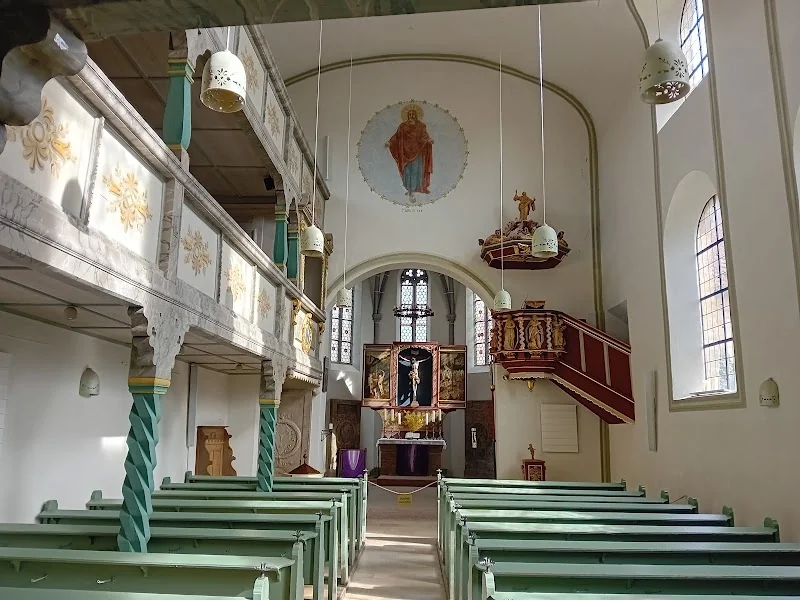
The interior of Matthäuskirche Heroldsberg is rich in art and design elements that make the long journey of the building visible. The altar with its different periods of origin is particularly highlighted. In the shrine, there has been a late Gothic crucifix by Tilman Riemenschneider since 1821, which, according to the church community, probably dates from 1485 to 1492. The figure was brought into the church as a donation from the Heroldsberg pastor Christoph G. Schmidt. The original painting is heavily damaged; the current version dates from 1907. This crucifix is not only an art-historical highlight but also an example of how a unique piece from another context continues to live on in a new liturgical environment. The wings of the altar are also remarkable: The front images in oil on wood are attributed to the Nuremberg painter Paul Juvenell the Elder, while the backs come from an unknown artist, possibly from a Dutch school. Thus, the altar unites regional and supra-regional art history in a single field of view. ([heroldsberg-evangelisch.de](https://heroldsberg-evangelisch.de/die-kirche-st-matthaeus/))
The iconographic decoration of the altar is also very multi-layered. The front of the left wing shows Adam and Eve in paradise, while the back depicts Jesus' prayer struggle in Gethsemane. The right wing connects the people of Israel, Moses, the saving snake, John the Baptist, the baptism of Jesus, and on the back, the Last Supper. The predella, in turn, shows on its back the sweat cloth of Saint Veronica. Such sequences of images are not decorative coincidences but theologically thought-out narratives in wood and color. Additionally, there is the Baroque pulpit from 1717, whose basket shows the four evangelists and whose sound cover depicts Christ as the Savior of the World. The iron-clad offering box below the pulpit still dates from the Gothic period and later received a Baroque mantle from 1678. Above the triumphal arch is a wall painting from 1821. This interior is thus not a museum in the narrow sense but a liturgically used space where several centuries of design have remained visible side by side. ([heroldsberg-evangelisch.de](https://heroldsberg-evangelisch.de/die-kirche-st-matthaeus/))
The current form of the nave was created during the major construction project of 1820/21. During this, the roof was raised, and a second gallery was installed. The gallery railing was restored in 1977 according to the original painting from 1821 in classicist-Biedermeier decor. The organ is also part of the history of the interior design. The existing organ has already had four predecessors. The main work and chest work were incorporated into the Biedermeier prospectus from 1822; the plan and disposition came from Walther Haffner. Organ builder E. Simon from Landshut-Ergolding built the organ in 1977/78, and it was consecrated on the 3rd Advent 1978. Thus, the instrument fits into the long history of music and worship. After the war damages that the tower suffered during World War II due to American shelling, the largest damages were repaired in 1946/47; the complete restoration took place with the renovation in 1956. The church is thus visibly well-maintained but never frozen in a rigid past. ([heroldsberg-evangelisch.de](https://heroldsberg-evangelisch.de/die-kirche-st-matthaeus/))
Directions, Contact, and Parking at Kirchenweg 2
For practical visits, Matthäuskirche Heroldsberg is easily accessible, and the church community communicates the most important visiting information clearly. The Evang.-luth. parish office St. Matthäus Heroldsberg is located at Kirchenweg 2, 90562 Heroldsberg. The office hours are Tuesday from 10 to 12 and Thursday from 16 to 18, as well as by appointment. The phone number and email address are also publicly listed on the website. Thus, the church is not only a historical site but also a reliably organized community location. Anyone with questions about services, visits, church tours, or community activities will find a clear point of contact here. Particularly helpful is that the website provides a menu item for contact and directions while simultaneously linking the church St. Matthew with a 360° panorama and a digital church tour. This significantly facilitates the preparation for a visit, especially for people who want to look digitally first before coming on-site. ([heroldsberg-evangelisch.de](https://heroldsberg-evangelisch.de/kontakt-anfahrt/))
The architectural development of the community area is also important for orientation on-site. Behind the daycare center of DIAKONEO at Kirchenweg 13, the new community center of the Evang.-luth. church community Heroldsberg is being built. The church community describes it as open, inviting, sustainable, and climate-neutral. Access is via Kirchenweg. The site will have 10 parking spaces and a parking space for people with disabilities. For larger events, the nearby parking spaces at the festival site in Heroldsberg are to be used as well. This information is particularly relevant for visitors as it shows that the community does not leave accessibility to chance. Especially for concerts, festive services, Church Kunterbunt, or other larger gatherings, the clear parking strategy is a real advantage. Those who know the town center will also perceive the scenic location between Schlossweiher and Gründlach as part of the overall impression, as the outdoor facilities of the new building reflect exactly this environment. ([heroldsberg-evangelisch.de](https://heroldsberg-evangelisch.de/neues-gemeindehaus/))
The new construction complements the old church fortress not only functionally but also in content. The community center is primarily made of wood and glass, stands on ductile cast piles, and was planned with geothermal probes, photovoltaic panels, heat pumps, and underfloor heating. Curtains, light awnings, and a mechanical ventilation system with heat recovery support acoustics and room climate. For the visitor, this means: The church community thinks of the place as a whole of historical church and contemporary community life. Therefore, those who do not just photograph St. Matthew from the outside but also visit for events, concerts, or discussion offerings experience an ensemble that cleverly connects the past and the present. Even the access and parking spaces are integrated into this planning. For a location and SEO consideration, this connection of historical church, new community center, and clear visitor guidance is a strong unique selling proposition. ([heroldsberg-evangelisch.de](https://heroldsberg-evangelisch.de/neues-gemeindehaus/))
Services, Church Kunterbunt, and Musical Community Life
Matthäuskirche Heroldsberg is a lively place of worship. On the church community's website, there is a dedicated section for services and events, and current announcements regularly appear on the homepage as well as in the community newsletters. Thus, the place is not reduced to its historical heritage but is continuously used liturgically. Particularly enlightening is the view of the Easter and Holy Week offerings: The church community publishes specific times for Good Friday, Easter Vigil, Resurrection Celebration, and other celebrations. Even though dates may change depending on the church year, the publication practice clearly shows that St. Matthew is a central place for the major stations of the Protestant church year. This includes not only the classic Sunday services but also Passion devotions, family services, baptism services, and special festive forms. For visitors, this is important because a church becomes alive not only through its masonry but above all through its use. This is exactly the case in Heroldsberg. ([heroldsberg-evangelisch.de](https://heroldsberg-evangelisch.de/gottesdienste-und-veranstaltungen/?utm_source=openai))
A particularly characteristic format is Church Kunterbunt. The church community describes this offer as intergenerational, creative, hospitable, and joyfully celebrating with Jesus Christ at the center. About every two to three months, a colorful service is celebrated in the community center, each with activity time, celebration time, and meal time. This format very well shows how the community addresses families, children, and different age groups. Church Kunterbunt does not take place as a rigid additional program but as a consciously designed form of community and faith. The communication about save-the-dates and the announcement of the next meeting also makes it clear that the offer is regularly planned. For keyword and SEO perspective, this is relevant because search queries like Church Kunterbunt Heroldsberg, Service Heroldsberg, or Community Center Heroldsberg fit well together in content. Thus, a local thematic connection is created that makes Matthäuskirche visible as the heart of a whole community offering. ([heroldsberg-evangelisch.de](https://heroldsberg-evangelisch.de/gruppen/kinder-und-jugendliche/kirche-kunterbunt/))
The musical aspect of community life primarily includes the brass choir. Its beginnings lie in the time after World War II when some musicians came together at the initiative of the church musician Witt. The first officially documented performance took place at Easter 1952 in the church. Today, the choir has been a fixed part of community life for over 70 years and accompanies services, church festivals, and events in the town. The website lists around 30 active brass players. Rehearsals take place on Wednesdays at 8 PM in the Evangelical community center. Additionally, there is the recorder ensemble Rundholz, which has existed since 1988 and contributes to services, devotions, and festivals with music from old to contemporary. This musical diversity makes Matthäuskirche interesting as a venue and church: it is not only a space for word and prayer but also for brass sound, flute music, and festive celebrations. Those searching for brass choir Heroldsberg, church music, or service music will find a very lively local connection here. ([heroldsberg-evangelisch.de](https://heroldsberg-evangelisch.de/gruppen/kirchenmusik/posaunenchor/))
360° Panorama, Digital Church Tour, and Visitor Information
For visitors who want to get to know the church in advance, the church community offers helpful digital access. On the St. Matthew website, there is a menu item for the church St. Matthew as well as a 360° panorama view of the interior. Additionally, the contact page refers to a digital church tour. This is not just a technical extra but a real added value for the user experience. Those searching for Matthäuskirche Heroldsberg, interior, church tour, or looking at the church can already get a good picture before their first visit. Especially with historic churches, this is valuable because architecture, altar, pulpit, and organ often only have the right effect spatially when one can view the interior in peace. The panorama view supports exactly that. It also helps to understand the liturgical space before being live on-site. For SEO and content, this means: digital and physical use work well together here. ([heroldsberg-evangelisch.de](https://heroldsberg-evangelisch.de/kontakt-anfahrt/))
Also, on the level of the church's self-understanding, Matthäuskirche shows a special quality. The church community speaks of the church as a living organism that is subjected to strong demands in the changing seasons and church year. Maintenance, repairs, and renovations cost a lot of money, and the community explicitly asks for support. This openness is remarkable because it addresses visitors not only as guests but also as co-carriers of a historical heritage. The church is thus not merely a monument but a continuously maintained space for worship, comfort, encouragement, joy, and liveliness. This mixture explains why Matthäuskirche Heroldsberg is so strongly connected in search queries about history, worship, music, parking, and community center. Therefore, those visiting the place do not just enter an old building but a vibrant center of the Protestant community in Heroldsberg. ([heroldsberg-evangelisch.de](https://heroldsberg-evangelisch.de/die-kirche-st-matthaeus/))
Sources:
- The Church St. Matthew - Evang. Church Community St. Matthew Heroldsberg
- Contact & Directions - Evang. Church Community St. Matthew Heroldsberg
- New Community Center, Kirchenweg 13 - Evang. Church Community St. Matthew Heroldsberg
- Brass Choir - Evang. Church Community St. Matthew Heroldsberg
- 360° Panorama of the Interior - Evang. Church Community St. Matthew Heroldsberg
- New Evangelical-Lutheran Community Center - Transsolar | Climate Engineering
Mehr anzeigenWeniger anzeigen
Matthäuskirche Heroldsberg | Service & History
The Matthäuskirche Heroldsberg is much more than a silent building in the town center. It connects medieval substance, developed community work, and a still vibrant church practice. Those who visit the church on Kirchenweg experience a place where history can not only be read but also felt atmospherically. The tower, the choir section, the wing altar, the pulpit, the organ, and the digital church tour together tell of centuries of religious, cultural, and architectural development. At the same time, the church community shows with services, music, Church Kunterbunt, brass choir, and community center that St. Matthew remains an active meeting point for Heroldsberg. The church thus stands for continuity and change at the same time: for the preservation of an old church fortress and for new forms of community life that cater to families, music enthusiasts, visitors, and people seeking peace, orientation, or community. ([heroldsberg-evangelisch.de](https://heroldsberg-evangelisch.de/die-kirche-st-matthaeus/))
History and Church Fortress of Matthäuskirche Heroldsberg
The historical depth of Matthäuskirche Heroldsberg begins long before the current form of the building. According to the church community, nothing is known about the first construction beginnings, but the development of the parish dates back very far. Heroldsberg was separated from its older affiliation with the parish of Neunkirchen am Sand as an independent parish. In a document from the Diocese of Bamberg from the year 1477, the Heroldsberg church is mentioned as the parish church of St. Margaretha. It received its current name St. Matthew after the Reformation in 1525. This sequence makes it clear that the place was religiously shaped for centuries and that the church changed with the upheavals of confessionalization without losing its central position in local life. Particularly noteworthy is the origin as a church fortress. Defensive walkways, storage cellars, accommodation rooms, and watchtowers once belonged to the picture; today, mainly the supporting walls are visible. This finding makes the charm of the church, as the building does not appear as a smoothly renovated monument, but as a historically grown ensemble with visible layers. ([heroldsberg-evangelisch.de](https://heroldsberg-evangelisch.de/die-kirche-st-matthaeus/))
The oldest preserved component is the tower. It was built in the 12th or 13th century and received its current tower helmet shape with four watch towers in 1435. Thus, it remains not only an architectural relic but also a hint at its former function as a watchtower. Particularly impressive is the observation that the altar area of the former church has been located in the ground floor of the tower since early Gothic times and that the altar was oriented to the west. This western orientation points to the great historical depth of the building, as it leads back to a time when the later eastern orientation was not yet legally required. The ceiling paintings show the symbols of the four evangelists Matthew, Mark, Luke, and John. The wall frescoes are only fragmentarily preserved; a Christmas scene is recognizable on the north side. The paintings date from after 1380. Thus, a early image of piety, defensiveness, and liturgical order is condensed in the tower and wall painting. ([heroldsberg-evangelisch.de](https://heroldsberg-evangelisch.de/die-kirche-st-matthaeus/))
Another central construction phase is the choir, which was built around 1440. The altar consecration is documented for 1444. With this step, the church was oriented to the east and simultaneously used as a burial place for the Nuremberg patrician family Geuder. This connection of liturgical function and representative memory is typical for medieval church spaces and explains why Matthäuskirche had significance not only as a parish church but also as a place of social and familial remembrance. Today, those who visit the church recognize in the grave slabs and memorial plaques this long connection to local and regional history. The church community explicitly presents the construction phase of the choir as its own part of the building history. This is where an important appeal lies for visitors: The building cannot be reduced to a single style but shows medieval, late Gothic, Baroque, classicist, and modern traces side by side. This diversity shapes the special aura of Matthäuskirche Heroldsberg to this day. ([heroldsberg-evangelisch.de](https://heroldsberg-evangelisch.de/die-kirche-st-matthaeus/))
Art Treasures, Organ, and Interior Design
The interior of Matthäuskirche Heroldsberg is rich in art and design elements that make the long journey of the building visible. The altar with its different periods of origin is particularly highlighted. In the shrine, there has been a late Gothic crucifix by Tilman Riemenschneider since 1821, which, according to the church community, probably dates from 1485 to 1492. The figure was brought into the church as a donation from the Heroldsberg pastor Christoph G. Schmidt. The original painting is heavily damaged; the current version dates from 1907. This crucifix is not only an art-historical highlight but also an example of how a unique piece from another context continues to live on in a new liturgical environment. The wings of the altar are also remarkable: The front images in oil on wood are attributed to the Nuremberg painter Paul Juvenell the Elder, while the backs come from an unknown artist, possibly from a Dutch school. Thus, the altar unites regional and supra-regional art history in a single field of view. ([heroldsberg-evangelisch.de](https://heroldsberg-evangelisch.de/die-kirche-st-matthaeus/))
The iconographic decoration of the altar is also very multi-layered. The front of the left wing shows Adam and Eve in paradise, while the back depicts Jesus' prayer struggle in Gethsemane. The right wing connects the people of Israel, Moses, the saving snake, John the Baptist, the baptism of Jesus, and on the back, the Last Supper. The predella, in turn, shows on its back the sweat cloth of Saint Veronica. Such sequences of images are not decorative coincidences but theologically thought-out narratives in wood and color. Additionally, there is the Baroque pulpit from 1717, whose basket shows the four evangelists and whose sound cover depicts Christ as the Savior of the World. The iron-clad offering box below the pulpit still dates from the Gothic period and later received a Baroque mantle from 1678. Above the triumphal arch is a wall painting from 1821. This interior is thus not a museum in the narrow sense but a liturgically used space where several centuries of design have remained visible side by side. ([heroldsberg-evangelisch.de](https://heroldsberg-evangelisch.de/die-kirche-st-matthaeus/))
The current form of the nave was created during the major construction project of 1820/21. During this, the roof was raised, and a second gallery was installed. The gallery railing was restored in 1977 according to the original painting from 1821 in classicist-Biedermeier decor. The organ is also part of the history of the interior design. The existing organ has already had four predecessors. The main work and chest work were incorporated into the Biedermeier prospectus from 1822; the plan and disposition came from Walther Haffner. Organ builder E. Simon from Landshut-Ergolding built the organ in 1977/78, and it was consecrated on the 3rd Advent 1978. Thus, the instrument fits into the long history of music and worship. After the war damages that the tower suffered during World War II due to American shelling, the largest damages were repaired in 1946/47; the complete restoration took place with the renovation in 1956. The church is thus visibly well-maintained but never frozen in a rigid past. ([heroldsberg-evangelisch.de](https://heroldsberg-evangelisch.de/die-kirche-st-matthaeus/))
Directions, Contact, and Parking at Kirchenweg 2
For practical visits, Matthäuskirche Heroldsberg is easily accessible, and the church community communicates the most important visiting information clearly. The Evang.-luth. parish office St. Matthäus Heroldsberg is located at Kirchenweg 2, 90562 Heroldsberg. The office hours are Tuesday from 10 to 12 and Thursday from 16 to 18, as well as by appointment. The phone number and email address are also publicly listed on the website. Thus, the church is not only a historical site but also a reliably organized community location. Anyone with questions about services, visits, church tours, or community activities will find a clear point of contact here. Particularly helpful is that the website provides a menu item for contact and directions while simultaneously linking the church St. Matthew with a 360° panorama and a digital church tour. This significantly facilitates the preparation for a visit, especially for people who want to look digitally first before coming on-site. ([heroldsberg-evangelisch.de](https://heroldsberg-evangelisch.de/kontakt-anfahrt/))
The architectural development of the community area is also important for orientation on-site. Behind the daycare center of DIAKONEO at Kirchenweg 13, the new community center of the Evang.-luth. church community Heroldsberg is being built. The church community describes it as open, inviting, sustainable, and climate-neutral. Access is via Kirchenweg. The site will have 10 parking spaces and a parking space for people with disabilities. For larger events, the nearby parking spaces at the festival site in Heroldsberg are to be used as well. This information is particularly relevant for visitors as it shows that the community does not leave accessibility to chance. Especially for concerts, festive services, Church Kunterbunt, or other larger gatherings, the clear parking strategy is a real advantage. Those who know the town center will also perceive the scenic location between Schlossweiher and Gründlach as part of the overall impression, as the outdoor facilities of the new building reflect exactly this environment. ([heroldsberg-evangelisch.de](https://heroldsberg-evangelisch.de/neues-gemeindehaus/))
The new construction complements the old church fortress not only functionally but also in content. The community center is primarily made of wood and glass, stands on ductile cast piles, and was planned with geothermal probes, photovoltaic panels, heat pumps, and underfloor heating. Curtains, light awnings, and a mechanical ventilation system with heat recovery support acoustics and room climate. For the visitor, this means: The church community thinks of the place as a whole of historical church and contemporary community life. Therefore, those who do not just photograph St. Matthew from the outside but also visit for events, concerts, or discussion offerings experience an ensemble that cleverly connects the past and the present. Even the access and parking spaces are integrated into this planning. For a location and SEO consideration, this connection of historical church, new community center, and clear visitor guidance is a strong unique selling proposition. ([heroldsberg-evangelisch.de](https://heroldsberg-evangelisch.de/neues-gemeindehaus/))
Services, Church Kunterbunt, and Musical Community Life
Matthäuskirche Heroldsberg is a lively place of worship. On the church community's website, there is a dedicated section for services and events, and current announcements regularly appear on the homepage as well as in the community newsletters. Thus, the place is not reduced to its historical heritage but is continuously used liturgically. Particularly enlightening is the view of the Easter and Holy Week offerings: The church community publishes specific times for Good Friday, Easter Vigil, Resurrection Celebration, and other celebrations. Even though dates may change depending on the church year, the publication practice clearly shows that St. Matthew is a central place for the major stations of the Protestant church year. This includes not only the classic Sunday services but also Passion devotions, family services, baptism services, and special festive forms. For visitors, this is important because a church becomes alive not only through its masonry but above all through its use. This is exactly the case in Heroldsberg. ([heroldsberg-evangelisch.de](https://heroldsberg-evangelisch.de/gottesdienste-und-veranstaltungen/?utm_source=openai))
A particularly characteristic format is Church Kunterbunt. The church community describes this offer as intergenerational, creative, hospitable, and joyfully celebrating with Jesus Christ at the center. About every two to three months, a colorful service is celebrated in the community center, each with activity time, celebration time, and meal time. This format very well shows how the community addresses families, children, and different age groups. Church Kunterbunt does not take place as a rigid additional program but as a consciously designed form of community and faith. The communication about save-the-dates and the announcement of the next meeting also makes it clear that the offer is regularly planned. For keyword and SEO perspective, this is relevant because search queries like Church Kunterbunt Heroldsberg, Service Heroldsberg, or Community Center Heroldsberg fit well together in content. Thus, a local thematic connection is created that makes Matthäuskirche visible as the heart of a whole community offering. ([heroldsberg-evangelisch.de](https://heroldsberg-evangelisch.de/gruppen/kinder-und-jugendliche/kirche-kunterbunt/))
The musical aspect of community life primarily includes the brass choir. Its beginnings lie in the time after World War II when some musicians came together at the initiative of the church musician Witt. The first officially documented performance took place at Easter 1952 in the church. Today, the choir has been a fixed part of community life for over 70 years and accompanies services, church festivals, and events in the town. The website lists around 30 active brass players. Rehearsals take place on Wednesdays at 8 PM in the Evangelical community center. Additionally, there is the recorder ensemble Rundholz, which has existed since 1988 and contributes to services, devotions, and festivals with music from old to contemporary. This musical diversity makes Matthäuskirche interesting as a venue and church: it is not only a space for word and prayer but also for brass sound, flute music, and festive celebrations. Those searching for brass choir Heroldsberg, church music, or service music will find a very lively local connection here. ([heroldsberg-evangelisch.de](https://heroldsberg-evangelisch.de/gruppen/kirchenmusik/posaunenchor/))
360° Panorama, Digital Church Tour, and Visitor Information
For visitors who want to get to know the church in advance, the church community offers helpful digital access. On the St. Matthew website, there is a menu item for the church St. Matthew as well as a 360° panorama view of the interior. Additionally, the contact page refers to a digital church tour. This is not just a technical extra but a real added value for the user experience. Those searching for Matthäuskirche Heroldsberg, interior, church tour, or looking at the church can already get a good picture before their first visit. Especially with historic churches, this is valuable because architecture, altar, pulpit, and organ often only have the right effect spatially when one can view the interior in peace. The panorama view supports exactly that. It also helps to understand the liturgical space before being live on-site. For SEO and content, this means: digital and physical use work well together here. ([heroldsberg-evangelisch.de](https://heroldsberg-evangelisch.de/kontakt-anfahrt/))
Also, on the level of the church's self-understanding, Matthäuskirche shows a special quality. The church community speaks of the church as a living organism that is subjected to strong demands in the changing seasons and church year. Maintenance, repairs, and renovations cost a lot of money, and the community explicitly asks for support. This openness is remarkable because it addresses visitors not only as guests but also as co-carriers of a historical heritage. The church is thus not merely a monument but a continuously maintained space for worship, comfort, encouragement, joy, and liveliness. This mixture explains why Matthäuskirche Heroldsberg is so strongly connected in search queries about history, worship, music, parking, and community center. Therefore, those visiting the place do not just enter an old building but a vibrant center of the Protestant community in Heroldsberg. ([heroldsberg-evangelisch.de](https://heroldsberg-evangelisch.de/die-kirche-st-matthaeus/))
Sources:
- The Church St. Matthew - Evang. Church Community St. Matthew Heroldsberg
- Contact & Directions - Evang. Church Community St. Matthew Heroldsberg
- New Community Center, Kirchenweg 13 - Evang. Church Community St. Matthew Heroldsberg
- Brass Choir - Evang. Church Community St. Matthew Heroldsberg
- 360° Panorama of the Interior - Evang. Church Community St. Matthew Heroldsberg
- New Evangelical-Lutheran Community Center - Transsolar | Climate Engineering
Matthäuskirche Heroldsberg | Service & History
The Matthäuskirche Heroldsberg is much more than a silent building in the town center. It connects medieval substance, developed community work, and a still vibrant church practice. Those who visit the church on Kirchenweg experience a place where history can not only be read but also felt atmospherically. The tower, the choir section, the wing altar, the pulpit, the organ, and the digital church tour together tell of centuries of religious, cultural, and architectural development. At the same time, the church community shows with services, music, Church Kunterbunt, brass choir, and community center that St. Matthew remains an active meeting point for Heroldsberg. The church thus stands for continuity and change at the same time: for the preservation of an old church fortress and for new forms of community life that cater to families, music enthusiasts, visitors, and people seeking peace, orientation, or community. ([heroldsberg-evangelisch.de](https://heroldsberg-evangelisch.de/die-kirche-st-matthaeus/))
History and Church Fortress of Matthäuskirche Heroldsberg
The historical depth of Matthäuskirche Heroldsberg begins long before the current form of the building. According to the church community, nothing is known about the first construction beginnings, but the development of the parish dates back very far. Heroldsberg was separated from its older affiliation with the parish of Neunkirchen am Sand as an independent parish. In a document from the Diocese of Bamberg from the year 1477, the Heroldsberg church is mentioned as the parish church of St. Margaretha. It received its current name St. Matthew after the Reformation in 1525. This sequence makes it clear that the place was religiously shaped for centuries and that the church changed with the upheavals of confessionalization without losing its central position in local life. Particularly noteworthy is the origin as a church fortress. Defensive walkways, storage cellars, accommodation rooms, and watchtowers once belonged to the picture; today, mainly the supporting walls are visible. This finding makes the charm of the church, as the building does not appear as a smoothly renovated monument, but as a historically grown ensemble with visible layers. ([heroldsberg-evangelisch.de](https://heroldsberg-evangelisch.de/die-kirche-st-matthaeus/))
The oldest preserved component is the tower. It was built in the 12th or 13th century and received its current tower helmet shape with four watch towers in 1435. Thus, it remains not only an architectural relic but also a hint at its former function as a watchtower. Particularly impressive is the observation that the altar area of the former church has been located in the ground floor of the tower since early Gothic times and that the altar was oriented to the west. This western orientation points to the great historical depth of the building, as it leads back to a time when the later eastern orientation was not yet legally required. The ceiling paintings show the symbols of the four evangelists Matthew, Mark, Luke, and John. The wall frescoes are only fragmentarily preserved; a Christmas scene is recognizable on the north side. The paintings date from after 1380. Thus, a early image of piety, defensiveness, and liturgical order is condensed in the tower and wall painting. ([heroldsberg-evangelisch.de](https://heroldsberg-evangelisch.de/die-kirche-st-matthaeus/))
Another central construction phase is the choir, which was built around 1440. The altar consecration is documented for 1444. With this step, the church was oriented to the east and simultaneously used as a burial place for the Nuremberg patrician family Geuder. This connection of liturgical function and representative memory is typical for medieval church spaces and explains why Matthäuskirche had significance not only as a parish church but also as a place of social and familial remembrance. Today, those who visit the church recognize in the grave slabs and memorial plaques this long connection to local and regional history. The church community explicitly presents the construction phase of the choir as its own part of the building history. This is where an important appeal lies for visitors: The building cannot be reduced to a single style but shows medieval, late Gothic, Baroque, classicist, and modern traces side by side. This diversity shapes the special aura of Matthäuskirche Heroldsberg to this day. ([heroldsberg-evangelisch.de](https://heroldsberg-evangelisch.de/die-kirche-st-matthaeus/))
Art Treasures, Organ, and Interior Design
The interior of Matthäuskirche Heroldsberg is rich in art and design elements that make the long journey of the building visible. The altar with its different periods of origin is particularly highlighted. In the shrine, there has been a late Gothic crucifix by Tilman Riemenschneider since 1821, which, according to the church community, probably dates from 1485 to 1492. The figure was brought into the church as a donation from the Heroldsberg pastor Christoph G. Schmidt. The original painting is heavily damaged; the current version dates from 1907. This crucifix is not only an art-historical highlight but also an example of how a unique piece from another context continues to live on in a new liturgical environment. The wings of the altar are also remarkable: The front images in oil on wood are attributed to the Nuremberg painter Paul Juvenell the Elder, while the backs come from an unknown artist, possibly from a Dutch school. Thus, the altar unites regional and supra-regional art history in a single field of view. ([heroldsberg-evangelisch.de](https://heroldsberg-evangelisch.de/die-kirche-st-matthaeus/))
The iconographic decoration of the altar is also very multi-layered. The front of the left wing shows Adam and Eve in paradise, while the back depicts Jesus' prayer struggle in Gethsemane. The right wing connects the people of Israel, Moses, the saving snake, John the Baptist, the baptism of Jesus, and on the back, the Last Supper. The predella, in turn, shows on its back the sweat cloth of Saint Veronica. Such sequences of images are not decorative coincidences but theologically thought-out narratives in wood and color. Additionally, there is the Baroque pulpit from 1717, whose basket shows the four evangelists and whose sound cover depicts Christ as the Savior of the World. The iron-clad offering box below the pulpit still dates from the Gothic period and later received a Baroque mantle from 1678. Above the triumphal arch is a wall painting from 1821. This interior is thus not a museum in the narrow sense but a liturgically used space where several centuries of design have remained visible side by side. ([heroldsberg-evangelisch.de](https://heroldsberg-evangelisch.de/die-kirche-st-matthaeus/))
The current form of the nave was created during the major construction project of 1820/21. During this, the roof was raised, and a second gallery was installed. The gallery railing was restored in 1977 according to the original painting from 1821 in classicist-Biedermeier decor. The organ is also part of the history of the interior design. The existing organ has already had four predecessors. The main work and chest work were incorporated into the Biedermeier prospectus from 1822; the plan and disposition came from Walther Haffner. Organ builder E. Simon from Landshut-Ergolding built the organ in 1977/78, and it was consecrated on the 3rd Advent 1978. Thus, the instrument fits into the long history of music and worship. After the war damages that the tower suffered during World War II due to American shelling, the largest damages were repaired in 1946/47; the complete restoration took place with the renovation in 1956. The church is thus visibly well-maintained but never frozen in a rigid past. ([heroldsberg-evangelisch.de](https://heroldsberg-evangelisch.de/die-kirche-st-matthaeus/))
Directions, Contact, and Parking at Kirchenweg 2
For practical visits, Matthäuskirche Heroldsberg is easily accessible, and the church community communicates the most important visiting information clearly. The Evang.-luth. parish office St. Matthäus Heroldsberg is located at Kirchenweg 2, 90562 Heroldsberg. The office hours are Tuesday from 10 to 12 and Thursday from 16 to 18, as well as by appointment. The phone number and email address are also publicly listed on the website. Thus, the church is not only a historical site but also a reliably organized community location. Anyone with questions about services, visits, church tours, or community activities will find a clear point of contact here. Particularly helpful is that the website provides a menu item for contact and directions while simultaneously linking the church St. Matthew with a 360° panorama and a digital church tour. This significantly facilitates the preparation for a visit, especially for people who want to look digitally first before coming on-site. ([heroldsberg-evangelisch.de](https://heroldsberg-evangelisch.de/kontakt-anfahrt/))
The architectural development of the community area is also important for orientation on-site. Behind the daycare center of DIAKONEO at Kirchenweg 13, the new community center of the Evang.-luth. church community Heroldsberg is being built. The church community describes it as open, inviting, sustainable, and climate-neutral. Access is via Kirchenweg. The site will have 10 parking spaces and a parking space for people with disabilities. For larger events, the nearby parking spaces at the festival site in Heroldsberg are to be used as well. This information is particularly relevant for visitors as it shows that the community does not leave accessibility to chance. Especially for concerts, festive services, Church Kunterbunt, or other larger gatherings, the clear parking strategy is a real advantage. Those who know the town center will also perceive the scenic location between Schlossweiher and Gründlach as part of the overall impression, as the outdoor facilities of the new building reflect exactly this environment. ([heroldsberg-evangelisch.de](https://heroldsberg-evangelisch.de/neues-gemeindehaus/))
The new construction complements the old church fortress not only functionally but also in content. The community center is primarily made of wood and glass, stands on ductile cast piles, and was planned with geothermal probes, photovoltaic panels, heat pumps, and underfloor heating. Curtains, light awnings, and a mechanical ventilation system with heat recovery support acoustics and room climate. For the visitor, this means: The church community thinks of the place as a whole of historical church and contemporary community life. Therefore, those who do not just photograph St. Matthew from the outside but also visit for events, concerts, or discussion offerings experience an ensemble that cleverly connects the past and the present. Even the access and parking spaces are integrated into this planning. For a location and SEO consideration, this connection of historical church, new community center, and clear visitor guidance is a strong unique selling proposition. ([heroldsberg-evangelisch.de](https://heroldsberg-evangelisch.de/neues-gemeindehaus/))
Services, Church Kunterbunt, and Musical Community Life
Matthäuskirche Heroldsberg is a lively place of worship. On the church community's website, there is a dedicated section for services and events, and current announcements regularly appear on the homepage as well as in the community newsletters. Thus, the place is not reduced to its historical heritage but is continuously used liturgically. Particularly enlightening is the view of the Easter and Holy Week offerings: The church community publishes specific times for Good Friday, Easter Vigil, Resurrection Celebration, and other celebrations. Even though dates may change depending on the church year, the publication practice clearly shows that St. Matthew is a central place for the major stations of the Protestant church year. This includes not only the classic Sunday services but also Passion devotions, family services, baptism services, and special festive forms. For visitors, this is important because a church becomes alive not only through its masonry but above all through its use. This is exactly the case in Heroldsberg. ([heroldsberg-evangelisch.de](https://heroldsberg-evangelisch.de/gottesdienste-und-veranstaltungen/?utm_source=openai))
A particularly characteristic format is Church Kunterbunt. The church community describes this offer as intergenerational, creative, hospitable, and joyfully celebrating with Jesus Christ at the center. About every two to three months, a colorful service is celebrated in the community center, each with activity time, celebration time, and meal time. This format very well shows how the community addresses families, children, and different age groups. Church Kunterbunt does not take place as a rigid additional program but as a consciously designed form of community and faith. The communication about save-the-dates and the announcement of the next meeting also makes it clear that the offer is regularly planned. For keyword and SEO perspective, this is relevant because search queries like Church Kunterbunt Heroldsberg, Service Heroldsberg, or Community Center Heroldsberg fit well together in content. Thus, a local thematic connection is created that makes Matthäuskirche visible as the heart of a whole community offering. ([heroldsberg-evangelisch.de](https://heroldsberg-evangelisch.de/gruppen/kinder-und-jugendliche/kirche-kunterbunt/))
The musical aspect of community life primarily includes the brass choir. Its beginnings lie in the time after World War II when some musicians came together at the initiative of the church musician Witt. The first officially documented performance took place at Easter 1952 in the church. Today, the choir has been a fixed part of community life for over 70 years and accompanies services, church festivals, and events in the town. The website lists around 30 active brass players. Rehearsals take place on Wednesdays at 8 PM in the Evangelical community center. Additionally, there is the recorder ensemble Rundholz, which has existed since 1988 and contributes to services, devotions, and festivals with music from old to contemporary. This musical diversity makes Matthäuskirche interesting as a venue and church: it is not only a space for word and prayer but also for brass sound, flute music, and festive celebrations. Those searching for brass choir Heroldsberg, church music, or service music will find a very lively local connection here. ([heroldsberg-evangelisch.de](https://heroldsberg-evangelisch.de/gruppen/kirchenmusik/posaunenchor/))
360° Panorama, Digital Church Tour, and Visitor Information
For visitors who want to get to know the church in advance, the church community offers helpful digital access. On the St. Matthew website, there is a menu item for the church St. Matthew as well as a 360° panorama view of the interior. Additionally, the contact page refers to a digital church tour. This is not just a technical extra but a real added value for the user experience. Those searching for Matthäuskirche Heroldsberg, interior, church tour, or looking at the church can already get a good picture before their first visit. Especially with historic churches, this is valuable because architecture, altar, pulpit, and organ often only have the right effect spatially when one can view the interior in peace. The panorama view supports exactly that. It also helps to understand the liturgical space before being live on-site. For SEO and content, this means: digital and physical use work well together here. ([heroldsberg-evangelisch.de](https://heroldsberg-evangelisch.de/kontakt-anfahrt/))
Also, on the level of the church's self-understanding, Matthäuskirche shows a special quality. The church community speaks of the church as a living organism that is subjected to strong demands in the changing seasons and church year. Maintenance, repairs, and renovations cost a lot of money, and the community explicitly asks for support. This openness is remarkable because it addresses visitors not only as guests but also as co-carriers of a historical heritage. The church is thus not merely a monument but a continuously maintained space for worship, comfort, encouragement, joy, and liveliness. This mixture explains why Matthäuskirche Heroldsberg is so strongly connected in search queries about history, worship, music, parking, and community center. Therefore, those visiting the place do not just enter an old building but a vibrant center of the Protestant community in Heroldsberg. ([heroldsberg-evangelisch.de](https://heroldsberg-evangelisch.de/die-kirche-st-matthaeus/))
Sources:
- The Church St. Matthew - Evang. Church Community St. Matthew Heroldsberg
- Contact & Directions - Evang. Church Community St. Matthew Heroldsberg
- New Community Center, Kirchenweg 13 - Evang. Church Community St. Matthew Heroldsberg
- Brass Choir - Evang. Church Community St. Matthew Heroldsberg
- 360° Panorama of the Interior - Evang. Church Community St. Matthew Heroldsberg
- New Evangelical-Lutheran Community Center - Transsolar | Climate Engineering
Frequently Asked Questions
Reviews
Marek Słomianowski
29. June 2021
In the town famous for its four castles, in Heroldsberg, there is also a beautiful Gothic church dedicated to St. Matthew. This is a very old temple whose origins date back to the early 12th century. The oldest preserved part is the tower from the 12th - 13th century, likely a medieval watchtower from the defensive fortress complex. In the lower vaulted room, original 14th-century frescoes with symbols of the Evangelists have been preserved. The current shape of the tower was given during a renovation in 1435. The vaulted presbytery was also built in 1444. The main nave was raised and remodeled in the 1820s. At that time, the then pastor purchased a beautiful crucifix from the turn of the 15th and 16th centuries, created by Tilman Riemenschneider, widely regarded as one of his finest sculptures. Currently, it is replaced by a faithful copy from 1907. The Gothic cabinet altar comes from the Franciscan monastery in Rothenburg and is adorned with paintings by various masters. The baroque pulpit dates back to the early 18th century, but the greatest impression is made by the entire structure of the church, immortalized by Albrecht Dürer in 1510. The artist was a frequent guest of the owners of the 'Red Castle'. Interestingly, the church was originally dedicated to St. Margaret and took on its current patron with the Reformation at the beginning of the 16th century. The church and its immediate surroundings should be seen, although three of the four castles are now privately owned and not accessible to visitors.
H. and A.
15. December 2025
The church staff is very kind and helpful.
Dieter Kallert
22. April 2017
A beautiful church, bright, with colorful benches. The accompanying garden is well-maintained, and the individual graves and the surrounding wall create a special atmosphere.
Jawad Fattahi
14. January 2023
Very beautiful church with friendly people and cozy benches, you find peace there.
Julia B.
22. November 2020
A beautiful church. We had a wonderful wedding and a really great baptism.