
Neustädter Kirchenpl. 1, Erlangen
Neustädter Kirchenpl. 1, 91054 Erlangen, Germany
Neustädter University Church Erlangen | Photos & Opening Hours
In the heart of Erlangen's city center, the Neustädter University Church welcomes visitors as a vibrant city and university church with a rich history, impressive architecture, and active church music. Its 60-meter high tower – the tallest church tower in Erlangen – together with the towers of the Altstädter Church and the Hugenotten Church shapes the cityscape. Upon entering the church, one experiences the typical spaciousness and brightness of a Lutheran Baroque church: double galleries along the longitudinal walls, a wide central aisle, a magnificent pulpit altar, and a continuous series of ceiling paintings define the space. Since 1837, it has been the university church of Friedrich-Alexander-University (FAU) and thus a regular venue for academic services. At the same time, the church is open to culture: Erlangen University Music and the Neustädter Cantorei invite to concerts, Passion motets, and festive programs. For a relaxed visit, clear key data helps: Generally, the church is open from Tuesday to Saturday between 11:00 AM and 2:00 PM. Due to its central location at Neustädter Kirchenplatz, it can be easily reached on foot from the pedestrian zone, the train station, or by bus via the nearby stops. Parking garages in the city center are within walking distance. For photography enthusiasts and architecture lovers, the church is a discovery – from the frescoes of the Leinberger brothers to the pulpit altar and the historic organ facade.
Photos and Visitor Experience in the Neustädter University Church
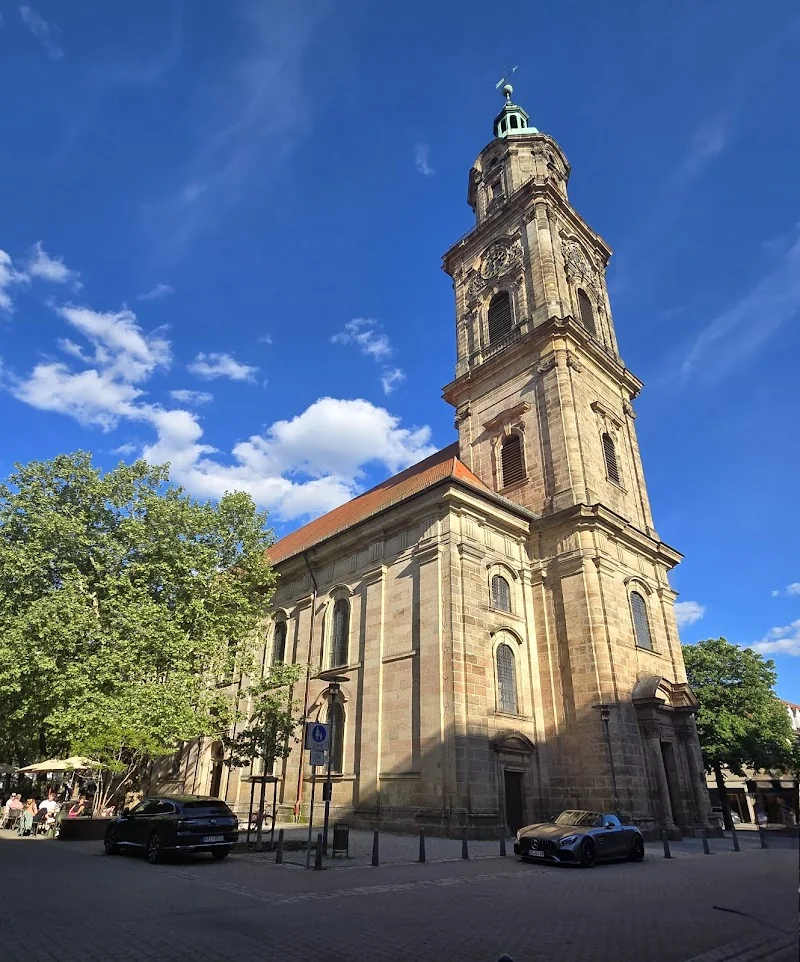
The Neustädter University Church is an impressive photo spot – both inside and outside. Outdoor shots are particularly successful at the eastern end of the square: From there, the view opens up to the two-bay choir closure, which reveals the clear, Baroque structure of the facade. The tower, at 60 meters the tallest church tower in the city, rises above and sets a confident vertical mark in the old town. Due to the narrow streets around the nave, the facade structure is less prominent; therefore, the east view offers the best distance for a balanced motif. Inside, three sight axes are recommended: First, the central axis from the west portal towards the altar area. It leads the gaze over the baptismal font to the pulpit altar – a main work in Franconian Margrave style – flanked by rising columns and enlivened by the ceiling painting above the crossing. Secondly, the view from the choir back to the organ gallery. Here, the frescoes unfold as a narrative cycle: the Birth of Christ, the Crucifixion, the Ascension of Christ, and – as the theological-symbolic highlight – the Eye of God. The frescoes were created in 1734/35 by the Erlangen painter Christian Leinberger; his brother Karl Georg likely contributed. Thirdly, a side view under the galleries is worthwhile, where the spatial effect of the double galleries, the fine profiling of the pilasters, and the rhythmic window arrangement become clear. Those who love details should capture the inscription of the Baroque baptismal font (1707, taken from the Sophienkirche), the ornate fittings of the historical portals, or the angel figures on the sound cover of the pulpit. For outdoor shots, soft morning or late light is recommended, which models the sandstone surfaces plastically. Inside, a mild, even brightness prevails; please be considerate during open church hours, services, and concerts. A formal photography regulation has not been published; generally, it is advisable to heed local notices and not disturb the devotion of others. Those planning photo series will find inspiring motifs of the tower and the square situation on municipal tourism pages. Also, organizer photos from concerts provide good impressions of the perspective from the nave and the galleries.
Opening Hours, Services, and University Tradition
The Neustädter University Church is generally open from Tuesday to Saturday from 11:00 AM to 2:00 PM – ideal for a lunchtime visit with quiet contemplation of frescoes, pulpit altar, and organ facade. As the church is an active venue for services and concerts, times may vary on holidays or during rehearsals; the congregation continuously publishes current notices and dates. As the university church of FAU – this status has existed since 1837 – the church is also closely linked to academic life: Traditionally, a university service takes place every second Sunday during the lecture period, led by a professor of theology. Already on November 4, 1743, during the festive opening of the university, a procession led to the Neustädter Church, where a service integrated the new university into city life. The congregation early on shaped its profile musically; in 1854, the Institute for Church Music was established (now continued in university music). A cultural-historical milestone is also documented: In 1850, the first German children's service was celebrated in the Neustädter Church. The spatial disposition supports the liturgical dramaturgy: The juxtaposition of word proclamation and sacrament is particularly visible in the Margrave style – the pulpit moves to the center above the altar table and is architecturally framed. The portals are located on the north and south sides; the tower portal is preferred for festive processions. On the floor, a star made of Solnhofen slabs marks the intersection of the longitudinal and transverse aisles – the geometric center of the space. Those attending a service experience how the fresco cycle, the sound of the organ, and the architectural axis emphasis interact. Notices of special openings (e.g., guided tours) as well as academic festive services and cantata services can also be found in the congregation's and FAU's event calendar.
Directions & Parking at Neustädter Kirchenplatz
Thanks to its location in the historic city center, the church is particularly easy to reach. From Erlangen train station, a short walk leads over Hugenottenplatz – one of the central squares of the city – further through Apothekergasse directly to Neustädter Kirchenplatz. Those who prefer public transport can get off at the nearby stops Hugenottenplatz or Langemarckplatz, depending on the line. For those arriving by car, the parking garages in the city center are recommended: Among the nearest are the Arcaden parking garage (Nägelsbachstraße 1, 91052 Erlangen) and the Neuer Markt parking garage. The tourist information and the city also point to additional parking garages and underground garages in the center, where capacities are available during most times of the day. Since Neustädter Kirchenplatz is part of the developed old town structure with narrow alleys and pedestrian areas, it is advisable to park the vehicle in the parking garage and walk the last meters. This also reveals the urban planning idea of the Baroque planned city: Altstädter Church, Hugenotten Church, and Neustädter Church are staggered along a parallel to the central north-south axis. On weekdays, the open church is particularly well combined with shopping or a city stroll between 11:00 AM and 2:00 PM; cafés, shops, and paths through the pedestrian zone are just steps away. For visitors with limited mobility: The galleries are accessible via the historic stair towers; individual support for access to the nave can be provided by the team on site, and notices are indicated at events. Those arriving by bicycle will find parking facilities in the public space around the square. For bus groups, the city's regulations on boarding and alighting zones apply; prior coordination with the tourist information or the organizer is advisable if a concert or service visit is planned. Please generally observe the current traffic and parking notices of the city of Erlangen.
Concerts, Tickets & Sound: University Music and Cantorei
The Neustädter University Church is one of the most important concert venues in Erlangen. Under the umbrella of FAU, Erlangen University Music brings together orchestras, choirs, and chamber music – many of its concerts take place in the Neustädter Church. For concerts with admission, prior reservation is usually possible; information is provided by the university music on its website. In addition, the Neustädter Cantorei shapes the church year with motets, cantatas, and festive programs. Ticketing and advance sales are handled differently depending on the organizer: In addition to reservations with university music, some events use regional ticket services. For major festivals like Good Friday or Easter, spiritual concerts and motets are highlighted; the formats range from a cappella choir evenings to Baroque cantata programs. The space is acoustically designed for speech and text intelligibility, making it attractive not only for preaching and congregational singing but also for choral music, soloists, and orchestras. The historic organ facade forms a visual frame: It frames the organ gallery and sets a festive accent in the field of view. For concert attendance, timely arrival is recommended, as free seating is often customary and demand – especially for university music and cantorei – can be high. Program notes are consolidated in the calendar of the church community and FAU; additional formats such as lunchtime tours during Lent open the space beyond the classic concert dates. Students of FAU are active in the ensembles of university music; thus, the church remains a bridge between academic life, urban society, and church music. Event details (entry times, discounted tickets, accessible seats) are announced by the respective organizers in advance; for special requirements, it is advisable to contact the contact details provided in the announcement.
Architecture, Ceiling Frescoes & Organs in Margrave Style
The history of the Neustädter Church is readable in its building substance. The foundation stone was laid on June 19, 1725; on December 8, 1737, the church was consecrated – provisionally completed. In 1744, the still-preserved pulpit altar and the sacristy with the underlying crypt were created. The upper tower floors were added in 1765; the tower helmet with lantern was placed in 1830. Architecturally, the building is committed to Lutheran Baroque: The nave is structured by pilasters with Doric capitals; the two rows of round-arched closing windows already indicate the double galleries outside. Inside, the theological program culminates in the pulpit altar – a typical feature of the Margrave style, which makes the equality of word and sacrament visible. The pulpit (1733) goes back to Johann David Räntz; in 1744, the visible altar architecture was added, including the paintings (e.g., Christ as the Good Shepherd). The ceiling paintings on the mirror ceiling are by Christian Leinberger (1734/35), likely with the participation of his brother Karl Georg. They form a cycle along the main axis: Nativitas (Birth of Christ), Crucifixion, Ascension of Christ, and the Eye of God before a reddish-golden sky. A special eye-catcher is the baptismal font from 1707, originally taken from the Sophienkirche, with acanthus ornamentation, angel heads, and a gilded baptismal bowl. The 60-meter high tower – on a square floor plan, four stories high, and structured in the sequence of classical column orders – is a key to the cityscape: It connects the three major city center churches in a common architectural language. In the crypt rests one of the last burials, Margravine Sophie Caroline Marie († 1817). The organ tradition dates back to the time of construction: In 1741, the Nuremberg organ builder Johann Glis built a two-manual organ with pedal and 31 registers; its magnificent prospect case with figures by sculptor Antonius Merz still shapes the space today. After several renovations in the 19th and 20th centuries, the congregation decided in 2002 to install a new organ in the historic case by the organ building company Goll (Lucerne). The current instrument (III/P/48) combines mechanical action, electronic setter, and a romantically oriented swell behind the main prospect; selected historical registers – including Principal 8’ and 4’ – still sound. A separate choir organ complements the sound; its revisions in the 2010s strengthened the substance. Thus, the church unites an authentic Baroque image with contemporary musical performance capability – an ideal resonance space for cantata, motet, and symphonic music.
Seating Arrangement, Path Guidance & Practical Tips in the Space
Those who perceive the interior structure quickly understand the logic of the Lutheran Baroque church. The main entrances are located on the north and south sides; another portal is located in the tower ground floor and is preferred for festive processions. From the side portals, longitudinal and transverse aisles lead towards each other and intersect at the geometric center of the nave, marked by a star in the floor made of Solnhofen slabs. The seating is divided into four blocks; in the front row, the historical doors that once closed all benches are still preserved. Along the longitudinal walls and at the back wall, an additional row of benches runs. The side double galleries are accessed via two stair towers: They increase the seating capacity and offer an elevated perspective on the pulpit altar and frescoes. The visual axis is clearly oriented towards the principal pieces: baptismal font, communion table, and pulpit lie in a line with the west portal, drawing the spatial effect into depth. For services and many concerts, free seating applies; at individual events, certain areas (e.g., galleries) may be reserved or closed. Since the galleries are accessible via historic stairs, it is advisable to choose seats in the nave for quick entry and exit; however, those who want to keep the entire fresco sequence in view will find a particularly clear sight along the central axis of the nave. For speech and choir, the area in front of the transverse aisle is recommended, where the axis emphasis and proximity to the pulpit interact. Photography enthusiasts will find interesting frames under the galleries but should pay attention to the lighting conditions: The window arrangement creates changing light islands that emphasize the relief effect of stucco painting and carvings. For families with children, edge seats along the longitudinal aisle offer uncomplicated access and exit. Notices for special groups (e.g., choir formations, orchestra disposition, additional seating) are provided by the respective organizer in their announcement; at academic services, the university service ensures orderly processions through the tower portal. Generally, the church is a place of devotion and culture – respectful behavior, quiet mobile phones, and adherence to usher notices ensure a good coexistence in the historic space.
History in Data & Context: From the New Town to University Church
The history of the Neustädter Church reflects the development of Erlangen from the Baroque planned city to today's university and research location. After the arrival of Lutheran and Reformed groups in the newly founded Neustadt in 1686, an independent Lutheran congregation formed in 1703. In 1725 – after intensive fundraising and donations – the foundation stone was laid. The construction supervision was initially with the Bayreuth master builder Wenzel Perner, then with Johann Georg Weiß; Johann David Räntz is documented as the author of the design drawings (south view 1726). The consecration took place in 1737; in 1744, the pulpit altar and sacristy with crypt were built. In 1765, the upper tower floors took shape, and in 1830, an octagonal attachment crowned the tower helmet – the distinctive silhouette that today shapes the cityscape. In 1837, the church was finally designated as the university church; since then, university services have regularly taken place during the lecture period. Significant theological teachers shaped the pulpit and discourse here; names like Adolf Harleß or Gottfried Thomasius stand for the so-called Erlangen theology. The crypt served for burials of noble persons until the early 19th century; the last to be buried there was Margravine Sophie Caroline Marie in 1817. The frescoes of the Leinberger brothers – a stroke of luck also for funding reasons, as the illusionistic painting replaced expensive stucco – still shape the spatial impression today. War damage to paintings and furnishings could be remedied in the 1950s; a comprehensive renovation from 1979 to 1982 brought the space to a uniform standard. The organ history ranges from the Glis organ (1741, 31 registers) through renovations (Walcker, Steinmeyer) to the current Goll organ (III/P/48), which preserves historical substance while being acoustically versatile. In its dual role as parish and university church, the Neustädter Church unites liturgy, teaching, and culture – visible in services, academic celebrations, and a diverse concert program ranging from chamber music to large choral symphonies to solo evenings. Anchored in the city center, close to the train station and lively squares like Hugenottenplatz, it is easily accessible for locals and guests alike – an open house in the heart of the city.
Sources:
- Evangelical-Lutheran (University) Congregation Erlangen-Neustadt – Official Website
- Wikipedia – Neustädter Church (Erlangen)
- Visit Erlangen – Neustädter Church Erlangen
- Erlangen University Music – Current Concerts (FAU)
- Visit Erlangen – Parking in Erlangen (Parking Garages & Notices)
- Visit Erlangen – Parking Garage Neuer Markt
- The Organs of the Neustädter (University) Church – Congregation Brochure (PDF)
- Wikipedia – Hugenottenplatz (Location & Connection to the City Center)
Mehr anzeigenWeniger anzeigen
Neustädter University Church Erlangen | Photos & Opening Hours
In the heart of Erlangen's city center, the Neustädter University Church welcomes visitors as a vibrant city and university church with a rich history, impressive architecture, and active church music. Its 60-meter high tower – the tallest church tower in Erlangen – together with the towers of the Altstädter Church and the Hugenotten Church shapes the cityscape. Upon entering the church, one experiences the typical spaciousness and brightness of a Lutheran Baroque church: double galleries along the longitudinal walls, a wide central aisle, a magnificent pulpit altar, and a continuous series of ceiling paintings define the space. Since 1837, it has been the university church of Friedrich-Alexander-University (FAU) and thus a regular venue for academic services. At the same time, the church is open to culture: Erlangen University Music and the Neustädter Cantorei invite to concerts, Passion motets, and festive programs. For a relaxed visit, clear key data helps: Generally, the church is open from Tuesday to Saturday between 11:00 AM and 2:00 PM. Due to its central location at Neustädter Kirchenplatz, it can be easily reached on foot from the pedestrian zone, the train station, or by bus via the nearby stops. Parking garages in the city center are within walking distance. For photography enthusiasts and architecture lovers, the church is a discovery – from the frescoes of the Leinberger brothers to the pulpit altar and the historic organ facade.
Photos and Visitor Experience in the Neustädter University Church
The Neustädter University Church is an impressive photo spot – both inside and outside. Outdoor shots are particularly successful at the eastern end of the square: From there, the view opens up to the two-bay choir closure, which reveals the clear, Baroque structure of the facade. The tower, at 60 meters the tallest church tower in the city, rises above and sets a confident vertical mark in the old town. Due to the narrow streets around the nave, the facade structure is less prominent; therefore, the east view offers the best distance for a balanced motif. Inside, three sight axes are recommended: First, the central axis from the west portal towards the altar area. It leads the gaze over the baptismal font to the pulpit altar – a main work in Franconian Margrave style – flanked by rising columns and enlivened by the ceiling painting above the crossing. Secondly, the view from the choir back to the organ gallery. Here, the frescoes unfold as a narrative cycle: the Birth of Christ, the Crucifixion, the Ascension of Christ, and – as the theological-symbolic highlight – the Eye of God. The frescoes were created in 1734/35 by the Erlangen painter Christian Leinberger; his brother Karl Georg likely contributed. Thirdly, a side view under the galleries is worthwhile, where the spatial effect of the double galleries, the fine profiling of the pilasters, and the rhythmic window arrangement become clear. Those who love details should capture the inscription of the Baroque baptismal font (1707, taken from the Sophienkirche), the ornate fittings of the historical portals, or the angel figures on the sound cover of the pulpit. For outdoor shots, soft morning or late light is recommended, which models the sandstone surfaces plastically. Inside, a mild, even brightness prevails; please be considerate during open church hours, services, and concerts. A formal photography regulation has not been published; generally, it is advisable to heed local notices and not disturb the devotion of others. Those planning photo series will find inspiring motifs of the tower and the square situation on municipal tourism pages. Also, organizer photos from concerts provide good impressions of the perspective from the nave and the galleries.
Opening Hours, Services, and University Tradition
The Neustädter University Church is generally open from Tuesday to Saturday from 11:00 AM to 2:00 PM – ideal for a lunchtime visit with quiet contemplation of frescoes, pulpit altar, and organ facade. As the church is an active venue for services and concerts, times may vary on holidays or during rehearsals; the congregation continuously publishes current notices and dates. As the university church of FAU – this status has existed since 1837 – the church is also closely linked to academic life: Traditionally, a university service takes place every second Sunday during the lecture period, led by a professor of theology. Already on November 4, 1743, during the festive opening of the university, a procession led to the Neustädter Church, where a service integrated the new university into city life. The congregation early on shaped its profile musically; in 1854, the Institute for Church Music was established (now continued in university music). A cultural-historical milestone is also documented: In 1850, the first German children's service was celebrated in the Neustädter Church. The spatial disposition supports the liturgical dramaturgy: The juxtaposition of word proclamation and sacrament is particularly visible in the Margrave style – the pulpit moves to the center above the altar table and is architecturally framed. The portals are located on the north and south sides; the tower portal is preferred for festive processions. On the floor, a star made of Solnhofen slabs marks the intersection of the longitudinal and transverse aisles – the geometric center of the space. Those attending a service experience how the fresco cycle, the sound of the organ, and the architectural axis emphasis interact. Notices of special openings (e.g., guided tours) as well as academic festive services and cantata services can also be found in the congregation's and FAU's event calendar.
Directions & Parking at Neustädter Kirchenplatz
Thanks to its location in the historic city center, the church is particularly easy to reach. From Erlangen train station, a short walk leads over Hugenottenplatz – one of the central squares of the city – further through Apothekergasse directly to Neustädter Kirchenplatz. Those who prefer public transport can get off at the nearby stops Hugenottenplatz or Langemarckplatz, depending on the line. For those arriving by car, the parking garages in the city center are recommended: Among the nearest are the Arcaden parking garage (Nägelsbachstraße 1, 91052 Erlangen) and the Neuer Markt parking garage. The tourist information and the city also point to additional parking garages and underground garages in the center, where capacities are available during most times of the day. Since Neustädter Kirchenplatz is part of the developed old town structure with narrow alleys and pedestrian areas, it is advisable to park the vehicle in the parking garage and walk the last meters. This also reveals the urban planning idea of the Baroque planned city: Altstädter Church, Hugenotten Church, and Neustädter Church are staggered along a parallel to the central north-south axis. On weekdays, the open church is particularly well combined with shopping or a city stroll between 11:00 AM and 2:00 PM; cafés, shops, and paths through the pedestrian zone are just steps away. For visitors with limited mobility: The galleries are accessible via the historic stair towers; individual support for access to the nave can be provided by the team on site, and notices are indicated at events. Those arriving by bicycle will find parking facilities in the public space around the square. For bus groups, the city's regulations on boarding and alighting zones apply; prior coordination with the tourist information or the organizer is advisable if a concert or service visit is planned. Please generally observe the current traffic and parking notices of the city of Erlangen.
Concerts, Tickets & Sound: University Music and Cantorei
The Neustädter University Church is one of the most important concert venues in Erlangen. Under the umbrella of FAU, Erlangen University Music brings together orchestras, choirs, and chamber music – many of its concerts take place in the Neustädter Church. For concerts with admission, prior reservation is usually possible; information is provided by the university music on its website. In addition, the Neustädter Cantorei shapes the church year with motets, cantatas, and festive programs. Ticketing and advance sales are handled differently depending on the organizer: In addition to reservations with university music, some events use regional ticket services. For major festivals like Good Friday or Easter, spiritual concerts and motets are highlighted; the formats range from a cappella choir evenings to Baroque cantata programs. The space is acoustically designed for speech and text intelligibility, making it attractive not only for preaching and congregational singing but also for choral music, soloists, and orchestras. The historic organ facade forms a visual frame: It frames the organ gallery and sets a festive accent in the field of view. For concert attendance, timely arrival is recommended, as free seating is often customary and demand – especially for university music and cantorei – can be high. Program notes are consolidated in the calendar of the church community and FAU; additional formats such as lunchtime tours during Lent open the space beyond the classic concert dates. Students of FAU are active in the ensembles of university music; thus, the church remains a bridge between academic life, urban society, and church music. Event details (entry times, discounted tickets, accessible seats) are announced by the respective organizers in advance; for special requirements, it is advisable to contact the contact details provided in the announcement.
Architecture, Ceiling Frescoes & Organs in Margrave Style
The history of the Neustädter Church is readable in its building substance. The foundation stone was laid on June 19, 1725; on December 8, 1737, the church was consecrated – provisionally completed. In 1744, the still-preserved pulpit altar and the sacristy with the underlying crypt were created. The upper tower floors were added in 1765; the tower helmet with lantern was placed in 1830. Architecturally, the building is committed to Lutheran Baroque: The nave is structured by pilasters with Doric capitals; the two rows of round-arched closing windows already indicate the double galleries outside. Inside, the theological program culminates in the pulpit altar – a typical feature of the Margrave style, which makes the equality of word and sacrament visible. The pulpit (1733) goes back to Johann David Räntz; in 1744, the visible altar architecture was added, including the paintings (e.g., Christ as the Good Shepherd). The ceiling paintings on the mirror ceiling are by Christian Leinberger (1734/35), likely with the participation of his brother Karl Georg. They form a cycle along the main axis: Nativitas (Birth of Christ), Crucifixion, Ascension of Christ, and the Eye of God before a reddish-golden sky. A special eye-catcher is the baptismal font from 1707, originally taken from the Sophienkirche, with acanthus ornamentation, angel heads, and a gilded baptismal bowl. The 60-meter high tower – on a square floor plan, four stories high, and structured in the sequence of classical column orders – is a key to the cityscape: It connects the three major city center churches in a common architectural language. In the crypt rests one of the last burials, Margravine Sophie Caroline Marie († 1817). The organ tradition dates back to the time of construction: In 1741, the Nuremberg organ builder Johann Glis built a two-manual organ with pedal and 31 registers; its magnificent prospect case with figures by sculptor Antonius Merz still shapes the space today. After several renovations in the 19th and 20th centuries, the congregation decided in 2002 to install a new organ in the historic case by the organ building company Goll (Lucerne). The current instrument (III/P/48) combines mechanical action, electronic setter, and a romantically oriented swell behind the main prospect; selected historical registers – including Principal 8’ and 4’ – still sound. A separate choir organ complements the sound; its revisions in the 2010s strengthened the substance. Thus, the church unites an authentic Baroque image with contemporary musical performance capability – an ideal resonance space for cantata, motet, and symphonic music.
Seating Arrangement, Path Guidance & Practical Tips in the Space
Those who perceive the interior structure quickly understand the logic of the Lutheran Baroque church. The main entrances are located on the north and south sides; another portal is located in the tower ground floor and is preferred for festive processions. From the side portals, longitudinal and transverse aisles lead towards each other and intersect at the geometric center of the nave, marked by a star in the floor made of Solnhofen slabs. The seating is divided into four blocks; in the front row, the historical doors that once closed all benches are still preserved. Along the longitudinal walls and at the back wall, an additional row of benches runs. The side double galleries are accessed via two stair towers: They increase the seating capacity and offer an elevated perspective on the pulpit altar and frescoes. The visual axis is clearly oriented towards the principal pieces: baptismal font, communion table, and pulpit lie in a line with the west portal, drawing the spatial effect into depth. For services and many concerts, free seating applies; at individual events, certain areas (e.g., galleries) may be reserved or closed. Since the galleries are accessible via historic stairs, it is advisable to choose seats in the nave for quick entry and exit; however, those who want to keep the entire fresco sequence in view will find a particularly clear sight along the central axis of the nave. For speech and choir, the area in front of the transverse aisle is recommended, where the axis emphasis and proximity to the pulpit interact. Photography enthusiasts will find interesting frames under the galleries but should pay attention to the lighting conditions: The window arrangement creates changing light islands that emphasize the relief effect of stucco painting and carvings. For families with children, edge seats along the longitudinal aisle offer uncomplicated access and exit. Notices for special groups (e.g., choir formations, orchestra disposition, additional seating) are provided by the respective organizer in their announcement; at academic services, the university service ensures orderly processions through the tower portal. Generally, the church is a place of devotion and culture – respectful behavior, quiet mobile phones, and adherence to usher notices ensure a good coexistence in the historic space.
History in Data & Context: From the New Town to University Church
The history of the Neustädter Church reflects the development of Erlangen from the Baroque planned city to today's university and research location. After the arrival of Lutheran and Reformed groups in the newly founded Neustadt in 1686, an independent Lutheran congregation formed in 1703. In 1725 – after intensive fundraising and donations – the foundation stone was laid. The construction supervision was initially with the Bayreuth master builder Wenzel Perner, then with Johann Georg Weiß; Johann David Räntz is documented as the author of the design drawings (south view 1726). The consecration took place in 1737; in 1744, the pulpit altar and sacristy with crypt were built. In 1765, the upper tower floors took shape, and in 1830, an octagonal attachment crowned the tower helmet – the distinctive silhouette that today shapes the cityscape. In 1837, the church was finally designated as the university church; since then, university services have regularly taken place during the lecture period. Significant theological teachers shaped the pulpit and discourse here; names like Adolf Harleß or Gottfried Thomasius stand for the so-called Erlangen theology. The crypt served for burials of noble persons until the early 19th century; the last to be buried there was Margravine Sophie Caroline Marie in 1817. The frescoes of the Leinberger brothers – a stroke of luck also for funding reasons, as the illusionistic painting replaced expensive stucco – still shape the spatial impression today. War damage to paintings and furnishings could be remedied in the 1950s; a comprehensive renovation from 1979 to 1982 brought the space to a uniform standard. The organ history ranges from the Glis organ (1741, 31 registers) through renovations (Walcker, Steinmeyer) to the current Goll organ (III/P/48), which preserves historical substance while being acoustically versatile. In its dual role as parish and university church, the Neustädter Church unites liturgy, teaching, and culture – visible in services, academic celebrations, and a diverse concert program ranging from chamber music to large choral symphonies to solo evenings. Anchored in the city center, close to the train station and lively squares like Hugenottenplatz, it is easily accessible for locals and guests alike – an open house in the heart of the city.
Sources:
- Evangelical-Lutheran (University) Congregation Erlangen-Neustadt – Official Website
- Wikipedia – Neustädter Church (Erlangen)
- Visit Erlangen – Neustädter Church Erlangen
- Erlangen University Music – Current Concerts (FAU)
- Visit Erlangen – Parking in Erlangen (Parking Garages & Notices)
- Visit Erlangen – Parking Garage Neuer Markt
- The Organs of the Neustädter (University) Church – Congregation Brochure (PDF)
- Wikipedia – Hugenottenplatz (Location & Connection to the City Center)
Neustädter University Church Erlangen | Photos & Opening Hours
In the heart of Erlangen's city center, the Neustädter University Church welcomes visitors as a vibrant city and university church with a rich history, impressive architecture, and active church music. Its 60-meter high tower – the tallest church tower in Erlangen – together with the towers of the Altstädter Church and the Hugenotten Church shapes the cityscape. Upon entering the church, one experiences the typical spaciousness and brightness of a Lutheran Baroque church: double galleries along the longitudinal walls, a wide central aisle, a magnificent pulpit altar, and a continuous series of ceiling paintings define the space. Since 1837, it has been the university church of Friedrich-Alexander-University (FAU) and thus a regular venue for academic services. At the same time, the church is open to culture: Erlangen University Music and the Neustädter Cantorei invite to concerts, Passion motets, and festive programs. For a relaxed visit, clear key data helps: Generally, the church is open from Tuesday to Saturday between 11:00 AM and 2:00 PM. Due to its central location at Neustädter Kirchenplatz, it can be easily reached on foot from the pedestrian zone, the train station, or by bus via the nearby stops. Parking garages in the city center are within walking distance. For photography enthusiasts and architecture lovers, the church is a discovery – from the frescoes of the Leinberger brothers to the pulpit altar and the historic organ facade.
Photos and Visitor Experience in the Neustädter University Church
The Neustädter University Church is an impressive photo spot – both inside and outside. Outdoor shots are particularly successful at the eastern end of the square: From there, the view opens up to the two-bay choir closure, which reveals the clear, Baroque structure of the facade. The tower, at 60 meters the tallest church tower in the city, rises above and sets a confident vertical mark in the old town. Due to the narrow streets around the nave, the facade structure is less prominent; therefore, the east view offers the best distance for a balanced motif. Inside, three sight axes are recommended: First, the central axis from the west portal towards the altar area. It leads the gaze over the baptismal font to the pulpit altar – a main work in Franconian Margrave style – flanked by rising columns and enlivened by the ceiling painting above the crossing. Secondly, the view from the choir back to the organ gallery. Here, the frescoes unfold as a narrative cycle: the Birth of Christ, the Crucifixion, the Ascension of Christ, and – as the theological-symbolic highlight – the Eye of God. The frescoes were created in 1734/35 by the Erlangen painter Christian Leinberger; his brother Karl Georg likely contributed. Thirdly, a side view under the galleries is worthwhile, where the spatial effect of the double galleries, the fine profiling of the pilasters, and the rhythmic window arrangement become clear. Those who love details should capture the inscription of the Baroque baptismal font (1707, taken from the Sophienkirche), the ornate fittings of the historical portals, or the angel figures on the sound cover of the pulpit. For outdoor shots, soft morning or late light is recommended, which models the sandstone surfaces plastically. Inside, a mild, even brightness prevails; please be considerate during open church hours, services, and concerts. A formal photography regulation has not been published; generally, it is advisable to heed local notices and not disturb the devotion of others. Those planning photo series will find inspiring motifs of the tower and the square situation on municipal tourism pages. Also, organizer photos from concerts provide good impressions of the perspective from the nave and the galleries.
Opening Hours, Services, and University Tradition
The Neustädter University Church is generally open from Tuesday to Saturday from 11:00 AM to 2:00 PM – ideal for a lunchtime visit with quiet contemplation of frescoes, pulpit altar, and organ facade. As the church is an active venue for services and concerts, times may vary on holidays or during rehearsals; the congregation continuously publishes current notices and dates. As the university church of FAU – this status has existed since 1837 – the church is also closely linked to academic life: Traditionally, a university service takes place every second Sunday during the lecture period, led by a professor of theology. Already on November 4, 1743, during the festive opening of the university, a procession led to the Neustädter Church, where a service integrated the new university into city life. The congregation early on shaped its profile musically; in 1854, the Institute for Church Music was established (now continued in university music). A cultural-historical milestone is also documented: In 1850, the first German children's service was celebrated in the Neustädter Church. The spatial disposition supports the liturgical dramaturgy: The juxtaposition of word proclamation and sacrament is particularly visible in the Margrave style – the pulpit moves to the center above the altar table and is architecturally framed. The portals are located on the north and south sides; the tower portal is preferred for festive processions. On the floor, a star made of Solnhofen slabs marks the intersection of the longitudinal and transverse aisles – the geometric center of the space. Those attending a service experience how the fresco cycle, the sound of the organ, and the architectural axis emphasis interact. Notices of special openings (e.g., guided tours) as well as academic festive services and cantata services can also be found in the congregation's and FAU's event calendar.
Directions & Parking at Neustädter Kirchenplatz
Thanks to its location in the historic city center, the church is particularly easy to reach. From Erlangen train station, a short walk leads over Hugenottenplatz – one of the central squares of the city – further through Apothekergasse directly to Neustädter Kirchenplatz. Those who prefer public transport can get off at the nearby stops Hugenottenplatz or Langemarckplatz, depending on the line. For those arriving by car, the parking garages in the city center are recommended: Among the nearest are the Arcaden parking garage (Nägelsbachstraße 1, 91052 Erlangen) and the Neuer Markt parking garage. The tourist information and the city also point to additional parking garages and underground garages in the center, where capacities are available during most times of the day. Since Neustädter Kirchenplatz is part of the developed old town structure with narrow alleys and pedestrian areas, it is advisable to park the vehicle in the parking garage and walk the last meters. This also reveals the urban planning idea of the Baroque planned city: Altstädter Church, Hugenotten Church, and Neustädter Church are staggered along a parallel to the central north-south axis. On weekdays, the open church is particularly well combined with shopping or a city stroll between 11:00 AM and 2:00 PM; cafés, shops, and paths through the pedestrian zone are just steps away. For visitors with limited mobility: The galleries are accessible via the historic stair towers; individual support for access to the nave can be provided by the team on site, and notices are indicated at events. Those arriving by bicycle will find parking facilities in the public space around the square. For bus groups, the city's regulations on boarding and alighting zones apply; prior coordination with the tourist information or the organizer is advisable if a concert or service visit is planned. Please generally observe the current traffic and parking notices of the city of Erlangen.
Concerts, Tickets & Sound: University Music and Cantorei
The Neustädter University Church is one of the most important concert venues in Erlangen. Under the umbrella of FAU, Erlangen University Music brings together orchestras, choirs, and chamber music – many of its concerts take place in the Neustädter Church. For concerts with admission, prior reservation is usually possible; information is provided by the university music on its website. In addition, the Neustädter Cantorei shapes the church year with motets, cantatas, and festive programs. Ticketing and advance sales are handled differently depending on the organizer: In addition to reservations with university music, some events use regional ticket services. For major festivals like Good Friday or Easter, spiritual concerts and motets are highlighted; the formats range from a cappella choir evenings to Baroque cantata programs. The space is acoustically designed for speech and text intelligibility, making it attractive not only for preaching and congregational singing but also for choral music, soloists, and orchestras. The historic organ facade forms a visual frame: It frames the organ gallery and sets a festive accent in the field of view. For concert attendance, timely arrival is recommended, as free seating is often customary and demand – especially for university music and cantorei – can be high. Program notes are consolidated in the calendar of the church community and FAU; additional formats such as lunchtime tours during Lent open the space beyond the classic concert dates. Students of FAU are active in the ensembles of university music; thus, the church remains a bridge between academic life, urban society, and church music. Event details (entry times, discounted tickets, accessible seats) are announced by the respective organizers in advance; for special requirements, it is advisable to contact the contact details provided in the announcement.
Architecture, Ceiling Frescoes & Organs in Margrave Style
The history of the Neustädter Church is readable in its building substance. The foundation stone was laid on June 19, 1725; on December 8, 1737, the church was consecrated – provisionally completed. In 1744, the still-preserved pulpit altar and the sacristy with the underlying crypt were created. The upper tower floors were added in 1765; the tower helmet with lantern was placed in 1830. Architecturally, the building is committed to Lutheran Baroque: The nave is structured by pilasters with Doric capitals; the two rows of round-arched closing windows already indicate the double galleries outside. Inside, the theological program culminates in the pulpit altar – a typical feature of the Margrave style, which makes the equality of word and sacrament visible. The pulpit (1733) goes back to Johann David Räntz; in 1744, the visible altar architecture was added, including the paintings (e.g., Christ as the Good Shepherd). The ceiling paintings on the mirror ceiling are by Christian Leinberger (1734/35), likely with the participation of his brother Karl Georg. They form a cycle along the main axis: Nativitas (Birth of Christ), Crucifixion, Ascension of Christ, and the Eye of God before a reddish-golden sky. A special eye-catcher is the baptismal font from 1707, originally taken from the Sophienkirche, with acanthus ornamentation, angel heads, and a gilded baptismal bowl. The 60-meter high tower – on a square floor plan, four stories high, and structured in the sequence of classical column orders – is a key to the cityscape: It connects the three major city center churches in a common architectural language. In the crypt rests one of the last burials, Margravine Sophie Caroline Marie († 1817). The organ tradition dates back to the time of construction: In 1741, the Nuremberg organ builder Johann Glis built a two-manual organ with pedal and 31 registers; its magnificent prospect case with figures by sculptor Antonius Merz still shapes the space today. After several renovations in the 19th and 20th centuries, the congregation decided in 2002 to install a new organ in the historic case by the organ building company Goll (Lucerne). The current instrument (III/P/48) combines mechanical action, electronic setter, and a romantically oriented swell behind the main prospect; selected historical registers – including Principal 8’ and 4’ – still sound. A separate choir organ complements the sound; its revisions in the 2010s strengthened the substance. Thus, the church unites an authentic Baroque image with contemporary musical performance capability – an ideal resonance space for cantata, motet, and symphonic music.
Seating Arrangement, Path Guidance & Practical Tips in the Space
Those who perceive the interior structure quickly understand the logic of the Lutheran Baroque church. The main entrances are located on the north and south sides; another portal is located in the tower ground floor and is preferred for festive processions. From the side portals, longitudinal and transverse aisles lead towards each other and intersect at the geometric center of the nave, marked by a star in the floor made of Solnhofen slabs. The seating is divided into four blocks; in the front row, the historical doors that once closed all benches are still preserved. Along the longitudinal walls and at the back wall, an additional row of benches runs. The side double galleries are accessed via two stair towers: They increase the seating capacity and offer an elevated perspective on the pulpit altar and frescoes. The visual axis is clearly oriented towards the principal pieces: baptismal font, communion table, and pulpit lie in a line with the west portal, drawing the spatial effect into depth. For services and many concerts, free seating applies; at individual events, certain areas (e.g., galleries) may be reserved or closed. Since the galleries are accessible via historic stairs, it is advisable to choose seats in the nave for quick entry and exit; however, those who want to keep the entire fresco sequence in view will find a particularly clear sight along the central axis of the nave. For speech and choir, the area in front of the transverse aisle is recommended, where the axis emphasis and proximity to the pulpit interact. Photography enthusiasts will find interesting frames under the galleries but should pay attention to the lighting conditions: The window arrangement creates changing light islands that emphasize the relief effect of stucco painting and carvings. For families with children, edge seats along the longitudinal aisle offer uncomplicated access and exit. Notices for special groups (e.g., choir formations, orchestra disposition, additional seating) are provided by the respective organizer in their announcement; at academic services, the university service ensures orderly processions through the tower portal. Generally, the church is a place of devotion and culture – respectful behavior, quiet mobile phones, and adherence to usher notices ensure a good coexistence in the historic space.
History in Data & Context: From the New Town to University Church
The history of the Neustädter Church reflects the development of Erlangen from the Baroque planned city to today's university and research location. After the arrival of Lutheran and Reformed groups in the newly founded Neustadt in 1686, an independent Lutheran congregation formed in 1703. In 1725 – after intensive fundraising and donations – the foundation stone was laid. The construction supervision was initially with the Bayreuth master builder Wenzel Perner, then with Johann Georg Weiß; Johann David Räntz is documented as the author of the design drawings (south view 1726). The consecration took place in 1737; in 1744, the pulpit altar and sacristy with crypt were built. In 1765, the upper tower floors took shape, and in 1830, an octagonal attachment crowned the tower helmet – the distinctive silhouette that today shapes the cityscape. In 1837, the church was finally designated as the university church; since then, university services have regularly taken place during the lecture period. Significant theological teachers shaped the pulpit and discourse here; names like Adolf Harleß or Gottfried Thomasius stand for the so-called Erlangen theology. The crypt served for burials of noble persons until the early 19th century; the last to be buried there was Margravine Sophie Caroline Marie in 1817. The frescoes of the Leinberger brothers – a stroke of luck also for funding reasons, as the illusionistic painting replaced expensive stucco – still shape the spatial impression today. War damage to paintings and furnishings could be remedied in the 1950s; a comprehensive renovation from 1979 to 1982 brought the space to a uniform standard. The organ history ranges from the Glis organ (1741, 31 registers) through renovations (Walcker, Steinmeyer) to the current Goll organ (III/P/48), which preserves historical substance while being acoustically versatile. In its dual role as parish and university church, the Neustädter Church unites liturgy, teaching, and culture – visible in services, academic celebrations, and a diverse concert program ranging from chamber music to large choral symphonies to solo evenings. Anchored in the city center, close to the train station and lively squares like Hugenottenplatz, it is easily accessible for locals and guests alike – an open house in the heart of the city.
Sources:
- Evangelical-Lutheran (University) Congregation Erlangen-Neustadt – Official Website
- Wikipedia – Neustädter Church (Erlangen)
- Visit Erlangen – Neustädter Church Erlangen
- Erlangen University Music – Current Concerts (FAU)
- Visit Erlangen – Parking in Erlangen (Parking Garages & Notices)
- Visit Erlangen – Parking Garage Neuer Markt
- The Organs of the Neustädter (University) Church – Congregation Brochure (PDF)
- Wikipedia – Hugenottenplatz (Location & Connection to the City Center)
Upcoming Events
No events found
Frequently Asked Questions
Reviews
cy baek
8. September 2025
Such a nice place to take a rest and relax. This church provides us beautiful scenery and is surrounded by many restaurants where you can have simple foods and coffee.
Shashank Vikram
15. March 2021
No doubt, a beautiful church. New City Church, which it literally translates to, is located a stone's throw away from Erlangen railway station. Surrounded by quiet, cobbled streets and dotted with old houses, it certainly meets the theme of old European town with idyllic settings. The area also boasts many shops, coffee, merchandise, souvenirs, and artisanal bakeries in its vicinity. A modern shopping mall, with all the trappings of urban life is also not too far.
david antoun
16. September 2025
18th century baroque church.
Tak Wong
25. March 2023
As there is a spacious room for organizing some events outside the church, such as a Christmas market. There is a spring festival event being held outside the church this afternoon 👏🏻👏🏻🎉🎉
Max Daeschler
13. December 2018
Evangelic Church, Church of University, situated between Train Station and Arcaden: 100% worth a visit, paintings are made by Christian Leimberger. It is regularly open 11am - 2pm every day. For more information see the printed guides inside the Church (available for take-away in various languages).