
Erlangen
Paul-Gordan-Straße 17, 91052 Erlangen, Deutschland
Pauli | History & Access
Pauli in Erlangen represents a place in Röthelheimpark where urban development, monument preservation, and current neighborhood usage come together closely. The area is located in the eastern part of Erlangen, a district with around 8,100 inhabitants, and belongs to the historical context of the former artillery barracks, which later became known as Ferris Barracks. Today, the preserved buildings, open spaces, and the nearby recreational facility shape the image. Those looking for Pauli will discover not only an address on Paul-Gordan-Straße but also a piece of Erlangen's history that has evolved from a military site into a vibrant neighborhood. ([erlangen.de](https://erlangen.de/aktuelles/stadtteil-roethelheimpark))
History of the Artillery Barracks and Ferris Barracks
The official monument list of the Bavarian State Office for Monument Preservation lists the complex under D-5-62-000-928 and describes it as a former artillery barracks with a supply office. It was built for the 10th Bavarian Field Artillery Regiment, with construction planning dating from 1899 to 1903, and later additions followed in 1912/13 and in the 1930s. This makes it clear that Pauli was not created as a short-term new building but as a developed military functional site with a clear historical layering. This layering is still discernible in the existing structures today. ([geodaten.bayern.de](https://www.geodaten.bayern.de/denkmal_static_data/externe_denkmalliste/pdf/denkmalliste_merge_562000.pdf))
After World War II, the site was used by the US forces and operated as Ferris Barracks. A municipal conversion document states that the US Department of Defense abandoned the Ferris Barracks in June 1993, ownership transferred to the Federal Republic in 1994, and the neighborhood was named Röthelheimpark starting in 1997. Thus, Pauli is also an example of how a military site can evolve into a modern neighborhood without completely losing its architectural memory. ([ratsinfo.erlangen.de](https://ratsinfo.erlangen.de/getfile.asp?id=18075309&type=do&utm_source=openai))
The monument group includes not only individual facades but a whole ensemble of different uses: staff buildings, a casino, barracks, guard and detention buildings, stables, riding halls, magazines, an economic building, and the former chapel. The monument text describes many of these buildings as historicist or in the Art Nouveau style, mostly with visible bricks, hipped roofs, gables, and clearly structured risalits. This mixture of function and representation gives the place its special character. Here, one can see how military functional architecture around 1900 was combined with architectural aspirations. ([geodaten.bayern.de](https://www.geodaten.bayern.de/denkmal_static_data/externe_denkmalliste/pdf/denkmalliste_merge_562000.pdf))
The spatial structure also tells a story. The buildings were not randomly arranged but follow a clear barracks logic with service buildings, riding and stable areas, accommodations, and infrastructure. Anyone walking through the area today can still recognize that the facility was designed for efficiency, order, and long-term use. At the same time, the different facades show that the complex was meant to be more than just military technology. Therefore, Pauli is not just a place of remembrance but also a lesson in architectural history in the south and east of Erlangen. ([geodaten.bayern.de](https://www.geodaten.bayern.de/denkmal_static_data/externe_denkmalliste/pdf/denkmalliste_merge_562000.pdf))
Röthelheimpark, Location and Orientation in Erlangen
Röthelheimpark is, according to the city of Erlangen, an eastern part of the city. The administration describes the neighborhood as a place where topics such as daycare centers, bus connections, and shopping opportunities are at the forefront, which are exactly the questions typical for a developed residential and neighborhood location. This places Pauli in an environment that is not only historically relevant but also well integrated into daily life. For orientation, it is best to think in terms of neighborhood structures: Erlangen-East, Röthelheimpark, and Paul-Gordan-Straße are the sensible search terms in the area. ([erlangen.de](https://erlangen.de/aktuelles/stadtteil-roethelheimpark))
The exact address Paul-Gordan-Straße 17 lies within the larger monument ensemble, which extends over several house numbers and streets. The monument list includes, among others, Paul-Gordan-Straße 15, 17, 19, 21, and 23 along with other buildings around Carl-Thiersch-Straße, Konrad-Zuse-Straße, and Artilleriestraße. This makes it clear that Pauli is not an isolated single object but part of a whole structure of former barracks and service buildings. This is helpful for visitors because it allows for a better understanding of the place as an ensemble rather than just a single house number. ([geodaten.bayern.de](https://www.geodaten.bayern.de/denkmal_static_data/externe_denkmalliste/pdf/denkmalliste_merge_562000.pdf))
The city's annual report on urban renewal explains that the Röthelheimpark district emerged in the mid-1990s as part of the conversion of military-used areas. At the same time, it emphasizes that the oldest settlement developments in the southeastern part of Erlangen date back to the listed buildings of the artillery barracks at the drill ground. Therefore, Pauli stands at an intersection of urban planning, history, and the present: a place where one can still trace the transition from barracks to neighborhood. ([erlangen.de](https://erlangen.de/uwao-api/faila/files/bypath/Dokumente/Bauen%20%26%20Planen/Stadterneuerung/Jahresberichte/jahresbericht_2022-24_.pdf?q=normal&s=list&tn=1&utm_source=openai))
Visitors experiencing the neighborhood quickly realize that the site does not function like a closed attraction but like a piece of lived city. Between the historical buildings, modern residential areas, and public spaces, a calm yet open impression emerges. This is typical for Erlangen: The city connects compact paths, clear neighborhoods, and a strong mix of tradition and everyday life. Pauli fits very well into this picture and can therefore be read both historically and urbanistically. ([erlangen.de](https://erlangen.de/aktuelles/stadtteil-roethelheimpark))
Recreational Facility Paul-Gordan-Straße and Current Use
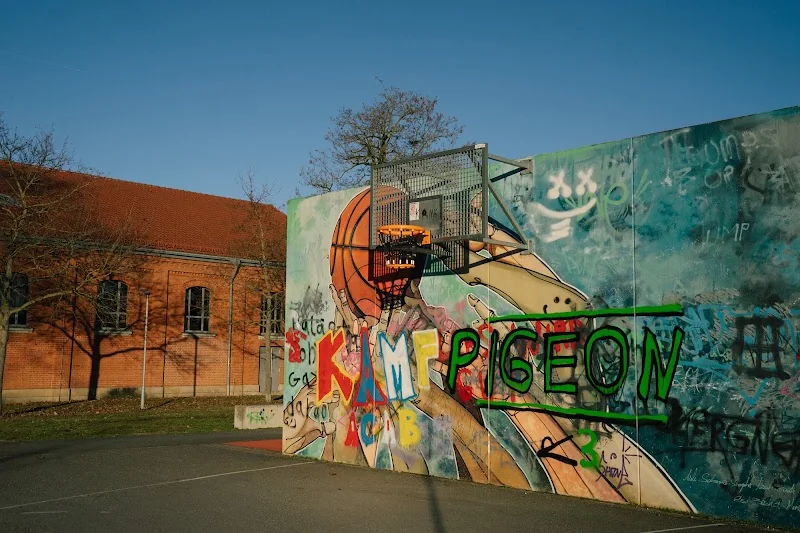
Today, Pauli is not only a historical site but also part of an active neighborhood. The city of Erlangen operates a recreational facility in direct relation to Paul-Gordan-Straße with table tennis tables, streetball, a petanque court, and a bouldering wall. This significantly enhances the environment for families, young people, and anyone wanting to be outdoors. This mixture is particularly interesting: The historical heritage remains visible while the neighborhood simultaneously receives a modern recreational offering. ([erlangen.de](https://erlangen.de/aktuelles/freizeitanlage-paul-gordan-strasse))
The recreational facility is also a good sign of how the neighborhood functions. According to the department, Erlangen maintains over 120 public playgrounds, trend sports, and recreational facilities that are continuously maintained, renewed, and further developed. Therefore, Pauli is not in a museum-like standstill but in an environment where urban life, movement, and community meet. Visitors to the site thus receive not only historical architecture but also a vibrant picture of today's everyday life in Röthelheimpark. ([erlangen.de](https://erlangen.de/aktuelles/freizeitanlage-paul-gordan-strasse))
Particularly noteworthy is that the site radiates calm and continuity through its buildings, while the recreational offerings right next to it provide for movement. This tension is what makes it appealing: an area with a military past where today children play, people exercise, and residents use the urban space as a neighborhood space. From an SEO perspective, terms like history, recreational facility, Röthelheimpark, and Paul-Gordan-Straße are the strongest local search motives because they best capture the character of the site. ([erlangen.de](https://erlangen.de/aktuelles/freizeitanlage-paul-gordan-strasse))
For a site like Pauli, this form of use is particularly valuable because it prevents monument preservation and everyday life from becoming separate worlds. The place remains visible, accessible, and meaningfully embedded. This is also pleasant for visitors, as one experiences not only a historical backdrop but an area that is genuinely needed in the neighborhood. This is precisely why Pauli remains relevant, even though its military function is long past. ([geodaten.bayern.de](https://www.geodaten.bayern.de/denkmal_static_data/externe_denkmalliste/pdf/denkmalliste_merge_562000.pdf))
Access, Parking, and Practical Tips
For access, it is important to know that Erlangen itself has a relatively clear parking and mobility structure. The city currently informs that there are free capacities in parking garages and underground garages around the city center at all times of the day and that the free city center area extends from the large parking lot to Zollhausplatz. For Pauli in Röthelheimpark, this is useful as orientation because one can plan the visit depending on the destination either by car, by bike, or in combination with public paths. ([erlangen.de](https://erlangen.de/aktuelles/parken-in-erlangen?utm_source=openai))
The large parking lot is located, according to the city, between the A73 and the train station; the official access recommendation is via the Erlangen-Center exit. Even though this parking lot is not directly on Paul-Gordan-Straße, the city's mobility strategy shows that Erlangen directs visitor flows through well-signposted and connected parking spaces. Therefore, anyone visiting Pauli should plan the specific route in advance and not rely solely on a spontaneous search. ([erlangen.de](https://erlangen.de/aktuelles/parken-in-erlangen?utm_source=openai))
In Röthelheimpark itself, the location is urban and well integrated, but the most suitable search strategy remains simple: Paul-Gordan-Straße, Röthelheimpark, and Erlangen-East. The city explicitly describes the neighborhood as a place where bus connections and accessibility are regularly discussed. This suggests that when visiting, one should check the current traffic situation instead of adopting old habits. Especially in a neighborhood that has emerged from a conversion area, paths, entrances, and uses can change over time. ([erlangen.de](https://erlangen.de/aktuelles/stadtteil-roethelheimpark))
Practically speaking, this means: Those driving to Pauli should coordinate their arrival with the time of day and destination; those coming on foot or by bike benefit from the compact neighborhood structure in the east of Erlangen. For visitors who want to experience the historical character of the site, a slow approach is also advisable. The ensemble appears best when one takes the time to consciously perceive the sequence of buildings, open spaces, and recreational offerings. ([geodaten.bayern.de](https://www.geodaten.bayern.de/denkmal_static_data/externe_denkmalliste/pdf/denkmalliste_merge_562000.pdf))
What Makes Pauli Special in the Neighborhood
Ultimately, Pauli is exciting because the place shows several levels at once. Erlangen describes itself as a baroque planned city, a Huguenot city, a bicycle city, a university city, and a medical location. In this diverse environment, Röthelheimpark with its conversion history fits surprisingly well into the urban landscape: a former military area is transformed into a residential and living space without denying its origins. Therefore, those visiting Pauli receive a small but very typical glimpse of what makes Erlangen a city. ([en.visit-erlangen.de](https://en.visit-erlangen.de/visiterlangen/?utm_source=openai))
The architectural language of the place also contributes to its identity. The historic visible brick buildings, riding halls, and service buildings differ significantly from the newer neighborhood components of Röthelheimpark. This makes the site photographically and atmospherically interesting: hard lines, red bricks, clear structures, and next to them the openness of a modern neighborhood. It is a place for people who do not just want to see a single building but can read the transition between past and present. ([geodaten.bayern.de](https://www.geodaten.bayern.de/denkmal_static_data/externe_denkmalliste/pdf/denkmalliste_merge_562000.pdf))
In the everyday life of the district, Pauli does not present itself as an isolated special case but as part of a walkable, usable urban space. The combination of monument, recreational facility, and residential neighborhood is important because it keeps the site permanently relevant. Instead of a purely tourist backdrop, a lively place emerges where history is not just documented but continues to be written in the surroundings. This is precisely the strength of this site and the reason why a visit is worthwhile even for short trips and spontaneous discoveries. ([erlangen.de](https://erlangen.de/aktuelles/freizeitanlage-paul-gordan-strasse))
Those searching for Pauli online often expect little spectacular and then find a surprisingly multifaceted urban landscape: the memory of the Ferris Barracks, the transformation into Röthelheimpark, the recreational facility on Paul-Gordan-Straße, and the integration into the Erlangen urban structure. This interplay should be conveyed by a good location page because it helps visitors to create a real, tangible image from a name. ([ratsinfo.erlangen.de](https://ratsinfo.erlangen.de/getfile.asp?id=18075309&type=do&utm_source=openai))
Sources:
- Bavarian State Office for Monument Preservation - Monument List Erlangen
- City of Erlangen - District Röthelheimpark
- City of Erlangen - Recreational Facility Paul-Gordan-Straße
- City of Erlangen - Parking in Erlangen
- City of Erlangen - Conversion Ferris Barracks and Röthelheimpark
- City of Erlangen - Urban Renewal Annual Report 2022-24
Mehr anzeigenWeniger anzeigen
Pauli | History & Access
Pauli in Erlangen represents a place in Röthelheimpark where urban development, monument preservation, and current neighborhood usage come together closely. The area is located in the eastern part of Erlangen, a district with around 8,100 inhabitants, and belongs to the historical context of the former artillery barracks, which later became known as Ferris Barracks. Today, the preserved buildings, open spaces, and the nearby recreational facility shape the image. Those looking for Pauli will discover not only an address on Paul-Gordan-Straße but also a piece of Erlangen's history that has evolved from a military site into a vibrant neighborhood. ([erlangen.de](https://erlangen.de/aktuelles/stadtteil-roethelheimpark))
History of the Artillery Barracks and Ferris Barracks
The official monument list of the Bavarian State Office for Monument Preservation lists the complex under D-5-62-000-928 and describes it as a former artillery barracks with a supply office. It was built for the 10th Bavarian Field Artillery Regiment, with construction planning dating from 1899 to 1903, and later additions followed in 1912/13 and in the 1930s. This makes it clear that Pauli was not created as a short-term new building but as a developed military functional site with a clear historical layering. This layering is still discernible in the existing structures today. ([geodaten.bayern.de](https://www.geodaten.bayern.de/denkmal_static_data/externe_denkmalliste/pdf/denkmalliste_merge_562000.pdf))
After World War II, the site was used by the US forces and operated as Ferris Barracks. A municipal conversion document states that the US Department of Defense abandoned the Ferris Barracks in June 1993, ownership transferred to the Federal Republic in 1994, and the neighborhood was named Röthelheimpark starting in 1997. Thus, Pauli is also an example of how a military site can evolve into a modern neighborhood without completely losing its architectural memory. ([ratsinfo.erlangen.de](https://ratsinfo.erlangen.de/getfile.asp?id=18075309&type=do&utm_source=openai))
The monument group includes not only individual facades but a whole ensemble of different uses: staff buildings, a casino, barracks, guard and detention buildings, stables, riding halls, magazines, an economic building, and the former chapel. The monument text describes many of these buildings as historicist or in the Art Nouveau style, mostly with visible bricks, hipped roofs, gables, and clearly structured risalits. This mixture of function and representation gives the place its special character. Here, one can see how military functional architecture around 1900 was combined with architectural aspirations. ([geodaten.bayern.de](https://www.geodaten.bayern.de/denkmal_static_data/externe_denkmalliste/pdf/denkmalliste_merge_562000.pdf))
The spatial structure also tells a story. The buildings were not randomly arranged but follow a clear barracks logic with service buildings, riding and stable areas, accommodations, and infrastructure. Anyone walking through the area today can still recognize that the facility was designed for efficiency, order, and long-term use. At the same time, the different facades show that the complex was meant to be more than just military technology. Therefore, Pauli is not just a place of remembrance but also a lesson in architectural history in the south and east of Erlangen. ([geodaten.bayern.de](https://www.geodaten.bayern.de/denkmal_static_data/externe_denkmalliste/pdf/denkmalliste_merge_562000.pdf))
Röthelheimpark, Location and Orientation in Erlangen
Röthelheimpark is, according to the city of Erlangen, an eastern part of the city. The administration describes the neighborhood as a place where topics such as daycare centers, bus connections, and shopping opportunities are at the forefront, which are exactly the questions typical for a developed residential and neighborhood location. This places Pauli in an environment that is not only historically relevant but also well integrated into daily life. For orientation, it is best to think in terms of neighborhood structures: Erlangen-East, Röthelheimpark, and Paul-Gordan-Straße are the sensible search terms in the area. ([erlangen.de](https://erlangen.de/aktuelles/stadtteil-roethelheimpark))
The exact address Paul-Gordan-Straße 17 lies within the larger monument ensemble, which extends over several house numbers and streets. The monument list includes, among others, Paul-Gordan-Straße 15, 17, 19, 21, and 23 along with other buildings around Carl-Thiersch-Straße, Konrad-Zuse-Straße, and Artilleriestraße. This makes it clear that Pauli is not an isolated single object but part of a whole structure of former barracks and service buildings. This is helpful for visitors because it allows for a better understanding of the place as an ensemble rather than just a single house number. ([geodaten.bayern.de](https://www.geodaten.bayern.de/denkmal_static_data/externe_denkmalliste/pdf/denkmalliste_merge_562000.pdf))
The city's annual report on urban renewal explains that the Röthelheimpark district emerged in the mid-1990s as part of the conversion of military-used areas. At the same time, it emphasizes that the oldest settlement developments in the southeastern part of Erlangen date back to the listed buildings of the artillery barracks at the drill ground. Therefore, Pauli stands at an intersection of urban planning, history, and the present: a place where one can still trace the transition from barracks to neighborhood. ([erlangen.de](https://erlangen.de/uwao-api/faila/files/bypath/Dokumente/Bauen%20%26%20Planen/Stadterneuerung/Jahresberichte/jahresbericht_2022-24_.pdf?q=normal&s=list&tn=1&utm_source=openai))
Visitors experiencing the neighborhood quickly realize that the site does not function like a closed attraction but like a piece of lived city. Between the historical buildings, modern residential areas, and public spaces, a calm yet open impression emerges. This is typical for Erlangen: The city connects compact paths, clear neighborhoods, and a strong mix of tradition and everyday life. Pauli fits very well into this picture and can therefore be read both historically and urbanistically. ([erlangen.de](https://erlangen.de/aktuelles/stadtteil-roethelheimpark))
Recreational Facility Paul-Gordan-Straße and Current Use
Today, Pauli is not only a historical site but also part of an active neighborhood. The city of Erlangen operates a recreational facility in direct relation to Paul-Gordan-Straße with table tennis tables, streetball, a petanque court, and a bouldering wall. This significantly enhances the environment for families, young people, and anyone wanting to be outdoors. This mixture is particularly interesting: The historical heritage remains visible while the neighborhood simultaneously receives a modern recreational offering. ([erlangen.de](https://erlangen.de/aktuelles/freizeitanlage-paul-gordan-strasse))
The recreational facility is also a good sign of how the neighborhood functions. According to the department, Erlangen maintains over 120 public playgrounds, trend sports, and recreational facilities that are continuously maintained, renewed, and further developed. Therefore, Pauli is not in a museum-like standstill but in an environment where urban life, movement, and community meet. Visitors to the site thus receive not only historical architecture but also a vibrant picture of today's everyday life in Röthelheimpark. ([erlangen.de](https://erlangen.de/aktuelles/freizeitanlage-paul-gordan-strasse))
Particularly noteworthy is that the site radiates calm and continuity through its buildings, while the recreational offerings right next to it provide for movement. This tension is what makes it appealing: an area with a military past where today children play, people exercise, and residents use the urban space as a neighborhood space. From an SEO perspective, terms like history, recreational facility, Röthelheimpark, and Paul-Gordan-Straße are the strongest local search motives because they best capture the character of the site. ([erlangen.de](https://erlangen.de/aktuelles/freizeitanlage-paul-gordan-strasse))
For a site like Pauli, this form of use is particularly valuable because it prevents monument preservation and everyday life from becoming separate worlds. The place remains visible, accessible, and meaningfully embedded. This is also pleasant for visitors, as one experiences not only a historical backdrop but an area that is genuinely needed in the neighborhood. This is precisely why Pauli remains relevant, even though its military function is long past. ([geodaten.bayern.de](https://www.geodaten.bayern.de/denkmal_static_data/externe_denkmalliste/pdf/denkmalliste_merge_562000.pdf))
Access, Parking, and Practical Tips
For access, it is important to know that Erlangen itself has a relatively clear parking and mobility structure. The city currently informs that there are free capacities in parking garages and underground garages around the city center at all times of the day and that the free city center area extends from the large parking lot to Zollhausplatz. For Pauli in Röthelheimpark, this is useful as orientation because one can plan the visit depending on the destination either by car, by bike, or in combination with public paths. ([erlangen.de](https://erlangen.de/aktuelles/parken-in-erlangen?utm_source=openai))
The large parking lot is located, according to the city, between the A73 and the train station; the official access recommendation is via the Erlangen-Center exit. Even though this parking lot is not directly on Paul-Gordan-Straße, the city's mobility strategy shows that Erlangen directs visitor flows through well-signposted and connected parking spaces. Therefore, anyone visiting Pauli should plan the specific route in advance and not rely solely on a spontaneous search. ([erlangen.de](https://erlangen.de/aktuelles/parken-in-erlangen?utm_source=openai))
In Röthelheimpark itself, the location is urban and well integrated, but the most suitable search strategy remains simple: Paul-Gordan-Straße, Röthelheimpark, and Erlangen-East. The city explicitly describes the neighborhood as a place where bus connections and accessibility are regularly discussed. This suggests that when visiting, one should check the current traffic situation instead of adopting old habits. Especially in a neighborhood that has emerged from a conversion area, paths, entrances, and uses can change over time. ([erlangen.de](https://erlangen.de/aktuelles/stadtteil-roethelheimpark))
Practically speaking, this means: Those driving to Pauli should coordinate their arrival with the time of day and destination; those coming on foot or by bike benefit from the compact neighborhood structure in the east of Erlangen. For visitors who want to experience the historical character of the site, a slow approach is also advisable. The ensemble appears best when one takes the time to consciously perceive the sequence of buildings, open spaces, and recreational offerings. ([geodaten.bayern.de](https://www.geodaten.bayern.de/denkmal_static_data/externe_denkmalliste/pdf/denkmalliste_merge_562000.pdf))
What Makes Pauli Special in the Neighborhood
Ultimately, Pauli is exciting because the place shows several levels at once. Erlangen describes itself as a baroque planned city, a Huguenot city, a bicycle city, a university city, and a medical location. In this diverse environment, Röthelheimpark with its conversion history fits surprisingly well into the urban landscape: a former military area is transformed into a residential and living space without denying its origins. Therefore, those visiting Pauli receive a small but very typical glimpse of what makes Erlangen a city. ([en.visit-erlangen.de](https://en.visit-erlangen.de/visiterlangen/?utm_source=openai))
The architectural language of the place also contributes to its identity. The historic visible brick buildings, riding halls, and service buildings differ significantly from the newer neighborhood components of Röthelheimpark. This makes the site photographically and atmospherically interesting: hard lines, red bricks, clear structures, and next to them the openness of a modern neighborhood. It is a place for people who do not just want to see a single building but can read the transition between past and present. ([geodaten.bayern.de](https://www.geodaten.bayern.de/denkmal_static_data/externe_denkmalliste/pdf/denkmalliste_merge_562000.pdf))
In the everyday life of the district, Pauli does not present itself as an isolated special case but as part of a walkable, usable urban space. The combination of monument, recreational facility, and residential neighborhood is important because it keeps the site permanently relevant. Instead of a purely tourist backdrop, a lively place emerges where history is not just documented but continues to be written in the surroundings. This is precisely the strength of this site and the reason why a visit is worthwhile even for short trips and spontaneous discoveries. ([erlangen.de](https://erlangen.de/aktuelles/freizeitanlage-paul-gordan-strasse))
Those searching for Pauli online often expect little spectacular and then find a surprisingly multifaceted urban landscape: the memory of the Ferris Barracks, the transformation into Röthelheimpark, the recreational facility on Paul-Gordan-Straße, and the integration into the Erlangen urban structure. This interplay should be conveyed by a good location page because it helps visitors to create a real, tangible image from a name. ([ratsinfo.erlangen.de](https://ratsinfo.erlangen.de/getfile.asp?id=18075309&type=do&utm_source=openai))
Sources:
- Bavarian State Office for Monument Preservation - Monument List Erlangen
- City of Erlangen - District Röthelheimpark
- City of Erlangen - Recreational Facility Paul-Gordan-Straße
- City of Erlangen - Parking in Erlangen
- City of Erlangen - Conversion Ferris Barracks and Röthelheimpark
- City of Erlangen - Urban Renewal Annual Report 2022-24
Pauli | History & Access
Pauli in Erlangen represents a place in Röthelheimpark where urban development, monument preservation, and current neighborhood usage come together closely. The area is located in the eastern part of Erlangen, a district with around 8,100 inhabitants, and belongs to the historical context of the former artillery barracks, which later became known as Ferris Barracks. Today, the preserved buildings, open spaces, and the nearby recreational facility shape the image. Those looking for Pauli will discover not only an address on Paul-Gordan-Straße but also a piece of Erlangen's history that has evolved from a military site into a vibrant neighborhood. ([erlangen.de](https://erlangen.de/aktuelles/stadtteil-roethelheimpark))
History of the Artillery Barracks and Ferris Barracks
The official monument list of the Bavarian State Office for Monument Preservation lists the complex under D-5-62-000-928 and describes it as a former artillery barracks with a supply office. It was built for the 10th Bavarian Field Artillery Regiment, with construction planning dating from 1899 to 1903, and later additions followed in 1912/13 and in the 1930s. This makes it clear that Pauli was not created as a short-term new building but as a developed military functional site with a clear historical layering. This layering is still discernible in the existing structures today. ([geodaten.bayern.de](https://www.geodaten.bayern.de/denkmal_static_data/externe_denkmalliste/pdf/denkmalliste_merge_562000.pdf))
After World War II, the site was used by the US forces and operated as Ferris Barracks. A municipal conversion document states that the US Department of Defense abandoned the Ferris Barracks in June 1993, ownership transferred to the Federal Republic in 1994, and the neighborhood was named Röthelheimpark starting in 1997. Thus, Pauli is also an example of how a military site can evolve into a modern neighborhood without completely losing its architectural memory. ([ratsinfo.erlangen.de](https://ratsinfo.erlangen.de/getfile.asp?id=18075309&type=do&utm_source=openai))
The monument group includes not only individual facades but a whole ensemble of different uses: staff buildings, a casino, barracks, guard and detention buildings, stables, riding halls, magazines, an economic building, and the former chapel. The monument text describes many of these buildings as historicist or in the Art Nouveau style, mostly with visible bricks, hipped roofs, gables, and clearly structured risalits. This mixture of function and representation gives the place its special character. Here, one can see how military functional architecture around 1900 was combined with architectural aspirations. ([geodaten.bayern.de](https://www.geodaten.bayern.de/denkmal_static_data/externe_denkmalliste/pdf/denkmalliste_merge_562000.pdf))
The spatial structure also tells a story. The buildings were not randomly arranged but follow a clear barracks logic with service buildings, riding and stable areas, accommodations, and infrastructure. Anyone walking through the area today can still recognize that the facility was designed for efficiency, order, and long-term use. At the same time, the different facades show that the complex was meant to be more than just military technology. Therefore, Pauli is not just a place of remembrance but also a lesson in architectural history in the south and east of Erlangen. ([geodaten.bayern.de](https://www.geodaten.bayern.de/denkmal_static_data/externe_denkmalliste/pdf/denkmalliste_merge_562000.pdf))
Röthelheimpark, Location and Orientation in Erlangen
Röthelheimpark is, according to the city of Erlangen, an eastern part of the city. The administration describes the neighborhood as a place where topics such as daycare centers, bus connections, and shopping opportunities are at the forefront, which are exactly the questions typical for a developed residential and neighborhood location. This places Pauli in an environment that is not only historically relevant but also well integrated into daily life. For orientation, it is best to think in terms of neighborhood structures: Erlangen-East, Röthelheimpark, and Paul-Gordan-Straße are the sensible search terms in the area. ([erlangen.de](https://erlangen.de/aktuelles/stadtteil-roethelheimpark))
The exact address Paul-Gordan-Straße 17 lies within the larger monument ensemble, which extends over several house numbers and streets. The monument list includes, among others, Paul-Gordan-Straße 15, 17, 19, 21, and 23 along with other buildings around Carl-Thiersch-Straße, Konrad-Zuse-Straße, and Artilleriestraße. This makes it clear that Pauli is not an isolated single object but part of a whole structure of former barracks and service buildings. This is helpful for visitors because it allows for a better understanding of the place as an ensemble rather than just a single house number. ([geodaten.bayern.de](https://www.geodaten.bayern.de/denkmal_static_data/externe_denkmalliste/pdf/denkmalliste_merge_562000.pdf))
The city's annual report on urban renewal explains that the Röthelheimpark district emerged in the mid-1990s as part of the conversion of military-used areas. At the same time, it emphasizes that the oldest settlement developments in the southeastern part of Erlangen date back to the listed buildings of the artillery barracks at the drill ground. Therefore, Pauli stands at an intersection of urban planning, history, and the present: a place where one can still trace the transition from barracks to neighborhood. ([erlangen.de](https://erlangen.de/uwao-api/faila/files/bypath/Dokumente/Bauen%20%26%20Planen/Stadterneuerung/Jahresberichte/jahresbericht_2022-24_.pdf?q=normal&s=list&tn=1&utm_source=openai))
Visitors experiencing the neighborhood quickly realize that the site does not function like a closed attraction but like a piece of lived city. Between the historical buildings, modern residential areas, and public spaces, a calm yet open impression emerges. This is typical for Erlangen: The city connects compact paths, clear neighborhoods, and a strong mix of tradition and everyday life. Pauli fits very well into this picture and can therefore be read both historically and urbanistically. ([erlangen.de](https://erlangen.de/aktuelles/stadtteil-roethelheimpark))
Recreational Facility Paul-Gordan-Straße and Current Use
Today, Pauli is not only a historical site but also part of an active neighborhood. The city of Erlangen operates a recreational facility in direct relation to Paul-Gordan-Straße with table tennis tables, streetball, a petanque court, and a bouldering wall. This significantly enhances the environment for families, young people, and anyone wanting to be outdoors. This mixture is particularly interesting: The historical heritage remains visible while the neighborhood simultaneously receives a modern recreational offering. ([erlangen.de](https://erlangen.de/aktuelles/freizeitanlage-paul-gordan-strasse))
The recreational facility is also a good sign of how the neighborhood functions. According to the department, Erlangen maintains over 120 public playgrounds, trend sports, and recreational facilities that are continuously maintained, renewed, and further developed. Therefore, Pauli is not in a museum-like standstill but in an environment where urban life, movement, and community meet. Visitors to the site thus receive not only historical architecture but also a vibrant picture of today's everyday life in Röthelheimpark. ([erlangen.de](https://erlangen.de/aktuelles/freizeitanlage-paul-gordan-strasse))
Particularly noteworthy is that the site radiates calm and continuity through its buildings, while the recreational offerings right next to it provide for movement. This tension is what makes it appealing: an area with a military past where today children play, people exercise, and residents use the urban space as a neighborhood space. From an SEO perspective, terms like history, recreational facility, Röthelheimpark, and Paul-Gordan-Straße are the strongest local search motives because they best capture the character of the site. ([erlangen.de](https://erlangen.de/aktuelles/freizeitanlage-paul-gordan-strasse))
For a site like Pauli, this form of use is particularly valuable because it prevents monument preservation and everyday life from becoming separate worlds. The place remains visible, accessible, and meaningfully embedded. This is also pleasant for visitors, as one experiences not only a historical backdrop but an area that is genuinely needed in the neighborhood. This is precisely why Pauli remains relevant, even though its military function is long past. ([geodaten.bayern.de](https://www.geodaten.bayern.de/denkmal_static_data/externe_denkmalliste/pdf/denkmalliste_merge_562000.pdf))
Access, Parking, and Practical Tips
For access, it is important to know that Erlangen itself has a relatively clear parking and mobility structure. The city currently informs that there are free capacities in parking garages and underground garages around the city center at all times of the day and that the free city center area extends from the large parking lot to Zollhausplatz. For Pauli in Röthelheimpark, this is useful as orientation because one can plan the visit depending on the destination either by car, by bike, or in combination with public paths. ([erlangen.de](https://erlangen.de/aktuelles/parken-in-erlangen?utm_source=openai))
The large parking lot is located, according to the city, between the A73 and the train station; the official access recommendation is via the Erlangen-Center exit. Even though this parking lot is not directly on Paul-Gordan-Straße, the city's mobility strategy shows that Erlangen directs visitor flows through well-signposted and connected parking spaces. Therefore, anyone visiting Pauli should plan the specific route in advance and not rely solely on a spontaneous search. ([erlangen.de](https://erlangen.de/aktuelles/parken-in-erlangen?utm_source=openai))
In Röthelheimpark itself, the location is urban and well integrated, but the most suitable search strategy remains simple: Paul-Gordan-Straße, Röthelheimpark, and Erlangen-East. The city explicitly describes the neighborhood as a place where bus connections and accessibility are regularly discussed. This suggests that when visiting, one should check the current traffic situation instead of adopting old habits. Especially in a neighborhood that has emerged from a conversion area, paths, entrances, and uses can change over time. ([erlangen.de](https://erlangen.de/aktuelles/stadtteil-roethelheimpark))
Practically speaking, this means: Those driving to Pauli should coordinate their arrival with the time of day and destination; those coming on foot or by bike benefit from the compact neighborhood structure in the east of Erlangen. For visitors who want to experience the historical character of the site, a slow approach is also advisable. The ensemble appears best when one takes the time to consciously perceive the sequence of buildings, open spaces, and recreational offerings. ([geodaten.bayern.de](https://www.geodaten.bayern.de/denkmal_static_data/externe_denkmalliste/pdf/denkmalliste_merge_562000.pdf))
What Makes Pauli Special in the Neighborhood
Ultimately, Pauli is exciting because the place shows several levels at once. Erlangen describes itself as a baroque planned city, a Huguenot city, a bicycle city, a university city, and a medical location. In this diverse environment, Röthelheimpark with its conversion history fits surprisingly well into the urban landscape: a former military area is transformed into a residential and living space without denying its origins. Therefore, those visiting Pauli receive a small but very typical glimpse of what makes Erlangen a city. ([en.visit-erlangen.de](https://en.visit-erlangen.de/visiterlangen/?utm_source=openai))
The architectural language of the place also contributes to its identity. The historic visible brick buildings, riding halls, and service buildings differ significantly from the newer neighborhood components of Röthelheimpark. This makes the site photographically and atmospherically interesting: hard lines, red bricks, clear structures, and next to them the openness of a modern neighborhood. It is a place for people who do not just want to see a single building but can read the transition between past and present. ([geodaten.bayern.de](https://www.geodaten.bayern.de/denkmal_static_data/externe_denkmalliste/pdf/denkmalliste_merge_562000.pdf))
In the everyday life of the district, Pauli does not present itself as an isolated special case but as part of a walkable, usable urban space. The combination of monument, recreational facility, and residential neighborhood is important because it keeps the site permanently relevant. Instead of a purely tourist backdrop, a lively place emerges where history is not just documented but continues to be written in the surroundings. This is precisely the strength of this site and the reason why a visit is worthwhile even for short trips and spontaneous discoveries. ([erlangen.de](https://erlangen.de/aktuelles/freizeitanlage-paul-gordan-strasse))
Those searching for Pauli online often expect little spectacular and then find a surprisingly multifaceted urban landscape: the memory of the Ferris Barracks, the transformation into Röthelheimpark, the recreational facility on Paul-Gordan-Straße, and the integration into the Erlangen urban structure. This interplay should be conveyed by a good location page because it helps visitors to create a real, tangible image from a name. ([ratsinfo.erlangen.de](https://ratsinfo.erlangen.de/getfile.asp?id=18075309&type=do&utm_source=openai))
Sources:
- Bavarian State Office for Monument Preservation - Monument List Erlangen
- City of Erlangen - District Röthelheimpark
- City of Erlangen - Recreational Facility Paul-Gordan-Straße
- City of Erlangen - Parking in Erlangen
- City of Erlangen - Conversion Ferris Barracks and Röthelheimpark
- City of Erlangen - Urban Renewal Annual Report 2022-24
Frequently Asked Questions
Reviews
No reviews found