
Erlangen-Höchstadt, gemeindefreies Gebiet
90562 Erlangen-Höchstadt, gemeindefreies Gebiet, Germany
Przewalski wild horse enclosure Tennenlohe | Directions & Enclosure
The Przewalski wild horse enclosure Tennenlohe is not a classic event venue, but an extraordinary natural destination suitable for walks, family outings, and quiet hours in nature. Southeast of Erlangen lies the Tennenloher Forest as a vast nature reserve with open sandy areas, light pine forests, moorland, and one of Germany's most well-known wild horse projects. Since 2003, Przewalski wild horses have been helping to maintain valuable open spaces there, and that is what makes the place so special for visitors: Here, nature conservation is experienced not as a theory, but directly in the field. Admission is free, the area is accessible at any time, and the paths can be easily combined with an excursion to the surroundings. At the same time, the area is a place with clear rules, as the former military training area requires respect and attention. Those who approach the visit calmly, stay on the paved paths, and bring enough time will experience a rare combination of nature, openness, wilderness feeling, and views in a region that is only a few minutes from Erlangen. ([visit-erlangen.de](https://www.visit-erlangen.de/poi/wildpferde_im_tennenloher_fors-27422/))
Directions, Parking Turmberg and Bus Line 20/290/295
Getting to the Przewalski wild horse enclosure Tennenlohe is pleasantly uncomplicated if you know the official route. For drivers, the Turmberg parking lot is the most important starting point. It is located at the exit of the B4 and serves as the starting point for the path to the horse area. From there, a forest path of about 2 kilometers leads to the enclosure, so you do not drive directly to the fence, but consciously experience the character of the area on foot. This small approach is part of the excursion: Even on the way to the enclosure, you notice how quickly city and nature merge, and how quiet the Tennenloher Forest feels despite its location on the edge of an urban area. For those arriving by bicycle, the area is also attractive, as the terrain is a popular destination for a cycling trip, and the paths in the surroundings are well-suited for a relaxed tour. However, those planning their arrival should allow enough time for the outbound journey, the return trip, and any photo breaks. Although the area is close to Erlangen and Nuremberg, the forest path feels significantly more remote than a typical excursion destination with direct road access. ([visit-erlangen.de](https://www.visit-erlangen.de/poi/wildpferde_im_tennenloher_fors-27422/))
It is also easy to visit using public transport. The official visitor information mentions the Tennenlohe Sculpture Park stop as the destination for lines 20, 290, and 295. From there, follow Sebastianstraße south until you reach the volunteer fire department Tennenlohe, which is on the left side. Behind the fire station, the footpath continues, then over the red pedestrian bridge directly into the Tennenloher Forest nature reserve. This route is not only practical but also logically structured: The transition from the bus stop to the forest already shows that the visit is intended as a walk and not a quick stop at a parking lot. Those traveling with strollers, small children, or a daypack benefit from this clear path guidance but should still choose appropriate weather and footwear. For most visitors, the bus concept is particularly pleasant because it makes the excursion possible without a car while simultaneously reducing the environmental impact. This is especially sensible in a sensitive protected area. Combined with the short, understandable directions, this creates a destination that remains well-planned for both locals and guests from the region. ([visit-erlangen.de](https://www.visit-erlangen.de/poi/wildpferde_im_tennenloher_fors-27422/))
If you come from the region, arriving by bike is particularly worthwhile because the path itself is part of the experience. Visitor reviews describe the surroundings as pleasant for cycling, and this impression fits well with the official image of the Tennenloher Forest as a quiet natural space. Those arriving by car should not confuse the Turmberg parking lot with a parking garage or visitor center: There is no urban event operation here, but a nature-oriented starting point. This makes the place charming, but also simpler and more direct. Instead of long preparations, it is enough to take the parking lot or bus stop as a starting point and consciously walk the rest of the way on foot. Thus, the journey already becomes a small part of the excursion, and the visit begins not only at the fence of the enclosure but already when immersing oneself in the landscape. ([visit-erlangen.de](https://www.visit-erlangen.de/wanderwege/zu_den_wildpferden_im_tennenlo-4091/))
Loop Trail, Enclosure, and View at Kugelfangwall
The official hiking trail to the wild horses is more than just a connector. The family hike to the Przewalski wild horses is indicated as 2 hours and 8.7 kilometers long, with the loop trail being approximately 9 kilometers long and running directly along the fence of the generously designed enclosure. This makes the path particularly attractive for those who want to see nature without planning a demanding mountain tour. Under trees, past small streams and moors, a varied route develops that is both quiet and educational. Information boards with background knowledge about the nature reserve and its inhabitants stand at the edge of the path, making the walk also intellectually engaging. Those interested in landscape maintenance will find a good example here of how a former military training area can be transformed into an ecologically valuable protected area. The mix of open space, forest edge, sightlines, and animal observation makes the loop trail so varied. The route is described as easy, making it suitable for families, provided that one adheres to the path rules and allows enough time for breaks. ([visit-erlangen.de](https://www.visit-erlangen.de/wanderwege/zu_den_wildpferden_im_tennenlo-4091/))
A special highlight of the area is the former Kugelfangwall, from which one can enjoy a wide view all the way to Nuremberg Castle and even into the Franconian Switzerland. This viewpoint divides the enclosure almost in half and gives the place an additional spatial tension: On one hand, you can see the vastness of the protected area, while on the other hand, it becomes clear how strongly the landscape has been shaped by its past. Therefore, those visiting the area experience not only animals but also terrain forms, sightlines, and the transition between forest and open sandy biotope. This connection makes the walk so distinctive. The enclosure is large enough to see the animals not in an artificially confined setting and simultaneously open enough to understand the interplay of horses, vegetation, and landscape. The official description emphasizes that walking along the horse fence is safe because these areas have been demined. This is an important point: The path itself is deliberately suitable for visitors, but only if one respects the marked area. Those who simply walk quietly along benefit from exactly the kind of nature experience that makes Tennenlohe so popular. ([visit-erlangen.de](https://www.visit-erlangen.de/wanderwege/zu_den_wildpferden_im_tennenlo-4091/))
Even with a short visit, it is worth looking at the structure of the terrain. The enclosure is not set up like a classic zoo with a central loop, but is embedded in the landscape. This makes the horses appear not like they are in a show facility, but as part of a living ecosystem. This supports the special atmosphere that many visitors describe as calm, spacious, and natural. Because the area is large, it can be sensible to bring a little time and not just rush through the loop trail but stop at several points. The combination of soft ground, forest paths, open sandy areas, and viewpoints makes the loop trail one of the few places in the region where one can experience almost half a day of nature with little effort. The path is interesting for photographers as well as for families, nature lovers, or cyclists. Those who read the surroundings attentively quickly recognize that the path itself is part of the story of the place and not just access to the actual destination. ([visit-erlangen.de](https://www.visit-erlangen.de/wanderwege/zu_den_wildpferden_im_tennenlo-4091/))
History of the Tennenloher Forest and the Transformation from Military Training Area to Nature Reserve
The Tennenloher Forest is a good example of how a militarily influenced area can become a highly sensitive nature reserve. The historical notes on the project page show that as early as 1935, the German Wehrmacht established a training area in the current region and cleared large forest areas for it. After World War II, the US Army continued to use the site, and military use lasted until the early 1990s. Exactly these decades of intensive use have sustainably shaped the landscape. Tank movements and shooting exercises kept large open areas free, allowing special habitats to develop on the sandy soils. This resulted in sandy dry grasslands, heath areas, and open spaces that are now indispensable for many rare species. What once served as a training area is therefore today of exceptional ecological value. The open spaces are not simply remnants of chance but the result of a historical intervention whose aftereffects are positively utilized in nature conservation. ([wildpferde-tennenlohe.de](https://www.wildpferde-tennenlohe.de/geschichte.html))
The official nature conservation description makes it clear how large and significant this area is. Around 930 hectares of the Sebalder Reichswald were designated as a nature reserve in 1994, and the Tennenloher Forest is also part of the European Natura 2000 network. The area is one of the largest sandy biotope complexes in Bavaria and unites dry sandy grasslands, heaths, light pine forests, moor areas, and even alder swamp forests. Thus, it is not only a beautiful excursion destination but also an extremely diverse habitat. Over 1,800 animal and plant species have been documented there, more than 330 of which are highly endangered or even threatened with extinction. Such numbers show why the place is so strictly protected and why visitors must stay on the paths. The Tennenloher Forest is therefore not only interesting from a landscape perspective but also remarkable from a scientific standpoint because it is one of the most important sandy habitats in the region. Especially in a densely populated environment, such a large-scale protected area is of enormous value. ([wildpferde-tennenlohe.de](https://www.wildpferde-tennenlohe.de/das-naturschutzgebiet.html))
The transformation from military land to nature reserve also explains why the Tennenloher Forest appears so open today. Many plant and animal species that require light, warmth, and nutrient-poor soils benefit from the former shooting ranges and the wide open spaces. At the same time, without maintenance, natural succession would quickly lead to more forest growth. That is why grazing, protection concepts, and area management are so important. The landscape has not simply remained static but is actively maintained in a certain state so that rare species can retain their habitat. This makes the place particularly exciting for nature observers because one can see the interaction between history, use, and protection very directly. Therefore, those who take a walk through the forest are not only moving through a beautiful forest but through a landscape archive that tells the story of decades and layers of use. This historical depth is a key reason why many visitors find the area extraordinary, even if they actually come only for the horses. ([wildpferde-tennenlohe.de](https://www.wildpferde-tennenlohe.de/geschichte.html))
Przewalski Horses as Landscape Caretakers in the Tennenloher Forest
The real stars of the area are the Przewalski horses. On the official project page, they are described as four-legged landscape caretakers who have been ensuring the preservation of the sandy inhabitants of the area on around 100 hectares since 2003. This is particularly clever from a nature conservation perspective because the animals do what used to happen accidentally through military use: They keep open spaces free by influencing grass, herbs, and emerging shrubs. This preserves the habitat for species such as the woodlark, sand beetle, and smooth snake. The approach remarkably combines species protection, landscape maintenance, and visitor experience. For guests, the project is therefore interesting not only because of the horses themselves but also because it provides a concrete answer to the question of how to permanently preserve open sandy habitats. The animals are thus not decoration but an active part of an ecological concept. ([wildpferde-tennenlohe.de](https://www.wildpferde-tennenlohe.de/))
The Przewalski horses are considered the last living, true wild horses on Earth. Their history is explained in detail on the project page: They originate from the range of wild horses, were named after their discoverer Nikolai Przewalski, and have been considered extinct in the wild since 1970. Therefore, conservation breeding and their use in grazing projects are all the more important. Their external characteristics also make them distinctive. With a shoulder height of about 130 to 145 centimeters, they are more compactly built than many domestic breeds, have an upright mane, a robust body, and the typical sandy-colored coat pattern with a dark dorsal stripe. Those who see the animals in the enclosure quickly recognize that they are not ordinary pasture horses, but a special, rare subspecies with international conservation relevance. This makes observing them on-site even more interesting because the animals bring something very unique biologically and culturally. This makes the visit exciting even for people who do not usually engage intensively with horses. ([wildpferde-tennenlohe.de](https://www.wildpferde-tennenlohe.de/przewalski-pferde.html))
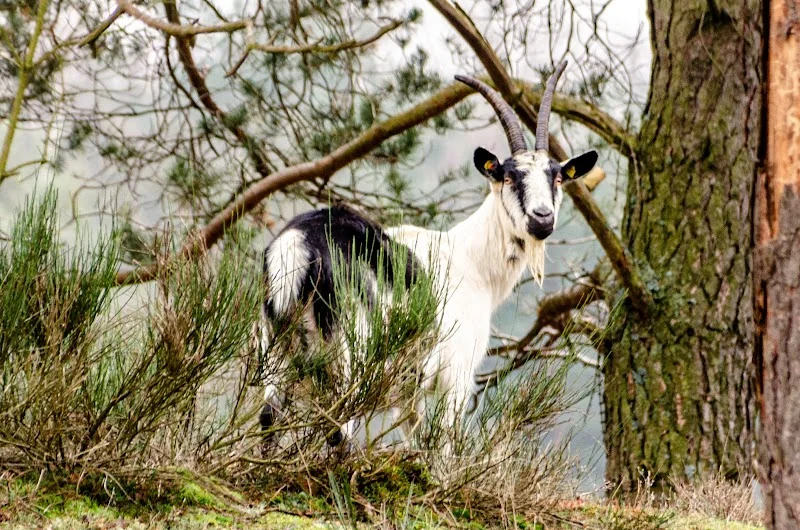
Since 2012, a herd of bezoar goats has additionally supported the project. They help combat the emerging shrubs and complement the horses' impact. This combination is a nice example of modern landscape maintenance because different animal species work together to keep a threatened habitat open. For visitors, this is also interesting because one can observe not only horses but, in a broader sense, a functioning nature conservation system. Important are the behavioral rules: The paths must not be left, dogs must be leashed, and the animals must not be fed under any circumstances. The project text explicitly warns against feeding because it can lead to serious illnesses and even fatalities. Those who take these rules seriously contribute directly to the preservation of the place. Especially in connection with the freely accessible visiting character, this creates an unusually open yet responsibly organized nature experience. The enclosure is thus not only a place to look at but also a place to learn about species protection, animal husbandry in nature conservation, and respectful interaction with sensitive protected areas. ([wildpferde-tennenlohe.de](https://www.wildpferde-tennenlohe.de/))
Visiting Tips, Safety, and Why the Trip is Worthwhile
Those visiting the Przewalski wild horse enclosure Tennenlohe should plan the trip as a nature experience and not as a quick photo stop. The official visitor information clearly states: The area is open at all times, admission is free, and access is uncomplicated. However, there is a very important safety detail that should not be overlooked. The Tennenloher Forest was formerly a shooting range, and explosive ammunition was fired there, among other things. Therefore, there is a risk to life if you leave the gravel paths. Especially in nice weather, the temptation is great to get closer to open areas, but that is not allowed. The paved paths are explicitly intended and safer. Those who adhere to this can visit the area without problems and enjoy a nature experience that has become rare in this form. For the visit, weatherproof clothing, good footwear, and, depending on the season, a bit of patience are also worthwhile. The terrain is large, the animals move freely in the enclosure, and the perception of the place thrives on not just passing through quickly but observing attentively. ([visit-erlangen.de](https://www.visit-erlangen.de/poi/wildpferde_im_tennenloher_fors-27422/))
It is particularly nice that there are regular guided tours by the area management. The LPV page points out that the project can be visited year-round and that tours are offered. This is especially interesting for guests who want to learn more about the history of the area, the plant life, or the role of the Przewalski horses. The combination of free access and professional guidance is very valuable for a protected area because it keeps the terrain open but not arbitrary. Visitors experience animals and landscapes but also understand why the place must be maintained and protected. Those planning an outing with children will find a good introduction to nature topics here because the observation is immediate and vivid. Also, for adults coming from Erlangen, Nuremberg, or the surrounding region, the visit is worthwhile because it requires little organizational effort while still leaving a strong impression. The interplay of proximity to the city, tranquility in the forest, and large-scale protected area is an important part of the appeal. The destination is therefore not only beautiful but also functionally thought out. ([lpv-mittelfranken.de](https://www.lpv-mittelfranken.de/projekt-details/urwildpferde-als-landschaftspfleger.html))
A final practical tip concerns expectations. The facility is not a zoo or a classic animal park with fixed opening hours, but a vast nature conservation and grazing project. Those coming here visit a place where the animals perform landscape maintenance and nature is at the center. That is why a calm attitude is more worthwhile than haste. One should take time for the forest path, the information boards, the view from the Kugelfangwall, and the slow impression of the open sandy landscape. For people specifically searching for the keywords Przewalski horse Tennenlohe, wild horses Tennenloher Forest, or Przewalski wild horse enclosure Tennenlohe, the area is a clear recommendation. It combines free nature experience, a strong history, and a very special animal species in an area that can also be visited without an entrance ticket. Those who walk respectfully along the path not only gain beautiful impressions but also a genuine understanding of how modern landscape maintenance and nature tourism can work together. ([visit-erlangen.de](https://www.visit-erlangen.de/poi/wildpferde_im_tennenloher_fors-27422/))
Sources:
- Wild Horses Tennenlohe - Homepage
- Wild Horses Tennenlohe - History
- Wild Horses Tennenlohe - The Nature Reserve
- Visit Erlangen - Wild Horses in the Tennenloher Forest
- Visit Erlangen - To the Wild Horses in the Tennenloher Forest
- Landscape Maintenance Association Middle Franconia - Wild Horses as Landscape Caretakers
Mehr anzeigenWeniger anzeigen
Przewalski wild horse enclosure Tennenlohe | Directions & Enclosure
The Przewalski wild horse enclosure Tennenlohe is not a classic event venue, but an extraordinary natural destination suitable for walks, family outings, and quiet hours in nature. Southeast of Erlangen lies the Tennenloher Forest as a vast nature reserve with open sandy areas, light pine forests, moorland, and one of Germany's most well-known wild horse projects. Since 2003, Przewalski wild horses have been helping to maintain valuable open spaces there, and that is what makes the place so special for visitors: Here, nature conservation is experienced not as a theory, but directly in the field. Admission is free, the area is accessible at any time, and the paths can be easily combined with an excursion to the surroundings. At the same time, the area is a place with clear rules, as the former military training area requires respect and attention. Those who approach the visit calmly, stay on the paved paths, and bring enough time will experience a rare combination of nature, openness, wilderness feeling, and views in a region that is only a few minutes from Erlangen. ([visit-erlangen.de](https://www.visit-erlangen.de/poi/wildpferde_im_tennenloher_fors-27422/))
Directions, Parking Turmberg and Bus Line 20/290/295
Getting to the Przewalski wild horse enclosure Tennenlohe is pleasantly uncomplicated if you know the official route. For drivers, the Turmberg parking lot is the most important starting point. It is located at the exit of the B4 and serves as the starting point for the path to the horse area. From there, a forest path of about 2 kilometers leads to the enclosure, so you do not drive directly to the fence, but consciously experience the character of the area on foot. This small approach is part of the excursion: Even on the way to the enclosure, you notice how quickly city and nature merge, and how quiet the Tennenloher Forest feels despite its location on the edge of an urban area. For those arriving by bicycle, the area is also attractive, as the terrain is a popular destination for a cycling trip, and the paths in the surroundings are well-suited for a relaxed tour. However, those planning their arrival should allow enough time for the outbound journey, the return trip, and any photo breaks. Although the area is close to Erlangen and Nuremberg, the forest path feels significantly more remote than a typical excursion destination with direct road access. ([visit-erlangen.de](https://www.visit-erlangen.de/poi/wildpferde_im_tennenloher_fors-27422/))
It is also easy to visit using public transport. The official visitor information mentions the Tennenlohe Sculpture Park stop as the destination for lines 20, 290, and 295. From there, follow Sebastianstraße south until you reach the volunteer fire department Tennenlohe, which is on the left side. Behind the fire station, the footpath continues, then over the red pedestrian bridge directly into the Tennenloher Forest nature reserve. This route is not only practical but also logically structured: The transition from the bus stop to the forest already shows that the visit is intended as a walk and not a quick stop at a parking lot. Those traveling with strollers, small children, or a daypack benefit from this clear path guidance but should still choose appropriate weather and footwear. For most visitors, the bus concept is particularly pleasant because it makes the excursion possible without a car while simultaneously reducing the environmental impact. This is especially sensible in a sensitive protected area. Combined with the short, understandable directions, this creates a destination that remains well-planned for both locals and guests from the region. ([visit-erlangen.de](https://www.visit-erlangen.de/poi/wildpferde_im_tennenloher_fors-27422/))
If you come from the region, arriving by bike is particularly worthwhile because the path itself is part of the experience. Visitor reviews describe the surroundings as pleasant for cycling, and this impression fits well with the official image of the Tennenloher Forest as a quiet natural space. Those arriving by car should not confuse the Turmberg parking lot with a parking garage or visitor center: There is no urban event operation here, but a nature-oriented starting point. This makes the place charming, but also simpler and more direct. Instead of long preparations, it is enough to take the parking lot or bus stop as a starting point and consciously walk the rest of the way on foot. Thus, the journey already becomes a small part of the excursion, and the visit begins not only at the fence of the enclosure but already when immersing oneself in the landscape. ([visit-erlangen.de](https://www.visit-erlangen.de/wanderwege/zu_den_wildpferden_im_tennenlo-4091/))
Loop Trail, Enclosure, and View at Kugelfangwall
The official hiking trail to the wild horses is more than just a connector. The family hike to the Przewalski wild horses is indicated as 2 hours and 8.7 kilometers long, with the loop trail being approximately 9 kilometers long and running directly along the fence of the generously designed enclosure. This makes the path particularly attractive for those who want to see nature without planning a demanding mountain tour. Under trees, past small streams and moors, a varied route develops that is both quiet and educational. Information boards with background knowledge about the nature reserve and its inhabitants stand at the edge of the path, making the walk also intellectually engaging. Those interested in landscape maintenance will find a good example here of how a former military training area can be transformed into an ecologically valuable protected area. The mix of open space, forest edge, sightlines, and animal observation makes the loop trail so varied. The route is described as easy, making it suitable for families, provided that one adheres to the path rules and allows enough time for breaks. ([visit-erlangen.de](https://www.visit-erlangen.de/wanderwege/zu_den_wildpferden_im_tennenlo-4091/))
A special highlight of the area is the former Kugelfangwall, from which one can enjoy a wide view all the way to Nuremberg Castle and even into the Franconian Switzerland. This viewpoint divides the enclosure almost in half and gives the place an additional spatial tension: On one hand, you can see the vastness of the protected area, while on the other hand, it becomes clear how strongly the landscape has been shaped by its past. Therefore, those visiting the area experience not only animals but also terrain forms, sightlines, and the transition between forest and open sandy biotope. This connection makes the walk so distinctive. The enclosure is large enough to see the animals not in an artificially confined setting and simultaneously open enough to understand the interplay of horses, vegetation, and landscape. The official description emphasizes that walking along the horse fence is safe because these areas have been demined. This is an important point: The path itself is deliberately suitable for visitors, but only if one respects the marked area. Those who simply walk quietly along benefit from exactly the kind of nature experience that makes Tennenlohe so popular. ([visit-erlangen.de](https://www.visit-erlangen.de/wanderwege/zu_den_wildpferden_im_tennenlo-4091/))
Even with a short visit, it is worth looking at the structure of the terrain. The enclosure is not set up like a classic zoo with a central loop, but is embedded in the landscape. This makes the horses appear not like they are in a show facility, but as part of a living ecosystem. This supports the special atmosphere that many visitors describe as calm, spacious, and natural. Because the area is large, it can be sensible to bring a little time and not just rush through the loop trail but stop at several points. The combination of soft ground, forest paths, open sandy areas, and viewpoints makes the loop trail one of the few places in the region where one can experience almost half a day of nature with little effort. The path is interesting for photographers as well as for families, nature lovers, or cyclists. Those who read the surroundings attentively quickly recognize that the path itself is part of the story of the place and not just access to the actual destination. ([visit-erlangen.de](https://www.visit-erlangen.de/wanderwege/zu_den_wildpferden_im_tennenlo-4091/))
History of the Tennenloher Forest and the Transformation from Military Training Area to Nature Reserve
The Tennenloher Forest is a good example of how a militarily influenced area can become a highly sensitive nature reserve. The historical notes on the project page show that as early as 1935, the German Wehrmacht established a training area in the current region and cleared large forest areas for it. After World War II, the US Army continued to use the site, and military use lasted until the early 1990s. Exactly these decades of intensive use have sustainably shaped the landscape. Tank movements and shooting exercises kept large open areas free, allowing special habitats to develop on the sandy soils. This resulted in sandy dry grasslands, heath areas, and open spaces that are now indispensable for many rare species. What once served as a training area is therefore today of exceptional ecological value. The open spaces are not simply remnants of chance but the result of a historical intervention whose aftereffects are positively utilized in nature conservation. ([wildpferde-tennenlohe.de](https://www.wildpferde-tennenlohe.de/geschichte.html))
The official nature conservation description makes it clear how large and significant this area is. Around 930 hectares of the Sebalder Reichswald were designated as a nature reserve in 1994, and the Tennenloher Forest is also part of the European Natura 2000 network. The area is one of the largest sandy biotope complexes in Bavaria and unites dry sandy grasslands, heaths, light pine forests, moor areas, and even alder swamp forests. Thus, it is not only a beautiful excursion destination but also an extremely diverse habitat. Over 1,800 animal and plant species have been documented there, more than 330 of which are highly endangered or even threatened with extinction. Such numbers show why the place is so strictly protected and why visitors must stay on the paths. The Tennenloher Forest is therefore not only interesting from a landscape perspective but also remarkable from a scientific standpoint because it is one of the most important sandy habitats in the region. Especially in a densely populated environment, such a large-scale protected area is of enormous value. ([wildpferde-tennenlohe.de](https://www.wildpferde-tennenlohe.de/das-naturschutzgebiet.html))
The transformation from military land to nature reserve also explains why the Tennenloher Forest appears so open today. Many plant and animal species that require light, warmth, and nutrient-poor soils benefit from the former shooting ranges and the wide open spaces. At the same time, without maintenance, natural succession would quickly lead to more forest growth. That is why grazing, protection concepts, and area management are so important. The landscape has not simply remained static but is actively maintained in a certain state so that rare species can retain their habitat. This makes the place particularly exciting for nature observers because one can see the interaction between history, use, and protection very directly. Therefore, those who take a walk through the forest are not only moving through a beautiful forest but through a landscape archive that tells the story of decades and layers of use. This historical depth is a key reason why many visitors find the area extraordinary, even if they actually come only for the horses. ([wildpferde-tennenlohe.de](https://www.wildpferde-tennenlohe.de/geschichte.html))
Przewalski Horses as Landscape Caretakers in the Tennenloher Forest
The real stars of the area are the Przewalski horses. On the official project page, they are described as four-legged landscape caretakers who have been ensuring the preservation of the sandy inhabitants of the area on around 100 hectares since 2003. This is particularly clever from a nature conservation perspective because the animals do what used to happen accidentally through military use: They keep open spaces free by influencing grass, herbs, and emerging shrubs. This preserves the habitat for species such as the woodlark, sand beetle, and smooth snake. The approach remarkably combines species protection, landscape maintenance, and visitor experience. For guests, the project is therefore interesting not only because of the horses themselves but also because it provides a concrete answer to the question of how to permanently preserve open sandy habitats. The animals are thus not decoration but an active part of an ecological concept. ([wildpferde-tennenlohe.de](https://www.wildpferde-tennenlohe.de/))
The Przewalski horses are considered the last living, true wild horses on Earth. Their history is explained in detail on the project page: They originate from the range of wild horses, were named after their discoverer Nikolai Przewalski, and have been considered extinct in the wild since 1970. Therefore, conservation breeding and their use in grazing projects are all the more important. Their external characteristics also make them distinctive. With a shoulder height of about 130 to 145 centimeters, they are more compactly built than many domestic breeds, have an upright mane, a robust body, and the typical sandy-colored coat pattern with a dark dorsal stripe. Those who see the animals in the enclosure quickly recognize that they are not ordinary pasture horses, but a special, rare subspecies with international conservation relevance. This makes observing them on-site even more interesting because the animals bring something very unique biologically and culturally. This makes the visit exciting even for people who do not usually engage intensively with horses. ([wildpferde-tennenlohe.de](https://www.wildpferde-tennenlohe.de/przewalski-pferde.html))
Since 2012, a herd of bezoar goats has additionally supported the project. They help combat the emerging shrubs and complement the horses' impact. This combination is a nice example of modern landscape maintenance because different animal species work together to keep a threatened habitat open. For visitors, this is also interesting because one can observe not only horses but, in a broader sense, a functioning nature conservation system. Important are the behavioral rules: The paths must not be left, dogs must be leashed, and the animals must not be fed under any circumstances. The project text explicitly warns against feeding because it can lead to serious illnesses and even fatalities. Those who take these rules seriously contribute directly to the preservation of the place. Especially in connection with the freely accessible visiting character, this creates an unusually open yet responsibly organized nature experience. The enclosure is thus not only a place to look at but also a place to learn about species protection, animal husbandry in nature conservation, and respectful interaction with sensitive protected areas. ([wildpferde-tennenlohe.de](https://www.wildpferde-tennenlohe.de/))
Visiting Tips, Safety, and Why the Trip is Worthwhile
Those visiting the Przewalski wild horse enclosure Tennenlohe should plan the trip as a nature experience and not as a quick photo stop. The official visitor information clearly states: The area is open at all times, admission is free, and access is uncomplicated. However, there is a very important safety detail that should not be overlooked. The Tennenloher Forest was formerly a shooting range, and explosive ammunition was fired there, among other things. Therefore, there is a risk to life if you leave the gravel paths. Especially in nice weather, the temptation is great to get closer to open areas, but that is not allowed. The paved paths are explicitly intended and safer. Those who adhere to this can visit the area without problems and enjoy a nature experience that has become rare in this form. For the visit, weatherproof clothing, good footwear, and, depending on the season, a bit of patience are also worthwhile. The terrain is large, the animals move freely in the enclosure, and the perception of the place thrives on not just passing through quickly but observing attentively. ([visit-erlangen.de](https://www.visit-erlangen.de/poi/wildpferde_im_tennenloher_fors-27422/))
It is particularly nice that there are regular guided tours by the area management. The LPV page points out that the project can be visited year-round and that tours are offered. This is especially interesting for guests who want to learn more about the history of the area, the plant life, or the role of the Przewalski horses. The combination of free access and professional guidance is very valuable for a protected area because it keeps the terrain open but not arbitrary. Visitors experience animals and landscapes but also understand why the place must be maintained and protected. Those planning an outing with children will find a good introduction to nature topics here because the observation is immediate and vivid. Also, for adults coming from Erlangen, Nuremberg, or the surrounding region, the visit is worthwhile because it requires little organizational effort while still leaving a strong impression. The interplay of proximity to the city, tranquility in the forest, and large-scale protected area is an important part of the appeal. The destination is therefore not only beautiful but also functionally thought out. ([lpv-mittelfranken.de](https://www.lpv-mittelfranken.de/projekt-details/urwildpferde-als-landschaftspfleger.html))
A final practical tip concerns expectations. The facility is not a zoo or a classic animal park with fixed opening hours, but a vast nature conservation and grazing project. Those coming here visit a place where the animals perform landscape maintenance and nature is at the center. That is why a calm attitude is more worthwhile than haste. One should take time for the forest path, the information boards, the view from the Kugelfangwall, and the slow impression of the open sandy landscape. For people specifically searching for the keywords Przewalski horse Tennenlohe, wild horses Tennenloher Forest, or Przewalski wild horse enclosure Tennenlohe, the area is a clear recommendation. It combines free nature experience, a strong history, and a very special animal species in an area that can also be visited without an entrance ticket. Those who walk respectfully along the path not only gain beautiful impressions but also a genuine understanding of how modern landscape maintenance and nature tourism can work together. ([visit-erlangen.de](https://www.visit-erlangen.de/poi/wildpferde_im_tennenloher_fors-27422/))
Sources:
- Wild Horses Tennenlohe - Homepage
- Wild Horses Tennenlohe - History
- Wild Horses Tennenlohe - The Nature Reserve
- Visit Erlangen - Wild Horses in the Tennenloher Forest
- Visit Erlangen - To the Wild Horses in the Tennenloher Forest
- Landscape Maintenance Association Middle Franconia - Wild Horses as Landscape Caretakers
Przewalski wild horse enclosure Tennenlohe | Directions & Enclosure
The Przewalski wild horse enclosure Tennenlohe is not a classic event venue, but an extraordinary natural destination suitable for walks, family outings, and quiet hours in nature. Southeast of Erlangen lies the Tennenloher Forest as a vast nature reserve with open sandy areas, light pine forests, moorland, and one of Germany's most well-known wild horse projects. Since 2003, Przewalski wild horses have been helping to maintain valuable open spaces there, and that is what makes the place so special for visitors: Here, nature conservation is experienced not as a theory, but directly in the field. Admission is free, the area is accessible at any time, and the paths can be easily combined with an excursion to the surroundings. At the same time, the area is a place with clear rules, as the former military training area requires respect and attention. Those who approach the visit calmly, stay on the paved paths, and bring enough time will experience a rare combination of nature, openness, wilderness feeling, and views in a region that is only a few minutes from Erlangen. ([visit-erlangen.de](https://www.visit-erlangen.de/poi/wildpferde_im_tennenloher_fors-27422/))
Directions, Parking Turmberg and Bus Line 20/290/295
Getting to the Przewalski wild horse enclosure Tennenlohe is pleasantly uncomplicated if you know the official route. For drivers, the Turmberg parking lot is the most important starting point. It is located at the exit of the B4 and serves as the starting point for the path to the horse area. From there, a forest path of about 2 kilometers leads to the enclosure, so you do not drive directly to the fence, but consciously experience the character of the area on foot. This small approach is part of the excursion: Even on the way to the enclosure, you notice how quickly city and nature merge, and how quiet the Tennenloher Forest feels despite its location on the edge of an urban area. For those arriving by bicycle, the area is also attractive, as the terrain is a popular destination for a cycling trip, and the paths in the surroundings are well-suited for a relaxed tour. However, those planning their arrival should allow enough time for the outbound journey, the return trip, and any photo breaks. Although the area is close to Erlangen and Nuremberg, the forest path feels significantly more remote than a typical excursion destination with direct road access. ([visit-erlangen.de](https://www.visit-erlangen.de/poi/wildpferde_im_tennenloher_fors-27422/))
It is also easy to visit using public transport. The official visitor information mentions the Tennenlohe Sculpture Park stop as the destination for lines 20, 290, and 295. From there, follow Sebastianstraße south until you reach the volunteer fire department Tennenlohe, which is on the left side. Behind the fire station, the footpath continues, then over the red pedestrian bridge directly into the Tennenloher Forest nature reserve. This route is not only practical but also logically structured: The transition from the bus stop to the forest already shows that the visit is intended as a walk and not a quick stop at a parking lot. Those traveling with strollers, small children, or a daypack benefit from this clear path guidance but should still choose appropriate weather and footwear. For most visitors, the bus concept is particularly pleasant because it makes the excursion possible without a car while simultaneously reducing the environmental impact. This is especially sensible in a sensitive protected area. Combined with the short, understandable directions, this creates a destination that remains well-planned for both locals and guests from the region. ([visit-erlangen.de](https://www.visit-erlangen.de/poi/wildpferde_im_tennenloher_fors-27422/))
If you come from the region, arriving by bike is particularly worthwhile because the path itself is part of the experience. Visitor reviews describe the surroundings as pleasant for cycling, and this impression fits well with the official image of the Tennenloher Forest as a quiet natural space. Those arriving by car should not confuse the Turmberg parking lot with a parking garage or visitor center: There is no urban event operation here, but a nature-oriented starting point. This makes the place charming, but also simpler and more direct. Instead of long preparations, it is enough to take the parking lot or bus stop as a starting point and consciously walk the rest of the way on foot. Thus, the journey already becomes a small part of the excursion, and the visit begins not only at the fence of the enclosure but already when immersing oneself in the landscape. ([visit-erlangen.de](https://www.visit-erlangen.de/wanderwege/zu_den_wildpferden_im_tennenlo-4091/))
Loop Trail, Enclosure, and View at Kugelfangwall
The official hiking trail to the wild horses is more than just a connector. The family hike to the Przewalski wild horses is indicated as 2 hours and 8.7 kilometers long, with the loop trail being approximately 9 kilometers long and running directly along the fence of the generously designed enclosure. This makes the path particularly attractive for those who want to see nature without planning a demanding mountain tour. Under trees, past small streams and moors, a varied route develops that is both quiet and educational. Information boards with background knowledge about the nature reserve and its inhabitants stand at the edge of the path, making the walk also intellectually engaging. Those interested in landscape maintenance will find a good example here of how a former military training area can be transformed into an ecologically valuable protected area. The mix of open space, forest edge, sightlines, and animal observation makes the loop trail so varied. The route is described as easy, making it suitable for families, provided that one adheres to the path rules and allows enough time for breaks. ([visit-erlangen.de](https://www.visit-erlangen.de/wanderwege/zu_den_wildpferden_im_tennenlo-4091/))
A special highlight of the area is the former Kugelfangwall, from which one can enjoy a wide view all the way to Nuremberg Castle and even into the Franconian Switzerland. This viewpoint divides the enclosure almost in half and gives the place an additional spatial tension: On one hand, you can see the vastness of the protected area, while on the other hand, it becomes clear how strongly the landscape has been shaped by its past. Therefore, those visiting the area experience not only animals but also terrain forms, sightlines, and the transition between forest and open sandy biotope. This connection makes the walk so distinctive. The enclosure is large enough to see the animals not in an artificially confined setting and simultaneously open enough to understand the interplay of horses, vegetation, and landscape. The official description emphasizes that walking along the horse fence is safe because these areas have been demined. This is an important point: The path itself is deliberately suitable for visitors, but only if one respects the marked area. Those who simply walk quietly along benefit from exactly the kind of nature experience that makes Tennenlohe so popular. ([visit-erlangen.de](https://www.visit-erlangen.de/wanderwege/zu_den_wildpferden_im_tennenlo-4091/))
Even with a short visit, it is worth looking at the structure of the terrain. The enclosure is not set up like a classic zoo with a central loop, but is embedded in the landscape. This makes the horses appear not like they are in a show facility, but as part of a living ecosystem. This supports the special atmosphere that many visitors describe as calm, spacious, and natural. Because the area is large, it can be sensible to bring a little time and not just rush through the loop trail but stop at several points. The combination of soft ground, forest paths, open sandy areas, and viewpoints makes the loop trail one of the few places in the region where one can experience almost half a day of nature with little effort. The path is interesting for photographers as well as for families, nature lovers, or cyclists. Those who read the surroundings attentively quickly recognize that the path itself is part of the story of the place and not just access to the actual destination. ([visit-erlangen.de](https://www.visit-erlangen.de/wanderwege/zu_den_wildpferden_im_tennenlo-4091/))
History of the Tennenloher Forest and the Transformation from Military Training Area to Nature Reserve
The Tennenloher Forest is a good example of how a militarily influenced area can become a highly sensitive nature reserve. The historical notes on the project page show that as early as 1935, the German Wehrmacht established a training area in the current region and cleared large forest areas for it. After World War II, the US Army continued to use the site, and military use lasted until the early 1990s. Exactly these decades of intensive use have sustainably shaped the landscape. Tank movements and shooting exercises kept large open areas free, allowing special habitats to develop on the sandy soils. This resulted in sandy dry grasslands, heath areas, and open spaces that are now indispensable for many rare species. What once served as a training area is therefore today of exceptional ecological value. The open spaces are not simply remnants of chance but the result of a historical intervention whose aftereffects are positively utilized in nature conservation. ([wildpferde-tennenlohe.de](https://www.wildpferde-tennenlohe.de/geschichte.html))
The official nature conservation description makes it clear how large and significant this area is. Around 930 hectares of the Sebalder Reichswald were designated as a nature reserve in 1994, and the Tennenloher Forest is also part of the European Natura 2000 network. The area is one of the largest sandy biotope complexes in Bavaria and unites dry sandy grasslands, heaths, light pine forests, moor areas, and even alder swamp forests. Thus, it is not only a beautiful excursion destination but also an extremely diverse habitat. Over 1,800 animal and plant species have been documented there, more than 330 of which are highly endangered or even threatened with extinction. Such numbers show why the place is so strictly protected and why visitors must stay on the paths. The Tennenloher Forest is therefore not only interesting from a landscape perspective but also remarkable from a scientific standpoint because it is one of the most important sandy habitats in the region. Especially in a densely populated environment, such a large-scale protected area is of enormous value. ([wildpferde-tennenlohe.de](https://www.wildpferde-tennenlohe.de/das-naturschutzgebiet.html))
The transformation from military land to nature reserve also explains why the Tennenloher Forest appears so open today. Many plant and animal species that require light, warmth, and nutrient-poor soils benefit from the former shooting ranges and the wide open spaces. At the same time, without maintenance, natural succession would quickly lead to more forest growth. That is why grazing, protection concepts, and area management are so important. The landscape has not simply remained static but is actively maintained in a certain state so that rare species can retain their habitat. This makes the place particularly exciting for nature observers because one can see the interaction between history, use, and protection very directly. Therefore, those who take a walk through the forest are not only moving through a beautiful forest but through a landscape archive that tells the story of decades and layers of use. This historical depth is a key reason why many visitors find the area extraordinary, even if they actually come only for the horses. ([wildpferde-tennenlohe.de](https://www.wildpferde-tennenlohe.de/geschichte.html))
Przewalski Horses as Landscape Caretakers in the Tennenloher Forest
The real stars of the area are the Przewalski horses. On the official project page, they are described as four-legged landscape caretakers who have been ensuring the preservation of the sandy inhabitants of the area on around 100 hectares since 2003. This is particularly clever from a nature conservation perspective because the animals do what used to happen accidentally through military use: They keep open spaces free by influencing grass, herbs, and emerging shrubs. This preserves the habitat for species such as the woodlark, sand beetle, and smooth snake. The approach remarkably combines species protection, landscape maintenance, and visitor experience. For guests, the project is therefore interesting not only because of the horses themselves but also because it provides a concrete answer to the question of how to permanently preserve open sandy habitats. The animals are thus not decoration but an active part of an ecological concept. ([wildpferde-tennenlohe.de](https://www.wildpferde-tennenlohe.de/))
The Przewalski horses are considered the last living, true wild horses on Earth. Their history is explained in detail on the project page: They originate from the range of wild horses, were named after their discoverer Nikolai Przewalski, and have been considered extinct in the wild since 1970. Therefore, conservation breeding and their use in grazing projects are all the more important. Their external characteristics also make them distinctive. With a shoulder height of about 130 to 145 centimeters, they are more compactly built than many domestic breeds, have an upright mane, a robust body, and the typical sandy-colored coat pattern with a dark dorsal stripe. Those who see the animals in the enclosure quickly recognize that they are not ordinary pasture horses, but a special, rare subspecies with international conservation relevance. This makes observing them on-site even more interesting because the animals bring something very unique biologically and culturally. This makes the visit exciting even for people who do not usually engage intensively with horses. ([wildpferde-tennenlohe.de](https://www.wildpferde-tennenlohe.de/przewalski-pferde.html))
Since 2012, a herd of bezoar goats has additionally supported the project. They help combat the emerging shrubs and complement the horses' impact. This combination is a nice example of modern landscape maintenance because different animal species work together to keep a threatened habitat open. For visitors, this is also interesting because one can observe not only horses but, in a broader sense, a functioning nature conservation system. Important are the behavioral rules: The paths must not be left, dogs must be leashed, and the animals must not be fed under any circumstances. The project text explicitly warns against feeding because it can lead to serious illnesses and even fatalities. Those who take these rules seriously contribute directly to the preservation of the place. Especially in connection with the freely accessible visiting character, this creates an unusually open yet responsibly organized nature experience. The enclosure is thus not only a place to look at but also a place to learn about species protection, animal husbandry in nature conservation, and respectful interaction with sensitive protected areas. ([wildpferde-tennenlohe.de](https://www.wildpferde-tennenlohe.de/))
Visiting Tips, Safety, and Why the Trip is Worthwhile
Those visiting the Przewalski wild horse enclosure Tennenlohe should plan the trip as a nature experience and not as a quick photo stop. The official visitor information clearly states: The area is open at all times, admission is free, and access is uncomplicated. However, there is a very important safety detail that should not be overlooked. The Tennenloher Forest was formerly a shooting range, and explosive ammunition was fired there, among other things. Therefore, there is a risk to life if you leave the gravel paths. Especially in nice weather, the temptation is great to get closer to open areas, but that is not allowed. The paved paths are explicitly intended and safer. Those who adhere to this can visit the area without problems and enjoy a nature experience that has become rare in this form. For the visit, weatherproof clothing, good footwear, and, depending on the season, a bit of patience are also worthwhile. The terrain is large, the animals move freely in the enclosure, and the perception of the place thrives on not just passing through quickly but observing attentively. ([visit-erlangen.de](https://www.visit-erlangen.de/poi/wildpferde_im_tennenloher_fors-27422/))
It is particularly nice that there are regular guided tours by the area management. The LPV page points out that the project can be visited year-round and that tours are offered. This is especially interesting for guests who want to learn more about the history of the area, the plant life, or the role of the Przewalski horses. The combination of free access and professional guidance is very valuable for a protected area because it keeps the terrain open but not arbitrary. Visitors experience animals and landscapes but also understand why the place must be maintained and protected. Those planning an outing with children will find a good introduction to nature topics here because the observation is immediate and vivid. Also, for adults coming from Erlangen, Nuremberg, or the surrounding region, the visit is worthwhile because it requires little organizational effort while still leaving a strong impression. The interplay of proximity to the city, tranquility in the forest, and large-scale protected area is an important part of the appeal. The destination is therefore not only beautiful but also functionally thought out. ([lpv-mittelfranken.de](https://www.lpv-mittelfranken.de/projekt-details/urwildpferde-als-landschaftspfleger.html))
A final practical tip concerns expectations. The facility is not a zoo or a classic animal park with fixed opening hours, but a vast nature conservation and grazing project. Those coming here visit a place where the animals perform landscape maintenance and nature is at the center. That is why a calm attitude is more worthwhile than haste. One should take time for the forest path, the information boards, the view from the Kugelfangwall, and the slow impression of the open sandy landscape. For people specifically searching for the keywords Przewalski horse Tennenlohe, wild horses Tennenloher Forest, or Przewalski wild horse enclosure Tennenlohe, the area is a clear recommendation. It combines free nature experience, a strong history, and a very special animal species in an area that can also be visited without an entrance ticket. Those who walk respectfully along the path not only gain beautiful impressions but also a genuine understanding of how modern landscape maintenance and nature tourism can work together. ([visit-erlangen.de](https://www.visit-erlangen.de/poi/wildpferde_im_tennenloher_fors-27422/))
Sources:
- Wild Horses Tennenlohe - Homepage
- Wild Horses Tennenlohe - History
- Wild Horses Tennenlohe - The Nature Reserve
- Visit Erlangen - Wild Horses in the Tennenloher Forest
- Visit Erlangen - To the Wild Horses in the Tennenloher Forest
- Landscape Maintenance Association Middle Franconia - Wild Horses as Landscape Caretakers
Upcoming Events
No events found
Frequently Asked Questions
Reviews
evrim oku
17. August 2023
Very nice environment, great camping place for horses 😀 I didn't have a chance to see them running wild. Roads around are quite nice for cycling. For hiking, this part of the area is a bit dull.
George Cee
9. September 2024
Gorgeous landscape and gorgeous animals. You can get there quite easily by bus (except for Sundays). There are a few dead-ended hiking trails, but plenty of spots to sit and relax and watch the horses. Be sure to bring a book in case they're in a different part of the pen.
Rissa Gan Laszlo
15. May 2019
Hiking and bicycle trip area for adults and smaller kids too.
Achim Schmidt
7. August 2022
A nice piece of nature in between Erlangen and Nuremberg.
Ricardo Abreu
12. May 2020
Amazing place, hopefully they can add even more horses in the future 😁