
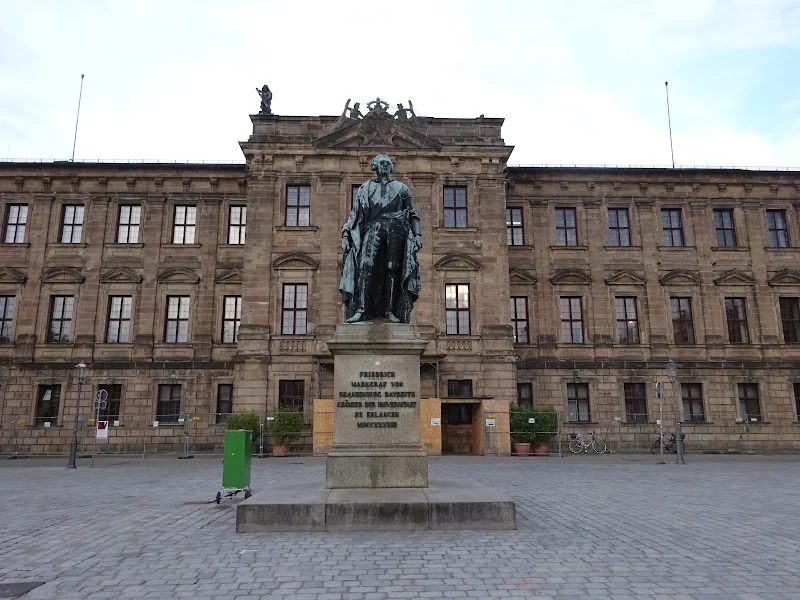
Erlangen
Schloßplatz, 91054 Erlangen, Germany
Schloßplatz Erlangen | Markets & Parking
The Schloßplatz in Erlangen is much more than just a central address on the city map. It is a place where history, everyday life, encounters, and festive events intertwine. Between the castle, the castle garden, and the adjacent city center axes, the square forms one of the most visible meeting points in the city. Those who arrive here quickly feel that the Schloßplatz does not simply function as an open space, but as an urban hinge between commerce, culture, public life, and urban identity. That is why it is equally interesting for visitors, locals, market-goers, and event organizers. The square stands for a vibrant city center, for seasonal highlights, and for a historical environment that remains influential to this day. The city of Erlangen describes the area as an integral part of market activities, urban culture, and inner-city life. ([erlangen.de](https://erlangen.de/aktuelles/wochenmarkt?utm_source=openai))
Particularly characteristic of the Schloßplatz is its versatility. On some days, it serves as a stage for markets with a regional character, while on other days it is the starting point for festivals, demonstrations, or cultural formats. Additionally, the historical proximity to the Erlangen Castle and the castle garden provides the location with a representative backdrop that has become rare in many city centers. In the recent history of the city, the square also plays an important role in the redesign of the city center towards more quality of stay and pedestrian-friendliness. This makes the Schloßplatz a place that not only wants to be visited but also understood. Those who know the square understand a piece of Erlangen better. ([erlangen.de](https://erlangen.de/uwao-api/faila/files/bypath/Dokumente/RHP1/rh1_07_2025_neu_bf_clean_dnk09a_gw_01.pdf))
Events, Markets, and Seasonal Highlights at the Schloßplatz
The strongest search queries related to the Schloßplatz clearly revolve around events, markets, and specific dates. This is logical, as the square has been an important venue in the heart of Erlangen for years. The weekly market utilizes the market and Schloßplatz; when events take place on the Schloßplatz itself, the market is moved to the marketplace. The city specifies fixed times from Monday to Saturday between 07:00 and 20:00, with the core time for vendors from 09:00 to 14:00. This combination of market everyday life and square usage makes the Schloßplatz a place where urban supply and public space come together directly. For visitors, this means: Here you find not only individual stalls but a developed system of inner-city usage. ([erlangen.de](https://erlangen.de/aktuelles/wochenmarkt?utm_source=openai))
Seasonal highlights include the Lichtmessmarkt, the Augustmarkt, and the Erlangen Waldweihnacht. According to the city, the Lichtmessmarkt starts from January 29 to February 5, 2026, at the Schloßplatz and offers goods of daily needs as well as decorative and culinary items. The Augustmarkt attracts visitors from August 20 to 27, 2026, to the Schloßplatz and presents a wide range of kitchen accessories and ceramics to Franconian specialties, jewelry, clothing, and accessories. During the Advent season, the Schloßplatz transforms annually into a winter Christmas forest; the city describes the Waldweihnacht as an atmospherically staged Christmas market with fir greenery, lovingly decorated market stalls, Christmas ornaments, nativity figures, and a central stage program. Thus, the square covers very different experiential worlds throughout the year: spring or winter beginnings, summer market, and Advent atmosphere. ([erlangen.de](https://erlangen.de/aktuelles/erlanger-lichtmessmarkt?utm_source=openai))
Additionally, there is a cultural dimension in the immediate vicinity. The castle garden concerts in front of the Orangerie have been a fixed part of Erlangen's cultural life for many years and offer a demanding program with free admission. In case of rain, they take place in the neighboring Redoutensaal. This mix of city festival, market tradition, and cultural offerings makes the area around the Schloßplatz particularly attractive. Therefore, those searching for events at Schloßplatz Erlangen will find not only individual dates but also a very dense sequence of recurring formats. This is important for the search intent, as many users want to know not only where the square is located but also what actually happens there and when a visit is particularly worthwhile. ([erlangen.de](https://erlangen.de/aktuelles/schlossgartenkonzerte?utm_source=openai))
Even for people who do not specifically visit a market, the Schloßplatz is a good anchor point. The events bring seasonal atmosphere to the city center, enliven the surrounding alleys, and connect shopping, gastronomy, and city strolling with a clear event framework. The combination of weekly markets and specialty markets ensures that the place remains a recognizable feature almost all year round. Therefore, anyone who wants to experience typical Erlangen will hardly miss the Schloßplatz. ([erlangen.de](https://erlangen.de/aktuelles/wochenmarkt?utm_source=openai))
Access, Parking, and the Best Way to the City Center
When it comes to search terms related to Schloßplatz Erlangen, it is not only about dates but very often about access and parking. Here, a close look at the city information helps. The city of Erlangen points out that there are several paid parking options available around the city center, including the Theaterplatz parking lot with about 153 spaces, the Altstadt Ost parking lot with about 80 spaces, as well as other central parking areas. Additionally, the city mentions the large parking lot on Parkplatzstraße between the A73 highway and the train station as a major point of access. From there, one can reach the city center for free with the City Line 299. This is particularly convenient for a visit to the Schloßplatz, as one can easily combine the stay with a walk or by bus. ([erlangen.de](https://erlangen.de/en/aktuelles/parken-in-erlangen?utm_source=openai))
The city explicitly aims to reduce search traffic when parking in the city center and to direct visitors more towards parking garages, large parking areas, and public transport. Since January 2024, free travel on all bus lines has also been in effect in the free city center area. This is relevant for the Schloßplatz because it is located right in this area and can therefore be easily reached without a car. However, those who still come by car should not rely on direct parking spaces at the square but rather use the inner-city parking structure. This saves time, reduces stress, and fits better with the character of the area as a pedestrian and event space. ([erlangen.de](https://erlangen.de/en/aktuelles/parken-in-erlangen?utm_source=openai))
From the perspective of modern micromobility, the Schloßplatz is also clearly regulated. The city names the Schloßplatz in its explanations regarding e-scooter parking prohibition zones as one of the areas where vehicles may not be parked or returned. This aligns with the use of the square as a sensitive city center area with many pedestrian movements and changing events. For visitors, this means: Those traveling with an e-scooter or similar vehicles should carefully plan their arrival and return and pay attention to the designated zones. This keeps the path clear and maintains the quality of stay. ([erlangen.de](https://erlangen.de/aktuelles/e-scooter?utm_source=openai))
In practice, the Schloßplatz is primarily a destination for short, well-planned routes. From the train station or the large parking lot, the square is well integrated into the city center structure, and the paths through the pedestrian zone are clearly oriented towards walking. This is no coincidence but a reflection of an urban development that aims to make staying in the center more attractive. Therefore, those attending an event, going to the weekly market, or simply strolling through the city center usually find it most convenient to arrive by parking garage, bus, or on foot. This is often the most pleasant solution for families, older visitors, or groups. ([erlangen.de](https://erlangen.de/en/aktuelles/parken-in-erlangen?utm_source=openai))
History of the Schloßplatz: From Car Parking Space to Strolling Zone
The historical development of the Schloßplatz impressively shows how much city centers can change over time. A municipal contribution from 2025 recalls that cars used to line up on the Schloßplatz. The article describes the situation of the post-war period, when cars conquered public space and even central squares of the baroque city center served as parking spaces. In 1957, the first parking meters were installed in Erlangen; the beginning was made with 45 devices on the eastern side of the main street between Schloß- and Martin-Luther- and at Hugenottenplatz. This historical perspective is important because it shows that the current character of the Schloßplatz as a promenade and event location is the result of a conscious urban development. ([erlangen.de](https://erlangen.de/uwao-api/faila/files/bypath/Dokumente/RHP1/rh1_07_2025_neu_bf_clean_dnk09a_gw_01.pdf))
The transformation from a heavily trafficked and parked urban space to a pedestrian-oriented center was not only a traffic issue but also a question of quality of life. In the urban documents on city center development, the Schloßplatz appears as part of an axis that should be integrated into the pedestrian zone. The combination of Schloßplatz, Apothekergasse, Halbmondstraße, and Apfelstraße was treated in traffic planning as an area where more space for pedestrians and cyclists should be created. Thus, a space that was once dominated by cars gradually became a space that today stands primarily for staying, commerce, markets, and encounters. This development also explains why the Schloßplatz is frequently associated with terms such as pedestrian zone, city center, and event in search queries. ([ratsinfo.erlangen.de](https://ratsinfo.erlangen.de/vo0050.asp?__kvonr=2128833&utm_source=openai))
Thus, the Schloßplatz is a good example of the transformation of historical city centers in the present. Not the pure function as a traffic area is in the foreground, but a mix of uses that keeps the place lively throughout the day and year. Markets bring frequency in the morning, events enliven afternoons and evenings, and the proximity to cultural and historical places ensures additional attention. This multifunctionality makes it a strong location for search queries with local relevance. Those searching for Schloßplatz Erlangen often want not only to know the location but also to understand the role the square plays in today's Erlangen. History provides a clear answer: It is a square that has continually adapted to the needs of the city. ([erlangen.de](https://erlangen.de/uwao-api/faila/files/bypath/Dokumente/RHP1/rh1_07_2025_neu_bf_clean_dnk09a_gw_01.pdf))
Castle, Castle Garden, and Orangerie as a Unique Environment
The Schloßplatz strongly benefits from its architectural and landscape environment. Directly adjacent are the Erlangen Castle, the castle garden, and the Orangerie, which together form an urban ensemble that enhances the square far beyond its mere area. The city of Erlangen informs in connection with the general renovation of the castle that the building has been the seat of the Friedrich-Alexander-University Erlangen-Nuremberg since 1825. At the same time, it was noted that the path on the north side of the castle between Schloßplatz and Orangerie remains continuously accessible. This shows how closely the square is intertwined with the surrounding historical structures. ([erlangen.de](https://erlangen.de/aktuelles/generalsanierung-des-erlanger-schlosses-vorgestellt?utm_source=openai))
The Orangerie itself is another important reference point. According to the city, it was built in 1705/1706 under the direction of the master builder Gottfried von Gedeler. The original purpose was the cultivation of orange trees and at the same time the representative self-presentation of the court. Since 1818, the Orangerie has belonged to the Friedrich-Alexander-University and has since been used for various teaching purposes. After a comprehensive renovation, it has shone again since 2012 and serves, among other things, as a venue for weddings. This mixture of garden space, historical architecture, and public use gives the environment of the Schloßplatz its special aura. ([erlangen.de](https://erlangen.de/aktuelles/trauung-orangerie?utm_source=openai))
Culturally, the environment is also closely connected to the square. The castle garden concerts take place in front of the Orangerie in the castle garden and have been a fixed part of the city's cultural calendar for many years. The city describes them as a popular concert series featuring musicians and ensembles from regional, national, and international backgrounds. In case of rain, the concerts are moved to the neighboring Redoutensaal. For visitors, this creates a very dense experiential zone: From the Schloßplatz, markets, castle garden, concert series, and historical architecture are just a few steps away. ([erlangen.de](https://erlangen.de/aktuelles/schlossgartenkonzerte?utm_source=openai))
This spatial proximity is also crucial for the perception of the city center. The Schloßplatz is not isolated but part of a series of places that together shape the city center experience. Those who arrive there experience not just an individual square but a combination of green space, university, history, market, and festival culture. That is why the Schloßplatz is so well suited as a starting point for a city center visit. It serves as a point of orientation, meeting place, and backdrop at the same time. For those searching for Schloßplatz Erlangen Orangerie or Schloßplatz Erlangen Castle Garden, this proximity is the real answer: The places are functionally and atmospherically connected. ([erlangen.de](https://erlangen.de/aktuelles/generalsanierung-des-erlanger-schlosses-vorgestellt?utm_source=openai))
Practical Tips for Visitors, Cyclists, and Event Organizers
Those visiting the Schloßplatz should understand it as a true city center location with changing uses. This means that not only dates but also traffic management, consideration, and possible closures can play a role. The city of Erlangen points out in its event and traffic documents that the area is used differently depending on the occasion and that during events on the Schloßplatz, the weekly market sometimes moves to the marketplace. Therefore, it is advisable for visitors to briefly check the current situation before a market or event date. This way, one can avoid detours and go directly to where the actual focus lies. ([erlangen.de](https://erlangen.de/aktuelles/wochenmarkt?utm_source=openai))
For event organizers, the Schloßplatz is also a clearly regulated space. The city offers a corresponding approval procedure for public events; in the online documents, there is even a specific site plan for the Schloßplatz. This underscores that the square is not used randomly but is part of a professionally organized city center logic. Therefore, those planning a festival, information booth, or public program here are working with a location that is well anchored in the city administration. This structure is important for the quality of events as it creates planning security and simultaneously protects the historical urban space. ([erlangen.de](https://erlangen.de/en/service/12310?utm_source=openai))
For cyclists and other mobile visitors, the same applies in everyday life as well as at events: consideration and orientation are worthwhile. The Schloßplatz is located in an area that is increasingly used in a pedestrian-oriented manner, and the city's traffic planning emphasizes this priority. E-scooters do not belong in the parking zones in sensitive city center areas in Erlangen, and one should not confuse the central location with direct access. Therefore, those who want to experience the square comfortably should better walk from the parking garages, take the bus, or plan a conscious walk through the city center. This not only fits the use of the square but often enhances the quality of stay. ([erlangen.de](https://erlangen.de/aktuelles/e-scooter?utm_source=openai))
In the end, the Schloßplatz is primarily a place where Erlangen shows itself concentrated: historically, lively, easily accessible, and versatile. Those looking for markets will find them here. Those who want to experience city history will find it as well. Those who want to experience the interplay of castle, castle garden, and city center will receive a particularly dense form of it here. This multifaceted nature makes the Schloßplatz one of the most important urban anchor points in Erlangen and explains why it is so frequently associated with parking, events, markets, and access in search queries. ([erlangen.de](https://erlangen.de/aktuelles/wochenmarkt?utm_source=openai))
Sources:
- Erlangen Weekly Market - City of Erlangen
- Erlangen Lichtmessmarkt - City of Erlangen
- Erlangen Augustmarkt - City of Erlangen
- Erlangen Waldweihnacht - City of Erlangen
- Parking in Erlangen - City of Erlangen
- Castle Garden Concerts 2025 - City of Erlangen
- Orangerie - City of Erlangen
- General Renovation of Erlangen Castle - City of Erlangen
- Rathausplatz 1 - July 2025, City of Erlangen
Mehr anzeigenWeniger anzeigen
Schloßplatz Erlangen | Markets & Parking
The Schloßplatz in Erlangen is much more than just a central address on the city map. It is a place where history, everyday life, encounters, and festive events intertwine. Between the castle, the castle garden, and the adjacent city center axes, the square forms one of the most visible meeting points in the city. Those who arrive here quickly feel that the Schloßplatz does not simply function as an open space, but as an urban hinge between commerce, culture, public life, and urban identity. That is why it is equally interesting for visitors, locals, market-goers, and event organizers. The square stands for a vibrant city center, for seasonal highlights, and for a historical environment that remains influential to this day. The city of Erlangen describes the area as an integral part of market activities, urban culture, and inner-city life. ([erlangen.de](https://erlangen.de/aktuelles/wochenmarkt?utm_source=openai))
Particularly characteristic of the Schloßplatz is its versatility. On some days, it serves as a stage for markets with a regional character, while on other days it is the starting point for festivals, demonstrations, or cultural formats. Additionally, the historical proximity to the Erlangen Castle and the castle garden provides the location with a representative backdrop that has become rare in many city centers. In the recent history of the city, the square also plays an important role in the redesign of the city center towards more quality of stay and pedestrian-friendliness. This makes the Schloßplatz a place that not only wants to be visited but also understood. Those who know the square understand a piece of Erlangen better. ([erlangen.de](https://erlangen.de/uwao-api/faila/files/bypath/Dokumente/RHP1/rh1_07_2025_neu_bf_clean_dnk09a_gw_01.pdf))
Events, Markets, and Seasonal Highlights at the Schloßplatz
The strongest search queries related to the Schloßplatz clearly revolve around events, markets, and specific dates. This is logical, as the square has been an important venue in the heart of Erlangen for years. The weekly market utilizes the market and Schloßplatz; when events take place on the Schloßplatz itself, the market is moved to the marketplace. The city specifies fixed times from Monday to Saturday between 07:00 and 20:00, with the core time for vendors from 09:00 to 14:00. This combination of market everyday life and square usage makes the Schloßplatz a place where urban supply and public space come together directly. For visitors, this means: Here you find not only individual stalls but a developed system of inner-city usage. ([erlangen.de](https://erlangen.de/aktuelles/wochenmarkt?utm_source=openai))
Seasonal highlights include the Lichtmessmarkt, the Augustmarkt, and the Erlangen Waldweihnacht. According to the city, the Lichtmessmarkt starts from January 29 to February 5, 2026, at the Schloßplatz and offers goods of daily needs as well as decorative and culinary items. The Augustmarkt attracts visitors from August 20 to 27, 2026, to the Schloßplatz and presents a wide range of kitchen accessories and ceramics to Franconian specialties, jewelry, clothing, and accessories. During the Advent season, the Schloßplatz transforms annually into a winter Christmas forest; the city describes the Waldweihnacht as an atmospherically staged Christmas market with fir greenery, lovingly decorated market stalls, Christmas ornaments, nativity figures, and a central stage program. Thus, the square covers very different experiential worlds throughout the year: spring or winter beginnings, summer market, and Advent atmosphere. ([erlangen.de](https://erlangen.de/aktuelles/erlanger-lichtmessmarkt?utm_source=openai))
Additionally, there is a cultural dimension in the immediate vicinity. The castle garden concerts in front of the Orangerie have been a fixed part of Erlangen's cultural life for many years and offer a demanding program with free admission. In case of rain, they take place in the neighboring Redoutensaal. This mix of city festival, market tradition, and cultural offerings makes the area around the Schloßplatz particularly attractive. Therefore, those searching for events at Schloßplatz Erlangen will find not only individual dates but also a very dense sequence of recurring formats. This is important for the search intent, as many users want to know not only where the square is located but also what actually happens there and when a visit is particularly worthwhile. ([erlangen.de](https://erlangen.de/aktuelles/schlossgartenkonzerte?utm_source=openai))
Even for people who do not specifically visit a market, the Schloßplatz is a good anchor point. The events bring seasonal atmosphere to the city center, enliven the surrounding alleys, and connect shopping, gastronomy, and city strolling with a clear event framework. The combination of weekly markets and specialty markets ensures that the place remains a recognizable feature almost all year round. Therefore, anyone who wants to experience typical Erlangen will hardly miss the Schloßplatz. ([erlangen.de](https://erlangen.de/aktuelles/wochenmarkt?utm_source=openai))
Access, Parking, and the Best Way to the City Center
When it comes to search terms related to Schloßplatz Erlangen, it is not only about dates but very often about access and parking. Here, a close look at the city information helps. The city of Erlangen points out that there are several paid parking options available around the city center, including the Theaterplatz parking lot with about 153 spaces, the Altstadt Ost parking lot with about 80 spaces, as well as other central parking areas. Additionally, the city mentions the large parking lot on Parkplatzstraße between the A73 highway and the train station as a major point of access. From there, one can reach the city center for free with the City Line 299. This is particularly convenient for a visit to the Schloßplatz, as one can easily combine the stay with a walk or by bus. ([erlangen.de](https://erlangen.de/en/aktuelles/parken-in-erlangen?utm_source=openai))
The city explicitly aims to reduce search traffic when parking in the city center and to direct visitors more towards parking garages, large parking areas, and public transport. Since January 2024, free travel on all bus lines has also been in effect in the free city center area. This is relevant for the Schloßplatz because it is located right in this area and can therefore be easily reached without a car. However, those who still come by car should not rely on direct parking spaces at the square but rather use the inner-city parking structure. This saves time, reduces stress, and fits better with the character of the area as a pedestrian and event space. ([erlangen.de](https://erlangen.de/en/aktuelles/parken-in-erlangen?utm_source=openai))
From the perspective of modern micromobility, the Schloßplatz is also clearly regulated. The city names the Schloßplatz in its explanations regarding e-scooter parking prohibition zones as one of the areas where vehicles may not be parked or returned. This aligns with the use of the square as a sensitive city center area with many pedestrian movements and changing events. For visitors, this means: Those traveling with an e-scooter or similar vehicles should carefully plan their arrival and return and pay attention to the designated zones. This keeps the path clear and maintains the quality of stay. ([erlangen.de](https://erlangen.de/aktuelles/e-scooter?utm_source=openai))
In practice, the Schloßplatz is primarily a destination for short, well-planned routes. From the train station or the large parking lot, the square is well integrated into the city center structure, and the paths through the pedestrian zone are clearly oriented towards walking. This is no coincidence but a reflection of an urban development that aims to make staying in the center more attractive. Therefore, those attending an event, going to the weekly market, or simply strolling through the city center usually find it most convenient to arrive by parking garage, bus, or on foot. This is often the most pleasant solution for families, older visitors, or groups. ([erlangen.de](https://erlangen.de/en/aktuelles/parken-in-erlangen?utm_source=openai))
History of the Schloßplatz: From Car Parking Space to Strolling Zone
The historical development of the Schloßplatz impressively shows how much city centers can change over time. A municipal contribution from 2025 recalls that cars used to line up on the Schloßplatz. The article describes the situation of the post-war period, when cars conquered public space and even central squares of the baroque city center served as parking spaces. In 1957, the first parking meters were installed in Erlangen; the beginning was made with 45 devices on the eastern side of the main street between Schloß- and Martin-Luther- and at Hugenottenplatz. This historical perspective is important because it shows that the current character of the Schloßplatz as a promenade and event location is the result of a conscious urban development. ([erlangen.de](https://erlangen.de/uwao-api/faila/files/bypath/Dokumente/RHP1/rh1_07_2025_neu_bf_clean_dnk09a_gw_01.pdf))
The transformation from a heavily trafficked and parked urban space to a pedestrian-oriented center was not only a traffic issue but also a question of quality of life. In the urban documents on city center development, the Schloßplatz appears as part of an axis that should be integrated into the pedestrian zone. The combination of Schloßplatz, Apothekergasse, Halbmondstraße, and Apfelstraße was treated in traffic planning as an area where more space for pedestrians and cyclists should be created. Thus, a space that was once dominated by cars gradually became a space that today stands primarily for staying, commerce, markets, and encounters. This development also explains why the Schloßplatz is frequently associated with terms such as pedestrian zone, city center, and event in search queries. ([ratsinfo.erlangen.de](https://ratsinfo.erlangen.de/vo0050.asp?__kvonr=2128833&utm_source=openai))
Thus, the Schloßplatz is a good example of the transformation of historical city centers in the present. Not the pure function as a traffic area is in the foreground, but a mix of uses that keeps the place lively throughout the day and year. Markets bring frequency in the morning, events enliven afternoons and evenings, and the proximity to cultural and historical places ensures additional attention. This multifunctionality makes it a strong location for search queries with local relevance. Those searching for Schloßplatz Erlangen often want not only to know the location but also to understand the role the square plays in today's Erlangen. History provides a clear answer: It is a square that has continually adapted to the needs of the city. ([erlangen.de](https://erlangen.de/uwao-api/faila/files/bypath/Dokumente/RHP1/rh1_07_2025_neu_bf_clean_dnk09a_gw_01.pdf))
Castle, Castle Garden, and Orangerie as a Unique Environment
The Schloßplatz strongly benefits from its architectural and landscape environment. Directly adjacent are the Erlangen Castle, the castle garden, and the Orangerie, which together form an urban ensemble that enhances the square far beyond its mere area. The city of Erlangen informs in connection with the general renovation of the castle that the building has been the seat of the Friedrich-Alexander-University Erlangen-Nuremberg since 1825. At the same time, it was noted that the path on the north side of the castle between Schloßplatz and Orangerie remains continuously accessible. This shows how closely the square is intertwined with the surrounding historical structures. ([erlangen.de](https://erlangen.de/aktuelles/generalsanierung-des-erlanger-schlosses-vorgestellt?utm_source=openai))
The Orangerie itself is another important reference point. According to the city, it was built in 1705/1706 under the direction of the master builder Gottfried von Gedeler. The original purpose was the cultivation of orange trees and at the same time the representative self-presentation of the court. Since 1818, the Orangerie has belonged to the Friedrich-Alexander-University and has since been used for various teaching purposes. After a comprehensive renovation, it has shone again since 2012 and serves, among other things, as a venue for weddings. This mixture of garden space, historical architecture, and public use gives the environment of the Schloßplatz its special aura. ([erlangen.de](https://erlangen.de/aktuelles/trauung-orangerie?utm_source=openai))
Culturally, the environment is also closely connected to the square. The castle garden concerts take place in front of the Orangerie in the castle garden and have been a fixed part of the city's cultural calendar for many years. The city describes them as a popular concert series featuring musicians and ensembles from regional, national, and international backgrounds. In case of rain, the concerts are moved to the neighboring Redoutensaal. For visitors, this creates a very dense experiential zone: From the Schloßplatz, markets, castle garden, concert series, and historical architecture are just a few steps away. ([erlangen.de](https://erlangen.de/aktuelles/schlossgartenkonzerte?utm_source=openai))
This spatial proximity is also crucial for the perception of the city center. The Schloßplatz is not isolated but part of a series of places that together shape the city center experience. Those who arrive there experience not just an individual square but a combination of green space, university, history, market, and festival culture. That is why the Schloßplatz is so well suited as a starting point for a city center visit. It serves as a point of orientation, meeting place, and backdrop at the same time. For those searching for Schloßplatz Erlangen Orangerie or Schloßplatz Erlangen Castle Garden, this proximity is the real answer: The places are functionally and atmospherically connected. ([erlangen.de](https://erlangen.de/aktuelles/generalsanierung-des-erlanger-schlosses-vorgestellt?utm_source=openai))
Practical Tips for Visitors, Cyclists, and Event Organizers
Those visiting the Schloßplatz should understand it as a true city center location with changing uses. This means that not only dates but also traffic management, consideration, and possible closures can play a role. The city of Erlangen points out in its event and traffic documents that the area is used differently depending on the occasion and that during events on the Schloßplatz, the weekly market sometimes moves to the marketplace. Therefore, it is advisable for visitors to briefly check the current situation before a market or event date. This way, one can avoid detours and go directly to where the actual focus lies. ([erlangen.de](https://erlangen.de/aktuelles/wochenmarkt?utm_source=openai))
For event organizers, the Schloßplatz is also a clearly regulated space. The city offers a corresponding approval procedure for public events; in the online documents, there is even a specific site plan for the Schloßplatz. This underscores that the square is not used randomly but is part of a professionally organized city center logic. Therefore, those planning a festival, information booth, or public program here are working with a location that is well anchored in the city administration. This structure is important for the quality of events as it creates planning security and simultaneously protects the historical urban space. ([erlangen.de](https://erlangen.de/en/service/12310?utm_source=openai))
For cyclists and other mobile visitors, the same applies in everyday life as well as at events: consideration and orientation are worthwhile. The Schloßplatz is located in an area that is increasingly used in a pedestrian-oriented manner, and the city's traffic planning emphasizes this priority. E-scooters do not belong in the parking zones in sensitive city center areas in Erlangen, and one should not confuse the central location with direct access. Therefore, those who want to experience the square comfortably should better walk from the parking garages, take the bus, or plan a conscious walk through the city center. This not only fits the use of the square but often enhances the quality of stay. ([erlangen.de](https://erlangen.de/aktuelles/e-scooter?utm_source=openai))
In the end, the Schloßplatz is primarily a place where Erlangen shows itself concentrated: historically, lively, easily accessible, and versatile. Those looking for markets will find them here. Those who want to experience city history will find it as well. Those who want to experience the interplay of castle, castle garden, and city center will receive a particularly dense form of it here. This multifaceted nature makes the Schloßplatz one of the most important urban anchor points in Erlangen and explains why it is so frequently associated with parking, events, markets, and access in search queries. ([erlangen.de](https://erlangen.de/aktuelles/wochenmarkt?utm_source=openai))
Sources:
- Erlangen Weekly Market - City of Erlangen
- Erlangen Lichtmessmarkt - City of Erlangen
- Erlangen Augustmarkt - City of Erlangen
- Erlangen Waldweihnacht - City of Erlangen
- Parking in Erlangen - City of Erlangen
- Castle Garden Concerts 2025 - City of Erlangen
- Orangerie - City of Erlangen
- General Renovation of Erlangen Castle - City of Erlangen
- Rathausplatz 1 - July 2025, City of Erlangen
Schloßplatz Erlangen | Markets & Parking
The Schloßplatz in Erlangen is much more than just a central address on the city map. It is a place where history, everyday life, encounters, and festive events intertwine. Between the castle, the castle garden, and the adjacent city center axes, the square forms one of the most visible meeting points in the city. Those who arrive here quickly feel that the Schloßplatz does not simply function as an open space, but as an urban hinge between commerce, culture, public life, and urban identity. That is why it is equally interesting for visitors, locals, market-goers, and event organizers. The square stands for a vibrant city center, for seasonal highlights, and for a historical environment that remains influential to this day. The city of Erlangen describes the area as an integral part of market activities, urban culture, and inner-city life. ([erlangen.de](https://erlangen.de/aktuelles/wochenmarkt?utm_source=openai))
Particularly characteristic of the Schloßplatz is its versatility. On some days, it serves as a stage for markets with a regional character, while on other days it is the starting point for festivals, demonstrations, or cultural formats. Additionally, the historical proximity to the Erlangen Castle and the castle garden provides the location with a representative backdrop that has become rare in many city centers. In the recent history of the city, the square also plays an important role in the redesign of the city center towards more quality of stay and pedestrian-friendliness. This makes the Schloßplatz a place that not only wants to be visited but also understood. Those who know the square understand a piece of Erlangen better. ([erlangen.de](https://erlangen.de/uwao-api/faila/files/bypath/Dokumente/RHP1/rh1_07_2025_neu_bf_clean_dnk09a_gw_01.pdf))
Events, Markets, and Seasonal Highlights at the Schloßplatz
The strongest search queries related to the Schloßplatz clearly revolve around events, markets, and specific dates. This is logical, as the square has been an important venue in the heart of Erlangen for years. The weekly market utilizes the market and Schloßplatz; when events take place on the Schloßplatz itself, the market is moved to the marketplace. The city specifies fixed times from Monday to Saturday between 07:00 and 20:00, with the core time for vendors from 09:00 to 14:00. This combination of market everyday life and square usage makes the Schloßplatz a place where urban supply and public space come together directly. For visitors, this means: Here you find not only individual stalls but a developed system of inner-city usage. ([erlangen.de](https://erlangen.de/aktuelles/wochenmarkt?utm_source=openai))
Seasonal highlights include the Lichtmessmarkt, the Augustmarkt, and the Erlangen Waldweihnacht. According to the city, the Lichtmessmarkt starts from January 29 to February 5, 2026, at the Schloßplatz and offers goods of daily needs as well as decorative and culinary items. The Augustmarkt attracts visitors from August 20 to 27, 2026, to the Schloßplatz and presents a wide range of kitchen accessories and ceramics to Franconian specialties, jewelry, clothing, and accessories. During the Advent season, the Schloßplatz transforms annually into a winter Christmas forest; the city describes the Waldweihnacht as an atmospherically staged Christmas market with fir greenery, lovingly decorated market stalls, Christmas ornaments, nativity figures, and a central stage program. Thus, the square covers very different experiential worlds throughout the year: spring or winter beginnings, summer market, and Advent atmosphere. ([erlangen.de](https://erlangen.de/aktuelles/erlanger-lichtmessmarkt?utm_source=openai))
Additionally, there is a cultural dimension in the immediate vicinity. The castle garden concerts in front of the Orangerie have been a fixed part of Erlangen's cultural life for many years and offer a demanding program with free admission. In case of rain, they take place in the neighboring Redoutensaal. This mix of city festival, market tradition, and cultural offerings makes the area around the Schloßplatz particularly attractive. Therefore, those searching for events at Schloßplatz Erlangen will find not only individual dates but also a very dense sequence of recurring formats. This is important for the search intent, as many users want to know not only where the square is located but also what actually happens there and when a visit is particularly worthwhile. ([erlangen.de](https://erlangen.de/aktuelles/schlossgartenkonzerte?utm_source=openai))
Even for people who do not specifically visit a market, the Schloßplatz is a good anchor point. The events bring seasonal atmosphere to the city center, enliven the surrounding alleys, and connect shopping, gastronomy, and city strolling with a clear event framework. The combination of weekly markets and specialty markets ensures that the place remains a recognizable feature almost all year round. Therefore, anyone who wants to experience typical Erlangen will hardly miss the Schloßplatz. ([erlangen.de](https://erlangen.de/aktuelles/wochenmarkt?utm_source=openai))
Access, Parking, and the Best Way to the City Center
When it comes to search terms related to Schloßplatz Erlangen, it is not only about dates but very often about access and parking. Here, a close look at the city information helps. The city of Erlangen points out that there are several paid parking options available around the city center, including the Theaterplatz parking lot with about 153 spaces, the Altstadt Ost parking lot with about 80 spaces, as well as other central parking areas. Additionally, the city mentions the large parking lot on Parkplatzstraße between the A73 highway and the train station as a major point of access. From there, one can reach the city center for free with the City Line 299. This is particularly convenient for a visit to the Schloßplatz, as one can easily combine the stay with a walk or by bus. ([erlangen.de](https://erlangen.de/en/aktuelles/parken-in-erlangen?utm_source=openai))
The city explicitly aims to reduce search traffic when parking in the city center and to direct visitors more towards parking garages, large parking areas, and public transport. Since January 2024, free travel on all bus lines has also been in effect in the free city center area. This is relevant for the Schloßplatz because it is located right in this area and can therefore be easily reached without a car. However, those who still come by car should not rely on direct parking spaces at the square but rather use the inner-city parking structure. This saves time, reduces stress, and fits better with the character of the area as a pedestrian and event space. ([erlangen.de](https://erlangen.de/en/aktuelles/parken-in-erlangen?utm_source=openai))
From the perspective of modern micromobility, the Schloßplatz is also clearly regulated. The city names the Schloßplatz in its explanations regarding e-scooter parking prohibition zones as one of the areas where vehicles may not be parked or returned. This aligns with the use of the square as a sensitive city center area with many pedestrian movements and changing events. For visitors, this means: Those traveling with an e-scooter or similar vehicles should carefully plan their arrival and return and pay attention to the designated zones. This keeps the path clear and maintains the quality of stay. ([erlangen.de](https://erlangen.de/aktuelles/e-scooter?utm_source=openai))
In practice, the Schloßplatz is primarily a destination for short, well-planned routes. From the train station or the large parking lot, the square is well integrated into the city center structure, and the paths through the pedestrian zone are clearly oriented towards walking. This is no coincidence but a reflection of an urban development that aims to make staying in the center more attractive. Therefore, those attending an event, going to the weekly market, or simply strolling through the city center usually find it most convenient to arrive by parking garage, bus, or on foot. This is often the most pleasant solution for families, older visitors, or groups. ([erlangen.de](https://erlangen.de/en/aktuelles/parken-in-erlangen?utm_source=openai))
History of the Schloßplatz: From Car Parking Space to Strolling Zone
The historical development of the Schloßplatz impressively shows how much city centers can change over time. A municipal contribution from 2025 recalls that cars used to line up on the Schloßplatz. The article describes the situation of the post-war period, when cars conquered public space and even central squares of the baroque city center served as parking spaces. In 1957, the first parking meters were installed in Erlangen; the beginning was made with 45 devices on the eastern side of the main street between Schloß- and Martin-Luther- and at Hugenottenplatz. This historical perspective is important because it shows that the current character of the Schloßplatz as a promenade and event location is the result of a conscious urban development. ([erlangen.de](https://erlangen.de/uwao-api/faila/files/bypath/Dokumente/RHP1/rh1_07_2025_neu_bf_clean_dnk09a_gw_01.pdf))
The transformation from a heavily trafficked and parked urban space to a pedestrian-oriented center was not only a traffic issue but also a question of quality of life. In the urban documents on city center development, the Schloßplatz appears as part of an axis that should be integrated into the pedestrian zone. The combination of Schloßplatz, Apothekergasse, Halbmondstraße, and Apfelstraße was treated in traffic planning as an area where more space for pedestrians and cyclists should be created. Thus, a space that was once dominated by cars gradually became a space that today stands primarily for staying, commerce, markets, and encounters. This development also explains why the Schloßplatz is frequently associated with terms such as pedestrian zone, city center, and event in search queries. ([ratsinfo.erlangen.de](https://ratsinfo.erlangen.de/vo0050.asp?__kvonr=2128833&utm_source=openai))
Thus, the Schloßplatz is a good example of the transformation of historical city centers in the present. Not the pure function as a traffic area is in the foreground, but a mix of uses that keeps the place lively throughout the day and year. Markets bring frequency in the morning, events enliven afternoons and evenings, and the proximity to cultural and historical places ensures additional attention. This multifunctionality makes it a strong location for search queries with local relevance. Those searching for Schloßplatz Erlangen often want not only to know the location but also to understand the role the square plays in today's Erlangen. History provides a clear answer: It is a square that has continually adapted to the needs of the city. ([erlangen.de](https://erlangen.de/uwao-api/faila/files/bypath/Dokumente/RHP1/rh1_07_2025_neu_bf_clean_dnk09a_gw_01.pdf))
Castle, Castle Garden, and Orangerie as a Unique Environment
The Schloßplatz strongly benefits from its architectural and landscape environment. Directly adjacent are the Erlangen Castle, the castle garden, and the Orangerie, which together form an urban ensemble that enhances the square far beyond its mere area. The city of Erlangen informs in connection with the general renovation of the castle that the building has been the seat of the Friedrich-Alexander-University Erlangen-Nuremberg since 1825. At the same time, it was noted that the path on the north side of the castle between Schloßplatz and Orangerie remains continuously accessible. This shows how closely the square is intertwined with the surrounding historical structures. ([erlangen.de](https://erlangen.de/aktuelles/generalsanierung-des-erlanger-schlosses-vorgestellt?utm_source=openai))
The Orangerie itself is another important reference point. According to the city, it was built in 1705/1706 under the direction of the master builder Gottfried von Gedeler. The original purpose was the cultivation of orange trees and at the same time the representative self-presentation of the court. Since 1818, the Orangerie has belonged to the Friedrich-Alexander-University and has since been used for various teaching purposes. After a comprehensive renovation, it has shone again since 2012 and serves, among other things, as a venue for weddings. This mixture of garden space, historical architecture, and public use gives the environment of the Schloßplatz its special aura. ([erlangen.de](https://erlangen.de/aktuelles/trauung-orangerie?utm_source=openai))
Culturally, the environment is also closely connected to the square. The castle garden concerts take place in front of the Orangerie in the castle garden and have been a fixed part of the city's cultural calendar for many years. The city describes them as a popular concert series featuring musicians and ensembles from regional, national, and international backgrounds. In case of rain, the concerts are moved to the neighboring Redoutensaal. For visitors, this creates a very dense experiential zone: From the Schloßplatz, markets, castle garden, concert series, and historical architecture are just a few steps away. ([erlangen.de](https://erlangen.de/aktuelles/schlossgartenkonzerte?utm_source=openai))
This spatial proximity is also crucial for the perception of the city center. The Schloßplatz is not isolated but part of a series of places that together shape the city center experience. Those who arrive there experience not just an individual square but a combination of green space, university, history, market, and festival culture. That is why the Schloßplatz is so well suited as a starting point for a city center visit. It serves as a point of orientation, meeting place, and backdrop at the same time. For those searching for Schloßplatz Erlangen Orangerie or Schloßplatz Erlangen Castle Garden, this proximity is the real answer: The places are functionally and atmospherically connected. ([erlangen.de](https://erlangen.de/aktuelles/generalsanierung-des-erlanger-schlosses-vorgestellt?utm_source=openai))
Practical Tips for Visitors, Cyclists, and Event Organizers
Those visiting the Schloßplatz should understand it as a true city center location with changing uses. This means that not only dates but also traffic management, consideration, and possible closures can play a role. The city of Erlangen points out in its event and traffic documents that the area is used differently depending on the occasion and that during events on the Schloßplatz, the weekly market sometimes moves to the marketplace. Therefore, it is advisable for visitors to briefly check the current situation before a market or event date. This way, one can avoid detours and go directly to where the actual focus lies. ([erlangen.de](https://erlangen.de/aktuelles/wochenmarkt?utm_source=openai))
For event organizers, the Schloßplatz is also a clearly regulated space. The city offers a corresponding approval procedure for public events; in the online documents, there is even a specific site plan for the Schloßplatz. This underscores that the square is not used randomly but is part of a professionally organized city center logic. Therefore, those planning a festival, information booth, or public program here are working with a location that is well anchored in the city administration. This structure is important for the quality of events as it creates planning security and simultaneously protects the historical urban space. ([erlangen.de](https://erlangen.de/en/service/12310?utm_source=openai))
For cyclists and other mobile visitors, the same applies in everyday life as well as at events: consideration and orientation are worthwhile. The Schloßplatz is located in an area that is increasingly used in a pedestrian-oriented manner, and the city's traffic planning emphasizes this priority. E-scooters do not belong in the parking zones in sensitive city center areas in Erlangen, and one should not confuse the central location with direct access. Therefore, those who want to experience the square comfortably should better walk from the parking garages, take the bus, or plan a conscious walk through the city center. This not only fits the use of the square but often enhances the quality of stay. ([erlangen.de](https://erlangen.de/aktuelles/e-scooter?utm_source=openai))
In the end, the Schloßplatz is primarily a place where Erlangen shows itself concentrated: historically, lively, easily accessible, and versatile. Those looking for markets will find them here. Those who want to experience city history will find it as well. Those who want to experience the interplay of castle, castle garden, and city center will receive a particularly dense form of it here. This multifaceted nature makes the Schloßplatz one of the most important urban anchor points in Erlangen and explains why it is so frequently associated with parking, events, markets, and access in search queries. ([erlangen.de](https://erlangen.de/aktuelles/wochenmarkt?utm_source=openai))
Sources:
- Erlangen Weekly Market - City of Erlangen
- Erlangen Lichtmessmarkt - City of Erlangen
- Erlangen Augustmarkt - City of Erlangen
- Erlangen Waldweihnacht - City of Erlangen
- Parking in Erlangen - City of Erlangen
- Castle Garden Concerts 2025 - City of Erlangen
- Orangerie - City of Erlangen
- General Renovation of Erlangen Castle - City of Erlangen
- Rathausplatz 1 - July 2025, City of Erlangen
Frequently Asked Questions
Reviews
No reviews found