
Karl von Hegel
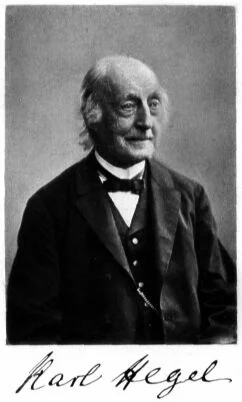
Image from Wikipedia
Image from Wikipedia
Karl von Hegel – The Historian of Cities, Archives, and Sources
A Influential Name in German Urban Historical Research in the 19th Century
Karl von Hegel, born on June 7, 1813, in Nuremberg and died on December 5, 1901, in Erlangen, is regarded as one of the most significant German historians of the 19th century. As the son of the philosopher Georg Wilhelm Friedrich Hegel, he grew up in the shadow of a great name yet developed an independent scholarly profile, marking him primarily as a specialist in urban history and source editions. Even during his lifetime, he was considered a respected scholar with a broad reputation; however, later his contributions partly faded into obscurity in the field of historical science. ([de.wikipedia.org](https://de.wikipedia.org/wiki/Karl_von_Hegel))
Background, Education, and Early Influences
The early years of Karl von Hegel were characterized by relocations and intellectual closeness to the scholarly world. After his time in Nuremberg, Heidelberg, and Berlin, he graduated from secondary school in Berlin in 1830 and studied there as well as in Heidelberg, notably under Leopold von Ranke. His mother came from the Nuremberg patrician family von Tucher, and his father died in 1831 when Karl was just 18 years old. This situation shaped a biography defined by family legacy, scholarly ambition, and the long shadow of his famous father. ([de.wikipedia.org](https://de.wikipedia.org/wiki/Karl_von_Hegel))
His academic training already showed the direction of his future work: source study, historical accuracy, and a strong interest in the political and social order of past centuries. In 1837, he received his doctorate in Berlin on Alexander the Great. More important than the title, however, was the method with which he approached historical materials: critically, meticulously, and always grounded in archival origins. ([de.wikipedia.org](https://de.wikipedia.org/wiki/Karl_von_Hegel))
Trip to Italy, Archive Work, and Academic Rise
The years 1838 and 1839 saw Hegel embark on a lengthy trip to Italy, which became crucial for his subsequent career. There, he conducted intensive archival studies and deepened his interest in the urban history of Italy, a field in which he would later set standards. After returning to Berlin, he initially worked briefly as a high school teacher before being appointed to the University of Rostock in 1841. He taught there until 1856 as an associate professor, and later as a full professor of history and politics. ([de.wikipedia.org](https://de.wikipedia.org/wiki/Karl_von_Hegel))
His academic breakthrough came in 1847 with the two-volume work on the history of the municipal constitution of Italy from the Roman era to the end of the 12th century. This work made him well-known in academic circles and marked the transition from a young scholar to an established historian. The impact of this book went far beyond its immediate research subject, as it rendered urban history visible as an independent and methodologically rigorous field. ([de.wikipedia.org](https://de.wikipedia.org/wiki/Karl_von_Hegel))
Chair in Erlangen and Major Editing Work
In 1856, Karl von Hegel received an appointment to the University of Erlangen, where a newly established chair for history was created for him. In 1870, he additionally assumed the office of prorector there. His academic presence became firmly anchored, but his true long-term influence unfolded even more significantly through his editing work, which represents a quiet yet immensely impactful form of historical foundational research. ([de.wikipedia.org](https://de.wikipedia.org/wiki/Karl_von_Hegel))
Between 1862 and 1899, 27 volumes of the "Chronicles of German Cities" were published under his direction, which he edited for the Historical Commission of the Bavarian Academy of Sciences. He personally worked on significant portions of six volumes concerning Nuremberg, Strasbourg, and Mainz. This series became one of the most successful editing projects of the still young commission and established Hegel as a key figure in German-speaking urban historical research. ([de.wikipedia.org](https://de.wikipedia.org/wiki/Karl_von_Hegel))
Controversies, Late Works, and Scholarly Authority
Karl von Hegel remained active in publishing well into his old age and repeatedly returned to his early research interests in Italian urban history. In the 1870s, he participated in the debate regarding the authenticity of the Florentine Chronicle of Dino Compagni and engaged in a professional exchange with Paul Scheffer-Boichorst. Hegel advocated for the authenticity of the chronicle and prevailed in the dispute. This illustrates a historian who not only collects and edits but also intervenes with discernment in methodological debates. ([de.wikipedia.org](https://de.wikipedia.org/wiki/Karl_von_Hegel))
His late authoritative works include "Cities and Guilds of the Germanic Peoples in the Middle Ages" from 1891 and "The Origin of German Urban Reality" from 1898. Both works received international attention and underscore the enduring nature of his scholarly presence. Hegel published his memoirs in 1900, a year before his death, thus leaving behind a personal document of a researcher who had accompanied his century across a broad expanse. ([en.wikipedia.org](https://en.wikipedia.org/wiki/Karl_von_Hegel))
Work Profile, Method, and Historical Style
Those who wish to read Karl von Hegel encounter a historian deeply connected to sources, institutions, and urban orders. His emphasis was not on grand event history but on the structures, constitutions, and chronicles of cities. It is precisely in this that his historiographical independence lies: He viewed cities as historical actors with their own constitution, their own tradition, and their own cultural memory. ([de.wikipedia.org](https://de.wikipedia.org/wiki/Karl_von_Hegel))
His method combined archival work, textual criticism, and a comparative perspective. The trip to Italy in the 1830s, the work on the chronicles, and the engagement with medieval city ordinances form a scholarly line that ranges from source editing to historical synthesis. In the historical science of the 19th century, Hegel thus stands for that generation that understood research not as interpretation from a distance but as precise exploration of historical traditions. ([de.wikipedia.org](https://de.wikipedia.org/wiki/Karl_von_Hegel))
Reception, Honors, and Scholarly Legacy
Karl von Hegel received numerous awards and honors during his lifetime. He was a member of several academies, including those in Munich, Göttingen, Berlin, and Vienna, was awarded an honorary doctorate by the University of Halle-Wittenberg, and received among others the Order of Saint Michael in 1872, the Bavarian Maximilian Order for Science and Art in 1876, and the Knight's Cross of the Order of Merit of the Bavarian Crown in 1889. These honors reflect the standing he held in the academic system of his time. ([en.wikipedia.org](https://en.wikipedia.org/wiki/Karl_von_Hegel))
Nonetheless, his posthumous fame remained more limited than that of his father. Even the historical biography indicates that Karl Hegel's career suffered under the celebrity of Georg Wilhelm Friedrich Hegel. At the same time, it was precisely his sober, source-rich work that secured him a firm place in the history of the discipline. Today, his memory continues primarily in academic institutions, in the Erlangen research tradition, and in the editions he helped shape. ([de.wikipedia.org](https://de.wikipedia.org/wiki/Karl_von_Hegel))
Cultural Influence and Positioning
Karl von Hegel belongs to those historians whose influence lies less in popular recognition and more in the infrastructure of the field. He helped to establish urban history as a serious field of research and promoted the sustainable availability of sources through the monumental edition of the "Chronicles of German Cities." His cultural influence thus lies in the establishment of historical knowledge bases, without which modern medieval studies and urban research would hardly be thinkable. ([de.wikipedia.org](https://de.wikipedia.org/wiki/Karl_von_Hegel))
Karl von Hegel also holds lasting significance for the University of Erlangen. The handling of his estate there, subsequent memorial events, and reflections on the history of science attest to his recognition as a founding figure of an institutional historical self-understanding. Today, his name represents a precise, disciplined, and decades-long effective research achievement. ([en.wikipedia.org](https://en.wikipedia.org/wiki/Karl_von_Hegel))
Conclusion: A Scholar of Quiet Greatness
Karl von Hegel fascinates through the combination of intellect, discipline, and scholarly endurance. He was not a loudly appearing theorist but rather a historian of sources, cities, and the long lines of European tradition. It is precisely in this lies his strength: those who follow his work discover a researcher who elevated historical detail work to an extraordinarily high level. Anyone wishing to understand urban history, edition philology, and the culture of the 19th century should not overlook Karl von Hegel. ([de.wikipedia.org](https://de.wikipedia.org/wiki/Karl_von_Hegel))
His life shows how strong scholarly authority arises from precision, patience, and methodological consistency. Karl von Hegel is worth rediscovering as one of the quiet yet essential figures in German historiography. Engaging with his work does not yield a spectacular appearance but the enduring power of historical knowledge. ([de.wikipedia.org](https://de.wikipedia.org/wiki/Karl_von_Hegel))
Official Channels of Karl von Hegel:
- Instagram: No official profile found
- Facebook: No official profile found
- YouTube: No official profile found
- Spotify: No official profile found
- TikTok: No official profile found